


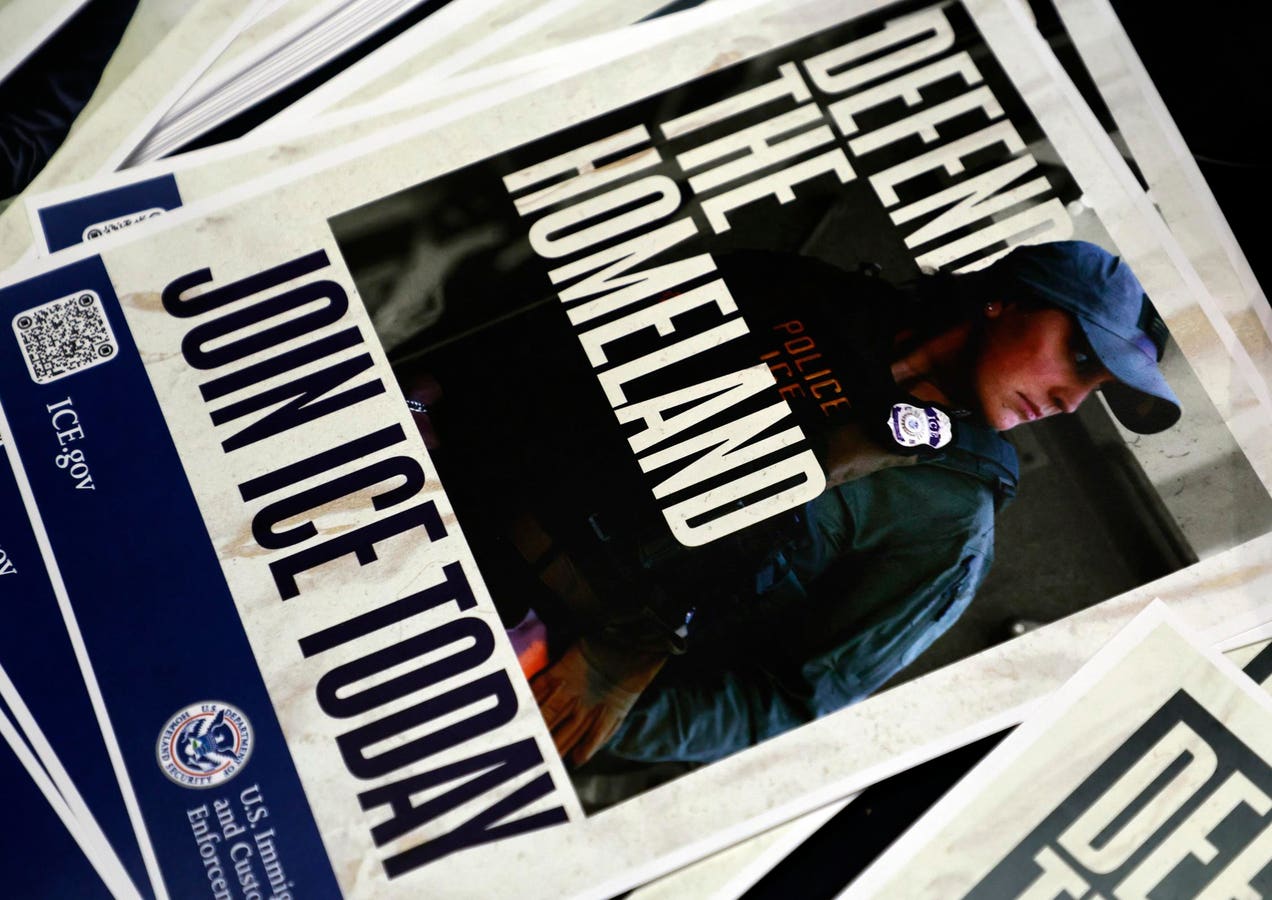
There will be many familiar things for NASCAR fans to see when they return to the track this season. Sure, some of the cars might look different, there will be a few new drivers, but overall, it will be a familiar place.
However, one thing will look different in 2026: a more visible presence of the U.S. government. U.S. Immigration and Customs Enforcement is planning to spend $100 million on what internal documents describe as a “wartime recruitment” strategy, leaning heavily on NASCAR fans as a potential pipeline to fill more than 10,000 positions tied to President Donald Trump’s mass-deportation initiative.
According to reporting by The Washington Post, ICE plans to rely on surge-style marketing that includes geotargeted advertising, social-media influencers, and on-site outreach at major sporting events — with NASCAR positioned prominently in the plan.
On the surface NASCAR looks like the perfect stage for this kind of recruitment strategy. After all this is the same sport President Trump has used as a political backdrop multiple times in recent years including two Daytona 500 visits while in office.
MORE FOR YOU
To many outside the sport, NASCAR remains shorthand for culturally conservative America, an idea reinforced by sponsors like Bass Pro Shops and team owners like NASCAR Hall of Famer Richard Childress whose comments about gun rights are part of his public persona. It seems like the last place one would expect to see political ambiguity; this world filled with camouflage hats, patriotic paint schemes and presidents circling the track in armored SUVs.
But there is a problem.
The fact is that most of the conservative ideology surrounding NASCAR may be more of an outside perception than actual reality. Yes, in the early years up through the first part of this century the sports southern roots and older male demographic meant that conservative Republicans were more the norm than an exception. But the guy sitting in a folding chair nursing a Bud at Talladega in 2008 is no longer the only fan NASCAR needs. And not necessarily the fans they are trying to attract. And indeed, there is far less contemporary empirical evidence to support the idea that the NASCAR fan base is overwhelmingly conservative — and growing signs that it isn’t.
There are some older polls that show a slight majority of fans who self-identify as conservative or Republican, but more recent studies seem to suggest that the fan base is diversifying, a diversification that is accelerating. NASCAR has made strategic moves to attract younger viewers. The sport has seen more growth among Latinos, and the product has been delivered in urban areas like Chicago. And new, younger drivers, are better able to speak to this new culture through a better grasp and use of social media and content creation. Drivers like Bubba Wallace and Daniel Suarez are no longer just symbolic exceptions but part of this broader trend.
This season will also be the second of the new media rights deal. This new deal continues with the new players led by Amazon, which is coming off a widely successful first season of streaming only races. Streaming changes who sees NASCAR entirely: it introduces the sport to audiences who didn’t go looking for it, shifting it from traditional appointment television to on-demand culture.
This all leads to an audience that not only skews younger but is more national than Southern and more ideologically mixed due to being broader. All this means that with NASCAR leaving cable and now part of the streaming ecosystem the sport is speaking to America as it actually is today, not how it was even a decade ago.
And all this matters to those who write the checks. Fortune 500 companies don’t invest in audiences that are ideologically rigid. If modern sponsors based their assumptions on the guy in the folding chair at Talladega, they wouldn’t be writing 9-digit checks, like several did last season. These corporate partners aren’t investing in the past; they are looking forward to future consumer bases with the confidence that NASCAR’s audience will look different tomorrow than yesterday.
This all begs the question: What does Homeland Security see in NASCAR? Is it a good recruiting pipeline for conservative Americans, have they been sold a bill of goods from an outside marketer that leans on old ideology, or are they looking ahead to the audience it is becoming?
Yes, NASCAR still has its conservative base with flag waving patriotism, but the DHS may be oversimplifying a space that has become increasingly complex, and diverse. Sure, they are welcome at any NASCAR event just like everyone is. And there will always be conservative NASCAR fans. But increasingly so are many more Americans who’d rather watch cars turn left.