


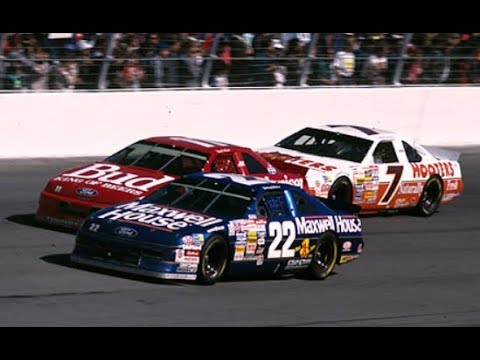
There was a time in NASCAR when safety rules were looser, in-car technology was basic, and driver comfort often trumped best practices. The 1980s and early 1990s were an era of improvisation, when seatbelts weren’t always worn as tightly as they should’ve been, pit road was far more chaotic, and what happened inside the cockpit was largely left to the driver.
In that environment, some habits that would be unthinkable today were treated as normal. One NASCAR legend has now admitted just how far that freedom went. In fact, he revealed that he knowingly risked safety mid-race for a reason that sounds almost unbelievable now.
Another part of the NASCAR race plan
“When I raced for Wayne Spears, Rick Carelli beat me at his home track in Colorado. So, Wayne calls me and I’m down at the shop. I said what do you need Wayne, he says look in the truck or look in the car. I look in there and there’s a little box and there’s a cigarette lighter. What’s that for? He says you ran out of nicotine in the race, that’s why Rick Carelli beat you. I want you to smoke every yellow flag. This was ‘92-’93.”
That story alone feels like it belongs to a completely different version of NASCAR. And in many ways, it does. Ron Hornaday Jr.’s time racing for Wayne Spears was built on trust, toughness, and an unapologetically old-school mindset. Spears wasn’t just a team owner; he was the kind of boss who believed every detail mattered, even a driver’s nicotine level. If smoking helped keep Hornaday calm and focused, then smoking became part of the strategy.
Back then, Hornaday drove for Spears Motorsports primarily in the ARCA Series, while also making a handful of NASCAR Cup Series starts with the team. It was a gritty partnership rooted in seat time, hard miles, and doing whatever it took to stay sharp. That’s where the smoking habit escalated from a personal vice into a full-blown race routine.
Hornaday would light up under caution, take a few drags, and then flick the cigarette out the window as the race went back green. Sometimes, the burning cigarette would bounce off the windshield of the car behind him. Drivers would radio in, confused, thinking something on their car was sparking or failing and never imagining it was a cigarette tossed mid-pack.
Read Top Stories First From EssentiallySports
Click here and check box next to EssentiallySports
To keep the system foolproof, Wayne Spears had a cigarette lighter installed directly in Hornaday’s truck. No pit stop required. No waiting. Just nicotine on demand.
Back then, Hornaday drove for Spear Motorsports primarily in the ARCA Series, while also making a handful of NASCAR Cup Series starts with the team. It was a gritty partnership rooted in seat time, hard miles, and doing whatever it took to stay sharp. That’s where the smoking habit escalated from a personal vice into a full-blown race routine.
Hornaday would light up under caution, take a few drags, and then flick the cigarette out the window as the race went back green. Sometimes, the burning cigarette would bounce off the windshield of the car behind him. Drivers would radio in, confused, thinking something on their car was sparking or failing, and never imagining it was a cigarette tossed mid-pack.
To keep the system foolproof, Wayne Spears had a cigarette lighter installed directly in Hornaday’s truck. No pit stop required. No waiting. Just nicotine on demand.
Ron Hornaday Jr wasn’t the only one
Hornaday’s cigarette-laced race routine wasn’t an isolated quirk from a wilder time. He was simply part of a larger, very real NASCAR era when drivers bent rules, ignored optics, and raced with habits that would be unthinkable today. Few embodied that spirit more than Dick Trickle.
The Wisconsin short-track legend arrived in NASCAR’s Winston Cup Series in 1989 carrying the same unapologetic personality that made him a folk hero back home. That included smoking cigarettes during races. NASCAR allowed it, with one condition: Trickle could only light up under yellow-flag caution periods. So he adapted.
Trickle drilled a small ventilation hole into his helmet, installed cigarette lighters inside his cars, and treated cautions like smoke breaks. The moment reached peak absurdity during the 1990 Winston 500 at Talladega, when in-car cameras caught him casually reaching for his lighter while the field slowed. Broadcasters couldn’t believe what they were seeing, openly marveling on-air as Trickle puffed away like it was a Sunday drive.
Fans loved it. Announcers compared him to David Pearson – another old-school racer who came from a time when feel mattered more than formality. The habit wasn’t rebellion as much as routine. Trickle came from short-track racing, where two-hour features left no room for pit strategy or wellness breaks. Nicotine was part of endurance.
Today, those moments feel surreal. Fire suits, HANS devices, strict cockpit protocols, and zero-tolerance safety standards have erased that version of NASCAR. But Trickle’s on-camera cigarette remains frozen in time. It’s a reminder of a sport that once operated on grit, instinct, and freedoms that no longer exist.