


We’ve all been there. You make what feels like the perfect swing. Solid contact, good tempo, exactly what your instructor has been preaching. The ball sails into the trees. Then your playing partner, who had the angle you didn’t, delivers the seven most frustrating words in golf: “It went right where you were aimed.”
Tyler and Zach, the co-founders of Laced Golf, know this moment intimately. It triggered what might be the most interesting golf technology story I’ve covered in years.
I recently sat down with the duo behind Laced Golf, a startup taking a radically different approach to golf improvement. The rest of the industry obsesses over swing mechanics and post-impact analysis. They’re focused on something much more fundamental: making sure you’re actually aimed at your target before you swing.
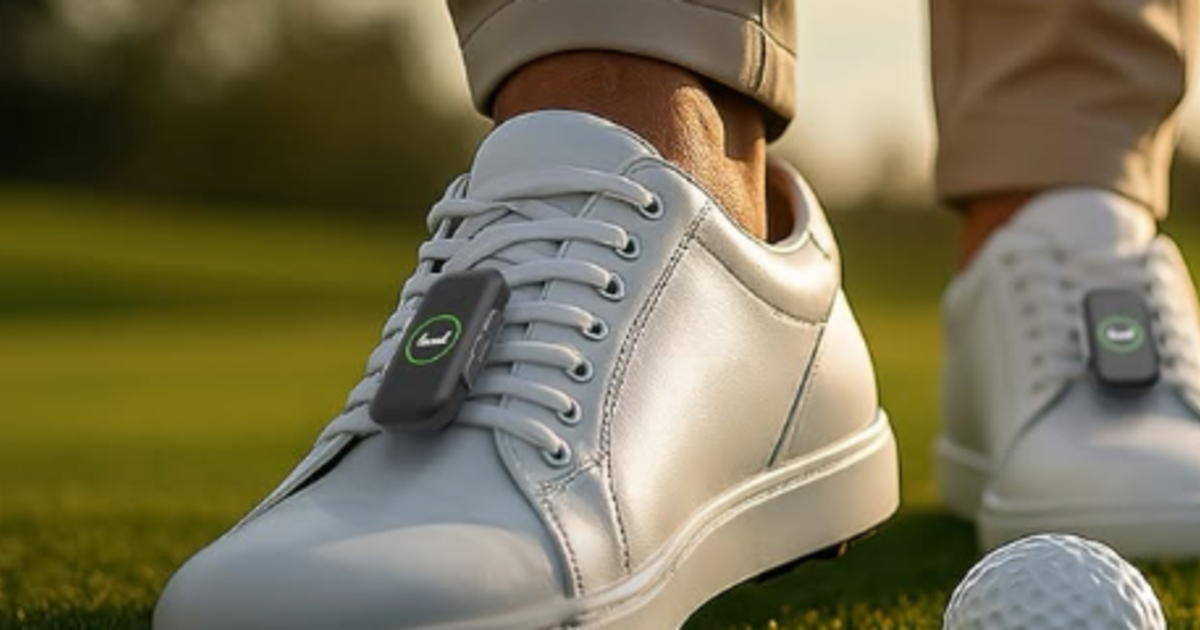
Their solution? Sensors that clip onto your shoes.
The Alignment Stick Problem
“Jack Nicklaus said it best,” Tyler tells me. “‘The best golf shot in the world doesn’t really matter if it isn’t aimed at the target.’ And yet, in an age where we can track ball speed to the decimal point, map every degree of club path, and analyze swing plane in 3D, the solution for the most fundamental skill in golf is a glorified driveway stake you lay on the ground.”
He’s talking about alignment sticks, of course. Those orange or yellow rods that every teaching pro swears by and every golfer promptly forgets in their trunk.
“Even on the range, alignment sticks frustrate golfers,” Tyler continues. “You bump them, there’s no data, no personalization. And they stay in your bag when you need them most: on the course, playing real golf.”
I’ve been a PGA Professional for years. I can’t count how many times I’ve watched a student nail their alignment on the range with sticks, only to spray it all over the course without them.
It’s Not You, It’s Your Biology
Zach started explaining the science behind why alignment is so difficult, even for tour players. That’s when things got interesting.
“What surprised us most in our research was discovering just how fundamentally humans are designed to struggle with golf alignment,” he explains. “It isn’t a talent problem or a focus problem. It’s a biology problem.”
He walks me through the visual parallax issue. Standing over the ball and looking downrange creates distortion in our perception. Then there’s eye dominance, which introduces an extra degree of complication.
“For example, a right-handed, right-eye-dominant golfer views the target from a slightly offset perspective, with facial structure subtly influencing the visual field. The body often compensates unconsciously for this mismatch, disrupting setup and alignment.”
Research suggests a disproportionately high percentage of elite golfers are cross-dominant, meaning their dominant eye and dominant hand are on opposite sides. Zach tells me this isn’t coincidental.
“The implication is that same-side dominant players may face a steeper alignment challenge, not because of effort or ability, but because their visual and motor systems are less naturally aligned at address.”
If you’re right-handed and right-eye dominant (like most people), you might be fighting an uphill battle that has nothing to do with your swing.
Your Swing DNA, Not Someone Else’s
Traditional alignment aids assume there’s one “correct” setup position for everyone. Laced Golf throws that assumption out the window.
“A 5’6” golfer with a natural draw has a very different optimal stance than a 6’4″ golfer who plays a fade,” Zach points out. “One-size-fits-all instruction ignores the biomechanical reality that golfers are individuals, not templates.”
Laced Golf’s system learns your patterns instead of prescribing an idealized position. When you’re swinging well, where are your feet? How does your stance change between a 7-iron and a driver? The system establishes a baseline from your best swings and helps you consistently replicate that foundation.
“We’re not imposing a generic stance alignment,” Zach explains. “We’re identifying, preserving, and reinforcing each golfer’s optimal setup.”
For teaching professionals, this opens up fascinating possibilities. A coach can identify a player’s ideal setup during a lesson (accounting for body type, eye dominance, and shot shape), save it to that player’s profile, and then have the golfer practice reproducing that exact position between sessions. The coach can later review the data to see how consistently the player executed it.
Why Shoes?
In an era of launch monitors and club sensors, why put the technology on your feet? The technology feels almost counterintuitive at first.
“Your feet are your body’s only point of contact with the ground throughout the entire swing,” Tyler explains. “They’re the foundation. Literally. Everything in the kinetic chain flows up from there. The feet tell a unique story that is currently completely uncaptured.”
The team has deep experience in sensor fusion and spatial tracking from building technology for augmented reality and other high-accuracy applications. They knew that correctly captured foot position and rotational data could reveal the causes of inconsistency that other technologies miss entirely.
“The shoe was the logical placement that detects the full picture of your setup and weight dynamics without adding friction to your game,” Tyler says. “The feet are also clearly in sight when setting up for a shot. The golfer is already looking down, so it becomes a very natural fit.”
Invisible Technology
One of my biggest concerns with golf tech is that it regularly comes across as gimmicky or excessively complicated. I ask Tyler about their design philosophy.
“Golfers don’t want another gadget to manage. They want to play golf,” he says. “‘Invisible’ means you clip Laced onto your laces, and from that point forward, you might even forget you’re wearing them. Small, lightweight and natural feeling.”
The system has different modes for different situations. In practice, you get active feedback to dial in your alignment. But in competitive rounds, you can switch to “Tourney Mode.” The sensors observe silently, collect data, and deliver a post-round report without any LED or haptic signals that might slow down play.
“We’re golfers ourselves, and we knew from day one that this had to be seamless,” Tyler emphasizes. “If it added friction to our round, we wouldn’t use it. Neither would anyone else.”
After the round, you see exactly where your alignment held up and where it went wrong. Maybe you were aiming left on every tee shot on the back nine. Or your stance lost consistency under pressure as you came down the stretch.
The Hardware Challenge
I have to ask about the elephant in the room. Hardware is notoriously difficult, and they’re targeting a Summer 2026 delivery. That’s ambitious.
“Hardware is hard. We don’t pretend otherwise,” Tyler acknowledges. “However, Laced is fundamentally a software company, and we’ve structured ourselves to stay that way while still delivering world-class hardware.”
They’ve established a partnership with Somatic VR, a company already making sensors for VR gaming applications that contain the same core technology Laced requires. The partnership means they’re building on proven, tested electrical components and established manufacturing relationships rather than starting from scratch.
“We share a mutual interest in moving to a smaller, sleeker form factor. We’re handling the industrial design and golf-specific software while benefiting from their significantly de-risked hardware platform.”
The remaining challenges are what you’d expect: optimizing for size and weight so the sensors are unnoticeable, preserving strength for weather and repeated use, and dialing in battery life for a full round.
They’re debuting at the PGA Show in January 2026, with Summer 2026 delivery. It’s an aggressive timeline, but Tyler and Zach seem confident it’s realistic given their hardware foundation.
Building for the Long Game
What strikes me most about Laced Golf isn’t just the technology. It’s the philosophy behind it. They’re not trying to reinvent the golf swing or promise you’ll hit it 20 yards farther. They’re solving a fundamental problem that affects every golfer, from weekend warriors to tour professionals.
“We’re addressing a clear gap in golf: a personalized way to learn and retain footwork fundamentals,” Zach tells me. “Golf doesn’t have an awareness or an engagement problem. It has a retention problem. Even the fundamentals are deceptively difficult, and many golfers quit because they struggle to make consistent progress early on.”
Their vision is that Laced becomes as automatic as putting on your golf shoes. Over time, they plan to layer in practice drills tailored to your unique patterns.
“Most training aids build muscle memory, then you put them away and hope it sticks,” Zach says. “We’re building something that accompanies you, keeps learning, and keeps helping you improve. Round after round, season after season.”
The Bottom Line
I’ve seen countless golf gadgets come and go as a PGA Professional. What makes Laced Golf interesting isn’t just the technology. It’s that they’re solving a real problem that every golfer faces, using a solution that actually makes sense.
The science behind why we struggle with alignment is compelling. The individualized approach respects that every golfer is different. And the pledge to making the technology invisible shows they understand golfers just want to play better golf, not manage more gadgets.
Will it work? I’m very optimistic. The team has the technical chops, they’ve thought through the hard problems, and they’re building on proven hardware rather than starting from scratch. Most importantly, they’re golfers themselves who understand that great technology must support the game, not complicate it.
I’ll be watching closely when they debut at the PGA Show in January 2026. If they can deliver on the promise (sensors that help you build and maintain proper alignment without disrupting your game), they might just be onto something.
After all, as Jack Nicklaus said, the best golf shot in the world doesn’t matter if it isn’t aimed at the target. And in 2025, we should have something better than a stick to help us with that.