


MLB’s winter meetings begin Monday in Orlando, Florida, signaling the time when baseball’s offseason activity is likely to take off.
br/>What’s the latest on free agent hitters, including coveted sluggers Kyle Schwarber and Kyle Tucker? Will Framber Valdez find a new home now that fellow top free agent pitcher Dylan Cease is off the board? What’s the latest on a trade market featuring stars such asKetel Marte and Steven Kwan? And which teams could surprise the sport by making a big splash in Florida?
Here is the latest intel Buster Olney and Jeff Passan are hearing on the players, teams and themes that will rule this year’s meetings.
Last year’s winter meetings were all about Juan Soto — is there one free agent or theme on everyone’s mind going into the meetings this year?
Olney: Some agents and execs are saying the money for free agents is generally locked down. There are outliers, of course — the Toronto Blue Jays are doing their thing, and the Pittsburgh Pirates, A’s and Miami Marlins are all angling for a We Are Trying posture.
The very elite guys, such as Kyle Schwarber, will get their money. But there are early indications that a lot of the teams that are traditionally aggressive might be more conservative this winter, perhaps because of the looming labor situation — and that could lead to more trades, rather than investments in free agents, as teams look to plug holes.
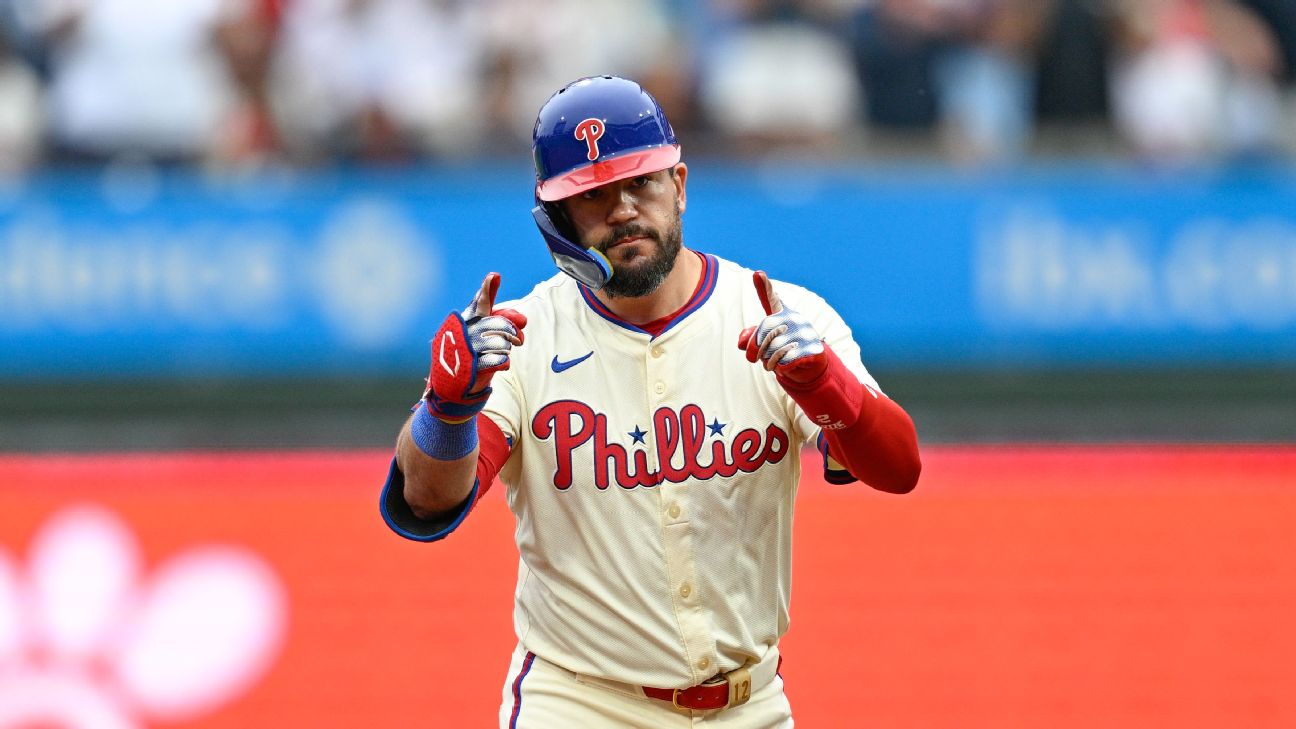
Passan: When does the Kyle Schwarber dam break? Several teams’ fortunes — from Philadelphia to Cincinnati to Pittsburgh to Boston to Baltimore to the New York Mets — depend on where Schwarber goes. The belief among teams is that it will take five years to secure the 32-year-old, and once that happens — perhaps sometime during the meetings — teams will start pivoting, and the action will pick up demonstrably.
Which top free agent hitter is most likely to sign during the winter meetings?
Olney: In recent winters, the Blue Jays wanted to spend big and couldn’t entice Shohei Ohtani or Juan Soto to take their money. Now, some free agents could need Toronto, if some of the big-money teams pass on pricey moves. Kyle Tucker has been projected as a $400 million-plus player, but it might behoove him to move quickly if he gets an early, aggressive bid from the Jays (or some other team).
This is not a winter in which you want to be waiting for the big offers to materialize, as they did for Bryce Harper and Manny Machado in past offseasons.
Passan: Schwarber is the best bet. Tucker isn’t close to done yet. Cody Bellinger has a healthy market but is biding his time. Alex Bregman and Bo Bichette are world-class infielders with ample, moneyed suitors. Pete Alonso’ssigning could go down after Schwarber.
What’s clear is that there’s a group of teams that will spend on a big bat (Phillies, Red Sox, Blue Jays), a number surveying multiple options (Yankees, Mets, Cubs) and a handful that would do so opportunistically (Orioles, Tigers, Reds, Pirates). Others could emerge depending on how the market plays out and what trade possibilities emerge.
Which other hitters could move quickly at the meetings?
Olney: Cedric Mullins’ choice to sign for a one-year, $7 million, with the Tampa Bay Rays could be a warning sign for this free agent class. Mullins was not a perfect free agent by any measure, after his struggles with the Mets, but the rapidity with which he agreed to a deal could reflect the general feeling that this market could play out like a game of musical chairs — if you’ve got offers in hand, it’d be best to move fast and grab a spot (and money). Jorge Polanco could be among those who sign sooner rather than later — he’s coveted by the Mariners and some other teams. Harrison Bader set himself up well with a strong performance in Philadelphia.
Passan: If Schwarber goes early, everyone is in play. Otherwise, the second tier of hitters includes infielder Jorge Polanco, catcher J.T. Realmuto and Japanese corner infielder Kazuma Okamoto, and teams believe there could be momentum toward deals with them. Another popular hitter: infielder Ha-Seong Kim, who could return to Atlanta — which still needs a shortstop — on a shorter-term deal or seek longer-term security elsewhere.
Now that Dylan Cease has signed, which big-name aces could move next?
Olney: It depends on your definition of ‘big-name.’ Max Scherzer and Justin Verlander, future Hall of Famers, will find landing spots, but they are on the downslopes of their remarkable careers; they can wait, and there is a presumption that Scherzer could pitch for his good friend and new San Francisco Giants manager Tony Vitello.
If you’re talking about the guys who will be getting paid the most, Framber Valdez and Ranger Suarez are next up, and there are clearly teams with which they could fit. The Mets need an ace; the Orioles need an ace. But the perceived expectations for Valdez’s next deal are high early in this offseason, evaluators say, and any team that bids on Suarez has to get comfortable with investing in a guy who doesn’t throw hard — which is not common in this era./p>
br/>Passan: Teams in the mix for Suarez believe he’s the next big-time starter off the board. Though the 30-year-old won’t fetch a Dylan Cease-level deal, he long has been a target for Houston, which balks at deals beyond six years, and Baltimore, which is seeking a top-end rotation piece. Right-hander Michael King has widespread interest because of his frontline potential with a willingness to sign for a shorter term than the top starters. Also worth watching: right-hander Merrill Kelly, who at 37 is in line for a multiyear deal. Arguably the best starter in the class, Valdez is often among the league leaders in innings with a playoff résumé, and his market will unfold alongside the best hitters’.
Will we see a run of reliever signings following Devin Williams and Ryan Helsley getting deals?
Olney: Not necessarily, because there are so many relievers available — more than 100 unsigned free agents. Pete Fairbanks could be among the next to sign, and the 35-year-old Robert Suarez. Edwin Diaz’s free agency is fascinating because he’s the best available pitcher in an offseason in which there are few teams seemingly prepared to invest a nine-figure contract on a short reliever. He has been linked to the Mets, of course, and the Blue Jays, but each of those teams has been filling other holes, so far./p>
br/>Passan: The run on relievers is slowing slightly, though Fairbanks and Kyle Finnegan are the closers who could be had sooner than later. Tyler Rogers is primed to get a three-year deal, as is Brad Keller, who could transition to be a starter. Luke Weaver will get multiple years. The left-handed market is thin and led by Steven Matz, Caleb Ferguson, Taylor Rogers, Gregory Soto and Sean Newcomb. Diaz and Robert Suarez are the two best relievers left, and they are likely to wait for the larger market to shake out.
Which players will be mentioned most in winter meetings trade discussions?
Olney: It makes sense for teams that have trade candidates under team control into 2027 to weigh offers now because they might struggle to get proper value for those players next July, given the labor uncertainty after the season. That means players such as Mackenzie Gore of the Nationals — and Paul Toboni, Washington’s president of baseball operations, said in a