


Here we are again.
In the ‘Groundhog Day’-esque nightmare that never ends, the Boston Red Sox have once again inexcusably lost out on a top – and very signable – free-agent target.
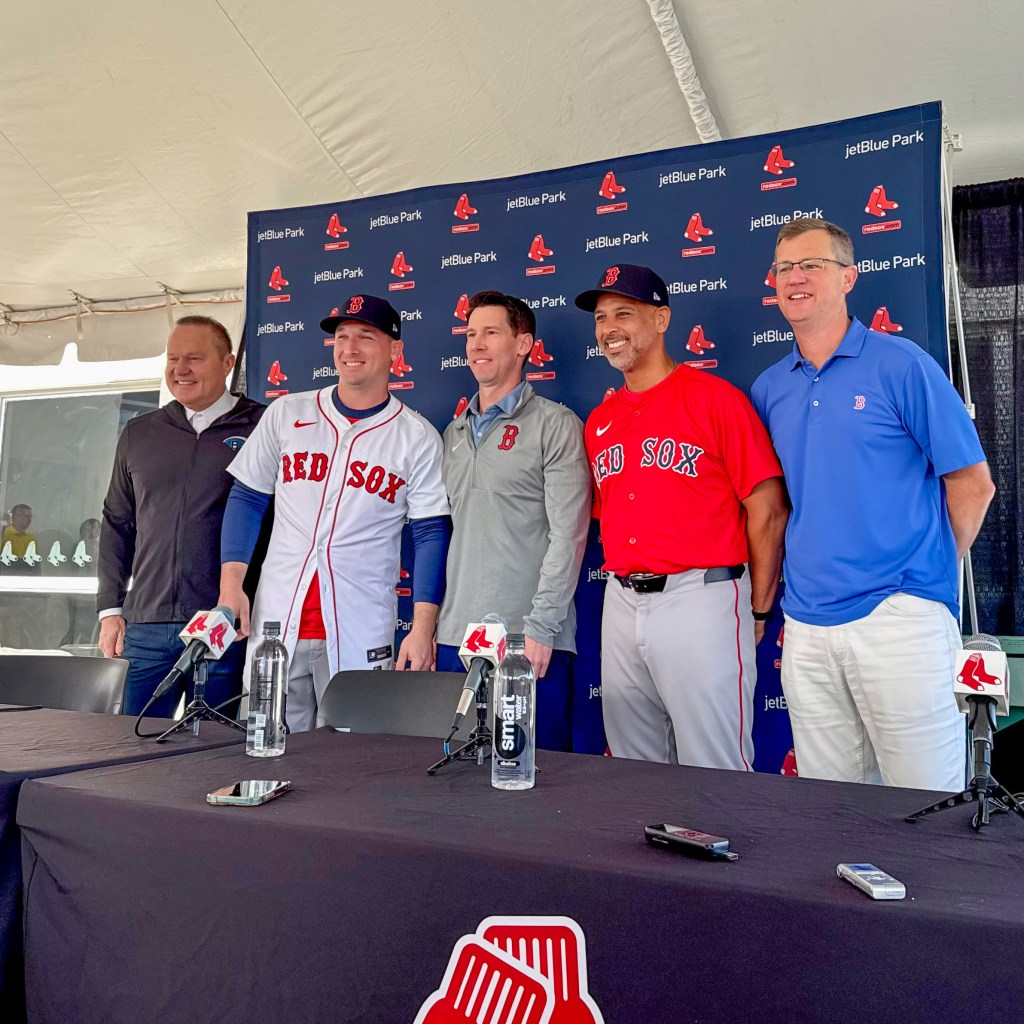
Alex Bregman, who spoke on more than one occasion during his lone Red Sox season about how much he enjoyed being in Boston and on the team, and made it clear he would welcome a long-term extension, will instead be a Chicago Cub for most, if not the rest of his playing career.
And the ‘urgent,’ ‘engaged,’ and ‘aggressive’ Red Sox are up a creek without paddle, vessel, and excuse.
Similar debacles have plagued the team over the last six years, but this one may just take the cake. Let’s unpack why.
Facts and figures
The Red Sox offered Bregman five years and somewhere in the $160-165 million range, not far off monetarily from the Cubs’ winning bid of five years and $175 million. Both proposals included deferrals, though Boston’s structure was reportedly decades long.
Chicago pursued Bregman last offseason, too. They landed him the second time around not because the price tag was significantly higher, but because they understood his priorities.
A father of two sons under four, Bregman made it clear he wanted a place his family could call home long-term. He wanted a full no-trade clause.
Boston’s unwillingness to budge on the FNTC, more than anything, sunk them. Bregman couldn’t trust that they would hold on to him for the entirety of the five years they offered him; he had a front-row seat last June, when the Red Sox dumped Rafael Devers on the San Francisco Giants, less than two years into his franchise-record 10-year, $313.5 million extension.
Which brings us to…
The Devers disaster
What makes Bregman’s decision an even worse failure for the Red Sox is that they haven’t lost one star player.
They’ve lost two.
In that way, though perhaps this is the aftershock and recency bias talking, it may be worse than the Mookie Betts trade, but we’ll get to that in a moment.
It’s impossible to discuss Bregman without Devers. The Red Sox made sure of that last winter, when they misled Devers for months about their targets and bids, signed Bregman the first weekend of spring training, and gave him Devers’ job.
Devers was justifiably outraged. In the unwritten rules of this traditional sport, proven veteran players and franchise cornerstones are accorded a certain level of respect. As the club’s longest-tenured player and only remaining World Series champion, he felt the Red Sox had disrespected him by not broaching the necessary topics before making a signing. Especially, Devers claimed, because he had been promised long-term positional security when he signed his extension in January ‘23 (to take effect in ‘24)
Manager Alex Cora’s response: Chaim Bloom no longer works here.
From start to finish, it was a careless, thoughtless, and passive stratagem team leadership’s part.
It would have been one thing if Bregman’s deal wasn’t tantamount to a one-year deal with choose-your-own adventure player opt-outs for the second and third seasons.
Or if the Red Sox had played Bregman at second, instead of forcing Devers off third and into the designated hitter role.
Or if the Red Sox had platooned Bregman and Devers, making them co-third-basemen who alternated as the DH.
Instead, the Red Sox destroyed and ended their relationship with their only true power hitter and proven winner for a player who, while undeniably an excellent addition, was here for 117 total games.
And when they traded Devers in mid-June, they should have immediately poured that money into Bregman, who was on the injured list at the time and vocal about wanting to stay.
“This is a risky strategy for the Red Sox,” I wrote in my Opening Day ‘25 column. “If Bregman opts out at season’s end, what then? Does Devers go back to third, or do the Red Sox again give the position he wants to someone else? … That’s a problem for another day, but it’s a legitimate possibility.”
Now, it’s today’s problem. And the next day’s.
Worst of the worst?
The Betts trade was a mistake of Babe Ruth-ian proportions.
But unlike subsequent superstar-related debacles, the Red Sox could make some flimsy, but legitimate enough, excuses. They were coming off a winning, albeit disappointing season, and four championships in 15 years when they salary-dumped Betts and David Price on the eager Los Angeles Dodgers in February 2020.
The move came after months of Betts’ repeated declarations that he would test free agency after the ‘20 season no matter what – though only after the Red Sox insulted him with a lowball offer right after his tremendous ‘18 season – and as the Red Sox were entering a farm system rebuild and (self-imposed) financial reset under a new leader in Bloom.
The present-day Red Sox are on the other side of that rebuild, and have no legs on which to stand in this entirely avoidable calamity of losing both Devers and Bregman.
The Betts trade was the beginning of an internal rebuild. They’ve done little to repair their relationship with the public, which has been promised ‘full throttle’ urgency and aggressiveness year after year and given gut-punch after gut-punch, instead.
The impact
Throughout all of these debacles, the Red Sox have saved countless millions.
In every other way, though, they have lost infinitely more.
They were just starting to make inroads with both fans and free agents, after trading Betts, shoving Xander Bogaerts out the door, and so many other messes and mistakes. Goodwill slowly built last offseason as chief baseball officer Craig Breslow acquired ace left-hander Garrett Crochet, signed Bregman, and extended Crochet and rookies Kristian Campbell and Roman Anthony.
Why would anyone trust the Red Sox now?
They were having a difficult enough time luring free agents before this Devers and Bregman saga came to a close Saturday night.
Under current ownership, the Red Sox first transformed themselves into the ultimate, elite destination for players, then they turned themselves into a last resort.
Imagine telling someone in 2018 that a free agent presented with identical three-year, $40 million offers from the Red Sox and Rays would choose the latter (Zach Eflin)
Or that someone would choose a one-year deal with the Dodgers over a multi-year offer from the Red Sox? (Teoscar Hernandez)
The irony is that the Red Sox used to undervalue and lose proven homegrown stars and overvalue and overcorrect with free agents. Jon Lester, replaced with Price, for example.
Now, they aren’t even doing the overvaluing and overcorrecting.
The Red Sox have the fifth-most expensive tickets in the majors, and rank 23rd in revenue spent on players.
When a player does want to stay in Boston, like Bregman or Xander Bogaerts, the Red Sox wait too long and are too cautious or unyielding to get a deal done. Refusing to give Bregman a full NTC won’t endear them to other family-focused players, either.
Breslow’s longest free agent contract was Bregman’s three years that turned into one. Perhaps Bregman’s new five-year pact will age badly, as he turns 32 on March 30, but it doesn’t really matter.
The Cubs, not the Red Sox, will benefit from the many intangibles Bregman brings to the organization and clubhouse. He is a tremendous leader, a proactively supportive and encouraging teammate and mentor to young players. As evidenced by the number of Red Sox players who made public pleas for him to re-sign at Fenway Fest, those qualities will make Bregman an absolute bargain.
What’s next?
More of the same, probably. Why expect anything different?
This quote is often misattributed to Albert Einstein but it rings true for the Red Sox nonetheless: “Insanity is doing the same thing over and over again and expecting different results.”
The Red Sox will pivot to Bo Bichette, the top remaining free agent position player. Outbidding the Philadelphia Phillies and former Boston boss Dave Dombrowski for him is about as likely as David Ortiz coming out of retirement to provide the pop this Red Sox lineup needs.
And when Bichette puts on another team’s cap and signs on their dotted line, the Red Sox will pivot again. And again.
A month from now, Red Sox brass will fly down to spring training and disseminate the usual messages:
They were engaged and operated with urgency this offseason. They are hungry for another crack at the postseason, and confident the players they have will get them there.
Certainly, the season’s outcome will be different and better than the last several times the Red Sox attempted this gambit.
Surely, they are on the cusp of making it up to you.