


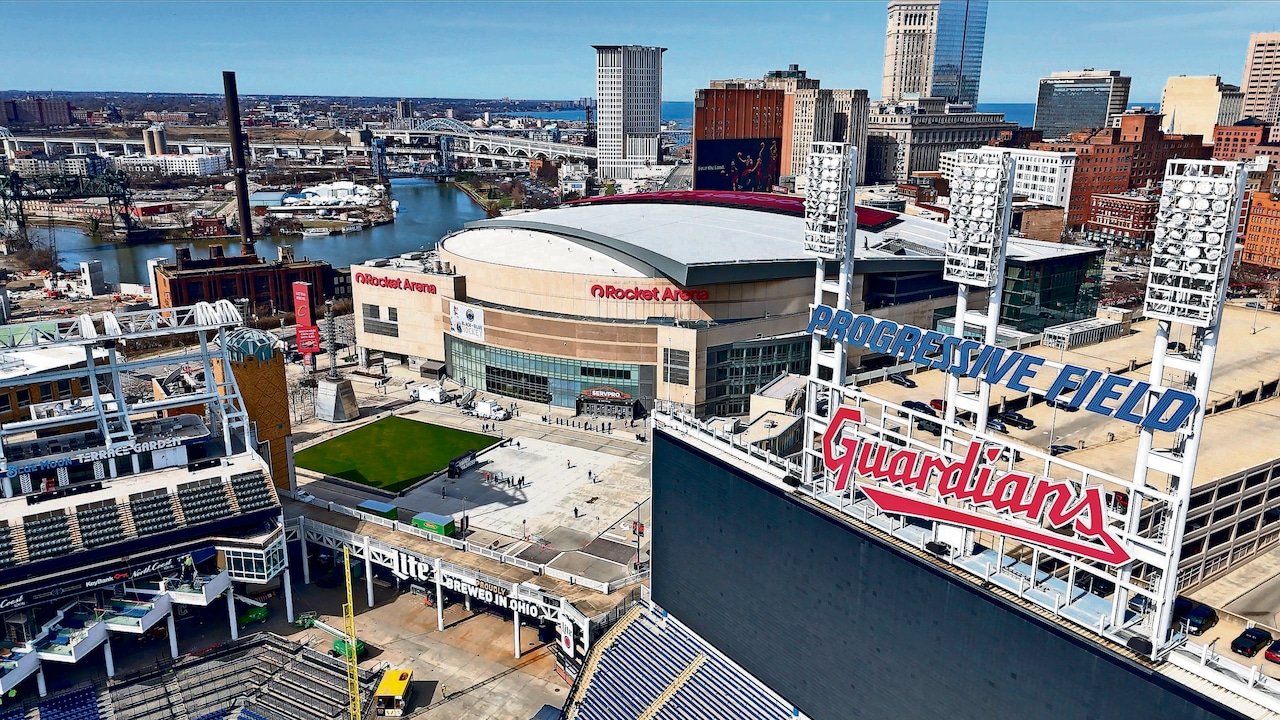
CLEVELAND, Ohio — Mayor Justin Bibb wants to raise up to $9 million for repairs at the Cavaliers’ and Guardians’ stadiums, aiming to shift the burden away from the public and onto stadium users through added fees on parking, tickets, nachos and branded T-shirts, records reveal.
That initial estimate reflects only a starting point, with fees tied to the Guardians’ and Cavaliers’ venues. Records show the city’s broader vision for a New Community Authority would extend well beyond the two stadiums, potentially tapping nearby businesses, parking and property owners across a large swath of downtown — significantly expanding how much revenue the district could generate.
So far, the plan hasn’t moved forward, and the teams haven’t publicly supported the idea. The Cavaliers and Guardians again did not respond to requests for comment.
Documents obtained through a records request show that the mayor’s team had envisioned a taxing district covering most of downtown, starting at the Cuyahoga River, stretching east to past Public Square and south to include the Gateway District. It excludes the lakefront, which is already part of another district.
Records show City Hall researched potential fees, calculated revenues and even identified city properties that would charge additional fees to fund repairs.
That plan could initially raise anywhere from $1.8 to $8.8 million, depending on what fees are charged and how high they become.
How much would the NCA raise?
Bibb’s plan revolves around the creation of a New Community Authority, or NCA, an entity that can levy taxes within a defined area.
Cleveland created a similar NCA to collect fees and fund lakefront development; the Browns also plan to use one in Brook Park, and the concept is used in Columbus and Cincinnati.
Property owners must agree to join. At most, it can charge up to 5% on retail, food, beverages and tickets, plus parking, hotel fees and property taxes.
Money from NCAs typically fund infrastructure for the businesses that join them, like sidewalks and lighting or funding marketing and special events. In this case, however, dollars would go toward stadium maintenance; a tradeoff business owners might welcome since the Cavs and Guardians drive the foot traffic that keeps the Gateway District alive.
Records show City Hall believes it can raise millions through 1%, 3% or 5% fees at publicly owned properties, starting with:
•Tickets, concessions and merchandise at Cavs games: $1 million to $4.9 million
•Similar fees at Guardians games: $700,000 to $3.5 million
•Parking at the Gateway East Garage: $28,000 to $141,000
• Charge (NBA G League) basketball games and other events at Public Auditorium: $30,000 to $149,000
For a fan, that could mean up to 25 cents extra on a $5 hotdog or 40 cents on an $8 beer.
The biggest expense might be on tickets, which at face value range from $32 in the upper bowl to hundreds of dollars closer to the court for an upcoming Cavs game, according to SeatGeek. At the Cavs team shop a jersey retails for $125. Both could see added fees.
Those fees alone, according to City Hall’s analysis, would generate between $52.5 million and $262.7 million over 30 years.
The potential for revenue generation doesn’t stop there.
Records show the city also considered capping the admissions tax revenue it collects at today’s levels and steering any growth above that cap to the NCA. As of 2024, Cleveland collected $5.4 million from Rocket Arena and $3.9 million from Progressive Field. The city could earmark half, or even all of the additional revenue generated in future years to the NCA.
Cleveland also considered special event parking districts that charge up to $8 an hour for street parking near the stadiums during games and events. Between 50 cents and $2 an hour would flow to the NCA, raising $47,000 to $374,000, depending on pricing and occupancy.
Downtown businesses surrounding the Gateway District could also contribute. With 30 businesses opting in and a 2% fee on food and beverages, the NCA could raise another $600,000 annually, a figure that would grow over time.
Lastly, City Hall considered what additional property taxes in the downtown district could generate. With $3.1 billion of property in the district, Cleveland estimated it could raise anywhere from $155,000 to $7.75 million annually — depending on the tax rate and how many property owners agree to participate.
A map of the potential NCA also includes other city properties, Public Square, Mall A and Perk Plaza as well as parking lots at Canal Basin, the Fire Museum and surface lots near Playhouse Square. The records don’t estimate how these properties might generate revenue.
City Spokesperson Jorge Ramos Pantoja said the downtown NCA concept is largely developed and ready to move forward with but is currently paused as the city explores additional funding options.
He said the city had preliminary discussions with the Cavaliers and Guardians, and the teams “indicated they recognize its value as one tool to support sustained investment in the Gateway District, while understanding it is not a standalone solution.”
Ramos Pantoja said they have yet to work with other downtown property owners, since the NCA has not been established.
Why an NCA
Bibb’s push for new revenue sources comes as existing funding for stadium repairs has fallen short, and as repairs for the three-decade old facilities are expected to grow more expensive.
The latest assessment calls for at least $150 million in spending at the arena and stadium over the next few years, and $411 million in combined repair and replacement needs before either the Cavs’ and Guardians’ leases end in 2034 and 2036 — an average of $17.4 million per team, per year.
Countywide sin taxes on alcohol and cigarettes — long the primary source of stadium repair money — haven’t kept pace with the bills at Rocket Mortgage Arena and Progressive Field.
Cleveland and Cuyahoga County approved a $40 million bailout at the end of 2024 to keep Gateway, the joint city-county authority that owns and manages both venues, afloat.
State legislators have authorized doubling the sin tax, but only with voter approval. County Executive Chris Ronayne has since said he won’t put it on the ballot, arguing it wouldn’t raise enough. He has sought permission to quadruple the tax rates instead.
A presentation shown to Cleveland City Council in 2025 frames Bibb’s financing district not as a silver bullet, but as one piece of the funding puzzle — though both the Cavs and Guardians would need to agree to add fees to tickets and concessions for it to work.
Without the teams’ participation, much of the potential revenue from the NCA disappears. The fees on tickets, concessions and merchandise are where City Hall projects the bulk of the NCA’s income.
Bibb has said previously he won’t bailout Rocket Arena or Progressive Field again until the teams start considering other concepts to generate revenue for repairs.
“I made it clear to the teams,” Bibb said. “I’m not tapping the general revenue fund until we look at these other concepts.”