


By Carolyn Coene
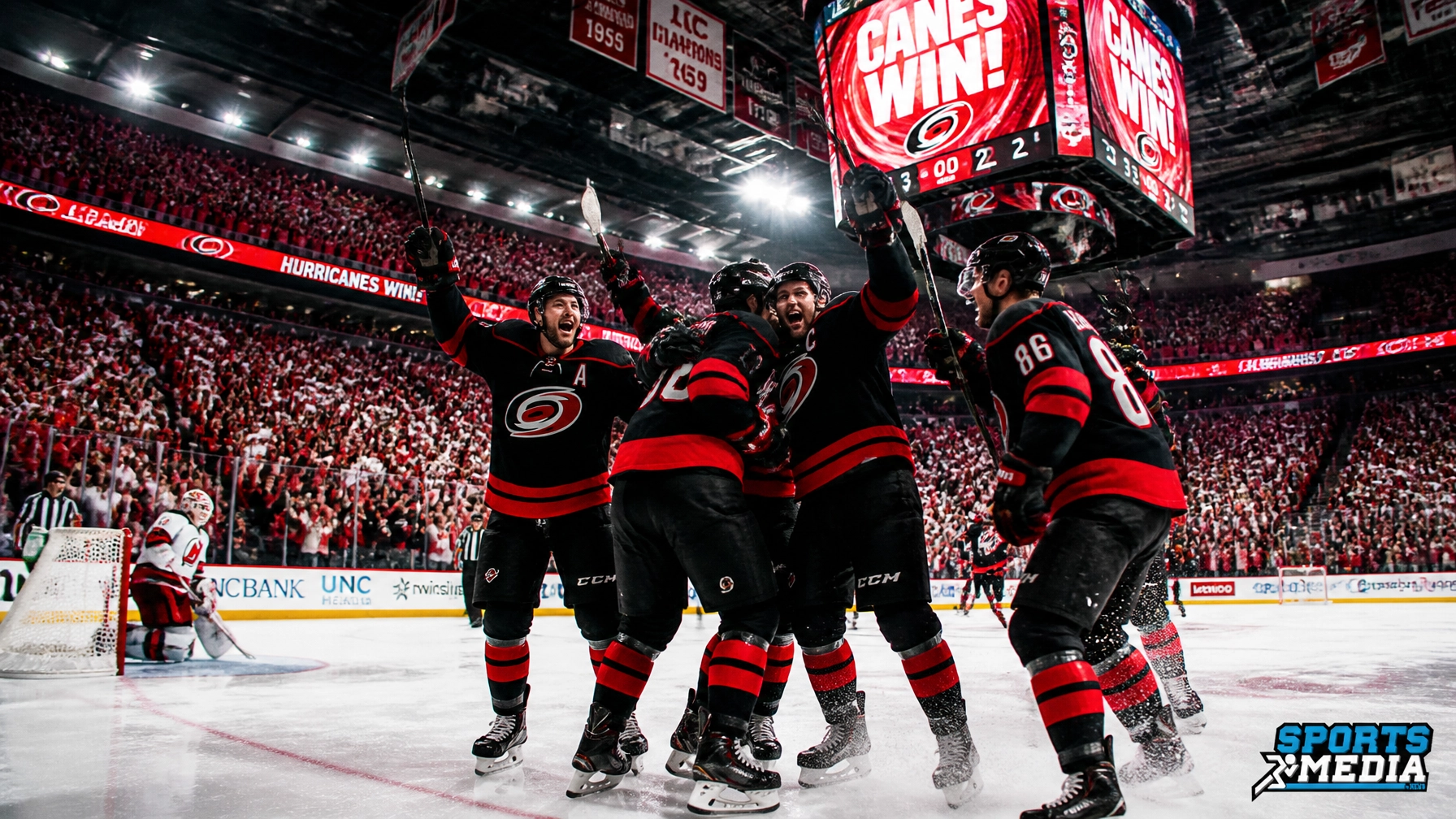
RALEIGH, North Carolina : For the first time in two decades, the "Caniacs" are preparing for a championship series. On Friday, June 2, 2026, the Carolina Hurricanes dismantled the Montreal Canadiens in a 6-1 blowout, officially clinching the Eastern Conference title and securing a spot in the Stanley Cup Final. The victory marks a historic pivot for a franchise that has spent the better part of the last twenty years wrestling with postseason heartbreak and a series of "sweeps" that became a dark cloud over North Carolina hockey.
The Hurricanes are now set to face the Vegas Golden Knights in a battle for hockey’s ultimate prize. For the Raleigh faithful, the wait has been arduous. It has been exactly twenty years since the Hurricanes hoisted the Stanley Cup in 2006, and while the team has remained a perennial contender, the final hurdle has often proven insurmountable.
Breaking the "Conference Final Curse"
The journey to the 2026 Final was not merely about winning four games against Montreal; it was about exorcising a ghost that had haunted the organization for nearly two decades. Entering the 2025 postseason, the Hurricanes were the holders of one of the most statistically improbable and frustrating streaks in professional sports.
Between 2009 and 2023, the Hurricanes had reached the Eastern Conference Final three times. In each instance: 2009 against Pittsburgh, 2019 against Boston, and 2023 against Florida: the team was swept 4-0. This created a 12-game losing streak in conference final games. Last season, that frustration peaked when the Florida Panthers took the first three games of the series, extending the streak to a record-breaking 15 consecutive losses at that stage of the tournament.
"There is a psychological weight to a streak like that," says Dr. Marcus Thorne, a professor of sports psychology and management. "When a roster sees the same result across different eras and different coaching staffs, it starts to feel like an institutional barrier rather than a personnel issue. Breaking through that in five games against a resilient Montreal team is perhaps the biggest win for this franchise since 2006."
The Hurricanes finally snapped the streak with a Game 4 win over the Panthers last season, though they ultimately lost the series in Game 5. This year, the narrative changed. Despite a 6-2 stumble in Game 1 against Montreal, Carolina responded by winning four straight, including back-to-back overtime thrillers fueled by stars Andrei Svechnikov and Nikolaj Ehlers.

The Tulsky Strategy: A Masterclass in Roster Construction
The Hurricanes' return to the elite tier of the NHL can be traced back to the aggressive and calculated maneuvers of General Manager Eric Tulsky. Following the departures of high-profile players Jake Guentzel and Mikko Rantanen in previous seasons, critics questioned whether the Hurricanes had a "core" capable of winning high-pressure playoff games.
Tulsky responded by pivoting away from a potential $12.5 million offer sheet for Oilers defenseman Evan Bouchard, opting instead for a more diversified investment. On July 1, 2025, Tulsky orchestrated a sign-and-trade with the New York Rangers to acquire defenseman K’Andre Miller, immediately signing him to an eight-year, $60 million extension ($7.5 million AAV). Two days later, he landed Danish winger Nikolaj Ehlers on a six-year, $51 million free-agent deal ($8.5 million AAV).
"The decision to skip the Bouchard sweepstakes in favor of the Miller-Ehlers combination was a turning point for this roster," notes Sarah Jenkins, a senior NHL analyst. "For roughly $3.5 million more per year than what a Bouchard deal would have cost, Tulsky secured a top-pair defenseman for nearly a decade and a top-six scoring threat who has been a difference-maker in this postseason."
The data-driven approach has paid dividends. Carolina finished the 2025-2026 regular season with the best record in the Eastern Conference and the second-most points in the entire league. Unlike previous years, where the Hurricanes' high-volume shooting style failed to produce "dirty" goals in the playoffs, the current iteration of the team has shown a newfound ability to dominate the middle of the ice and capitalize on transition opportunities.
Seeking Legitimacy on the National Stage
Despite their regular-season dominance, the Hurricanes entered the 2026 postseason under a microscope. National pundits remained skeptical, often citing the team’s 1-16 record in Eastern Conference Final games since 2006 as proof that the "Canes" were a regular-season juggernaut that lacked the "clutch" gene.
"In this business, you are what your record says you are until you change it," Tulsky remarked in a recent press conference. "We knew the history. We knew the numbers. Our focus was on ensuring we had the depth and the defensive structure to prevent the 'collapse' narratives from taking root."
The Hurricanes' commitment to their identity was evident in the 6-1 clincher against Montreal. The team didn't just win; they overwhelmed the Canadiens with a relentless forecheck and a defensive performance that allowed fewer than 20 shots on goal. The addition of veteran physical presence Nicolas Deslauriers at the trade deadline added the "sandpaper" many felt the team lacked in previous years.

Lasting Impacts and the Road Ahead
The Hurricanes now face a Vegas Golden Knights team that has become the gold standard for expansion success. Vegas brings a heavy, veteran-laden lineup to the Final, presenting a significant challenge for Carolina’s speed-based system.
However, the mood in Raleigh is one of quiet confidence. The "eye of the storm" is no longer a place of chaos for this team; it is a position of strength. With K’Andre Miller locked in for the next seven years and Nikolaj Ehlers providing the offensive spark that was missing in previous conference final exits, the Hurricanes believe they have finally built a sustainable championship window.
The implications for the franchise are significant. A second Stanley Cup banner would cement Carolina’s status as a premier NHL market and validate the long-term vision of the ownership group and front office. After twenty years of waiting, the frustration has been replaced by anticipation.
"They've moved past the disappointment of the last two decades," Jenkins adds. "They aren't just happy to be there. This is a team that feels it is overdue."
As the Stanley Cup Final begins, all eyes in the hockey world will be on Raleigh. The Hurricanes have proven the critics wrong by reaching this stage; now, they have four more wins to go to prove they belong at the top of the mountain.

For more updates on sports business and breaking news, visit Sportsmedia News.