


By Lillian Castor
6/2/2026
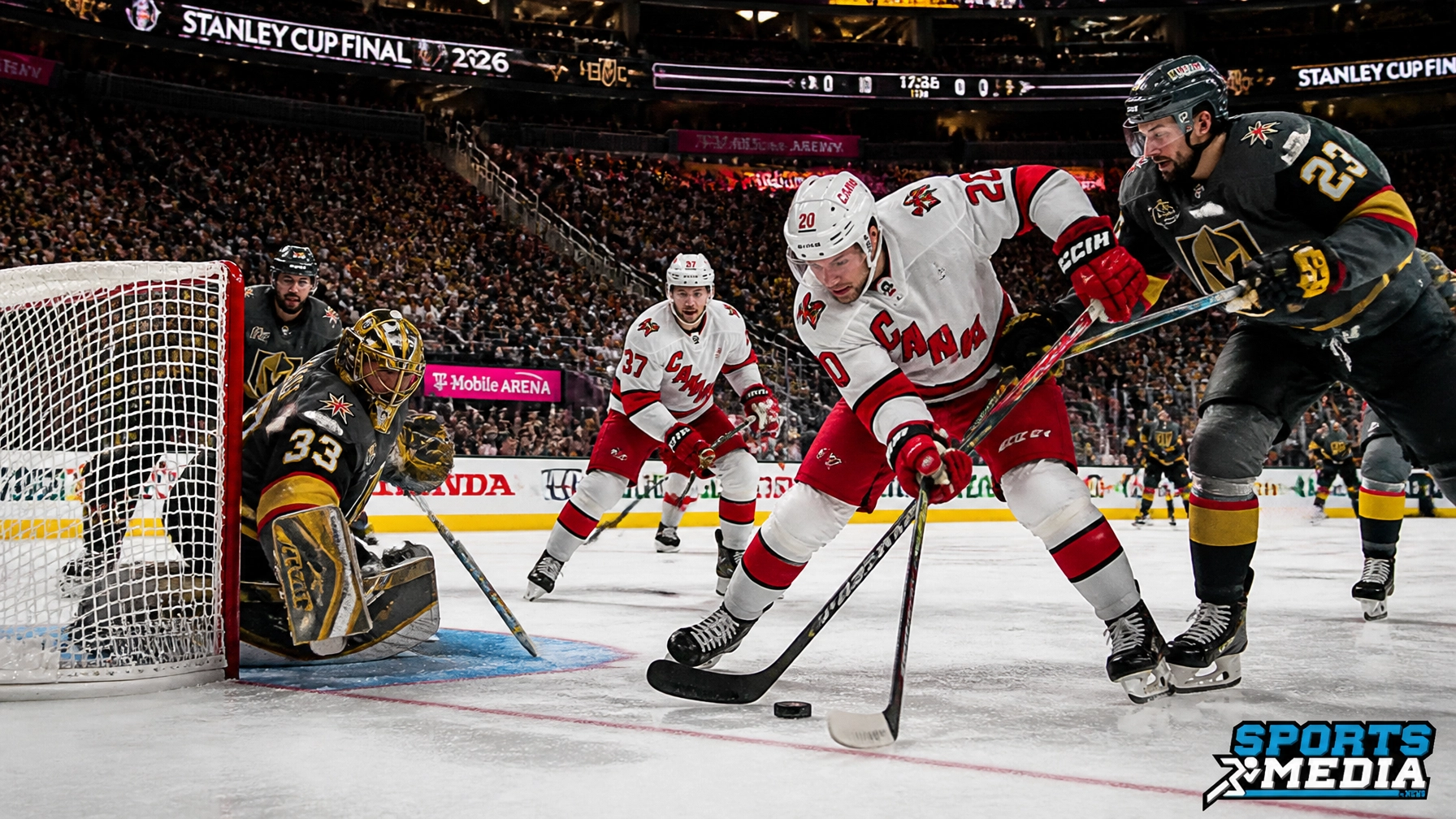
The Carolina Hurricanes and the Las Vegas Golden Knights squared off in an electric opening match of the 2026 Stanley Cup Final on May 2, 2026, delivering a high-scoring affair that immediately reset the expectations for the series. Despite entering the game as statistical favorites in many betting markets, the Carolina Hurricanes fell to the Las Vegas Golden Knights in a 5-4 decision. The narrow victory for Vegas serves as a significant opening statement in a series that many analysts predicted would be a defensive stalemate.
The game, held at the Lenovo Center, showcased a dramatic shift in momentum across three periods of play. While the Hurricanes controlled the early minutes with record-breaking speed, the Golden Knights' veteran poise and tactical adjustments eventually secured the win. Fans and analysts now look toward Game 2, scheduled for Thursday at 8:00 p.m. EST on ABC, to see if Carolina can adjust their defensive structure to counter the Golden Knights’ opportunistic offense.
A Record-Breaking Start
The contest began with a level of intensity rarely seen in championship openers. Carolina Hurricanes left wing Nikolaj Ehlers stunned the Vegas crowd by scoring the first goal of the game within the first 25 seconds. This lightning-fast strike set a new record for the fastest goal in a Stanley Cup Playoff Final series game. The play developed rapidly following a clean win at center ice, with defensemen Jaccob Slavin and Jalen Chatfield providing the assists on Ehlers' sharp snap shot.

"In a high-stakes environment like the Stanley Cup Final, the first 60 seconds often dictate the psychological tempo," noted Dr. Marcus Thorne, a sports psychology consultant and professor of athletic performance. "Carolina’s ability to find the net in under half a minute wasn't just a physical feat; it was a statement of intent that momentarily paralyzed the Vegas defensive structure."
Ehlers was not finished with his early-game dominance. Later in the first period, he found the back of the net again, this time utilizing a backhand shot. Jalen Chatfield earned his second assist of the night on the play, extending the Hurricanes' lead to 2-0. However, the Golden Knights responded before the period concluded. Defenseman Shea Theodore cut the deficit in half with a powerful goal, supported by slap shot assists from defenseman Brayden McNabb and left winger Cole Smith. The first frame ended with Carolina holding a 2-1 lead, though the momentum had clearly begun to tilt toward the home team.
Shifting Momentums
The second period saw the Las Vegas Golden Knights assert their offensive depth. Early in the frame, forward Ivan Barbashev leveled the score at 2-2. The play was the result of a coordinated entry into the offensive zone, with center Jack Eichel and defenseman Brayden McNabb providing the necessary puck movement to open up a lane for Barbashev.
The Golden Knights took their first lead of the night shortly after. Forward and alternate captain William Karlsson beat the Hurricanes' goaltender to make it 3-2. The goal featured assists from high-profile right winger Mitch Marner: whose presence in the Vegas lineup has been a focal point of sports media coverage this season: and center Brett Howden.
Carolina refused to go quietly into the second intermission. Hurricanes captain and veteran center Jordan Staal responded with a crucial goal to tie the game at 3-3. Defenseman K’andre Miller provided the lone assist on the play, showcasing the Hurricanes' ability to generate offense from the blue line.
"What we are seeing is a clash of two very different roster constructions," said Elena Rodriguez, a senior analyst for the International Hockey Research Group. "Carolina relies on a suffocating, system-based approach where the defense is heavily involved in the transition. Vegas, conversely, is playing a more opportunistic, high-skill game that punishes even the smallest positional errors."
The Final Push
The third period began with the score deadlocked, but the Golden Knights quickly regained the advantage. Center Brett Howden scored to put Vegas up 4-3, with assists credited to Shea Theodore and Brayden McNabb. The assist was McNabb’s third of the night, highlighting his role as a primary distributor from the defensive end.
The Hurricanes managed one last surge when defenseman Shayne Gostisbehere scored an unassisted goal, once again tying the game and silencing the Vegas faithful. The back-and-forth nature of the scoring kept the game in a state of constant flux until the final minutes.

The deciding blow came from forward Tomas Hertl, who scored the final goal of the night to secure the 5-4 victory for the Golden Knights. Assists on the game-winning goal were attributed to center Colton Sissons and defenseman Shea Theodore. Despite a desperate pull of their goaltender for an extra attacker in the closing minute, the Hurricanes were unable to beat the Vegas defense a fifth time.
Seeking Legitimacy
The high-scoring nature of Game 1 has led some experts to question whether the defensive discipline of both teams will hold up throughout a long series. While the Hurricanes entered the Final with the league’s top-rated penalty kill, the five goals allowed in Game 1 suggest a potential vulnerability against the Knights’ multi-line attack.
"There is a tendency to view high-scoring games as 'messy,' but this was actually a very high-level execution of offensive sets," explained Robert Vance, a former league executive and current sports management professor. "Vegas is seeking to cement its legitimacy as a modern dynasty, and winning a track meet against a disciplined team like Carolina is a strong indicator of their versatility."
The issue of penalties also loomed over the game. While the total number of infractions was relatively low for a playoff match, several unforced errors led to crucial momentum shifts. Industry insiders suggest that both coaching staffs will likely emphasize "controlled aggression" heading into Game 2 to avoid giving away free opportunities on the man advantage.
Lasting Impacts
For the Carolina Hurricanes, the loss is a missed opportunity to steal home-ice advantage, but the record-setting performance of Nikolaj Ehlers provides a silver lining. Historically, teams that win Game 1 of the Stanley Cup Final go on to win the series roughly 75% of the time, putting significant pressure on the Hurricanes to secure a win on Thursday.

"This series is far from over," noted Rodriguez. "The analytics show that Carolina actually led in expected goals (xG) for much of the game. If they maintain that shot quality, the law of averages suggests a bounce-back in Game 2."
As the teams prepare for the next installment of the series, the focus remains on whether Vegas can maintain its offensive efficiency or if Carolina’s defensive "machine" will find its rhythm. For fans at Sportsmedia News, the 5-4 thriller in Game 1 serves as a promising introduction to what could be one of the most competitive Finals in recent history.
Forward-looking projections suggest that if the Golden Knights can secure a 2-0 lead heading to Raleigh, the Hurricanes will be forced into a high-risk, high-reward style of play that could either save their season or lead to a quick exit. All eyes remain on the ice as the puck drops for Game 2 on Thursday night.