


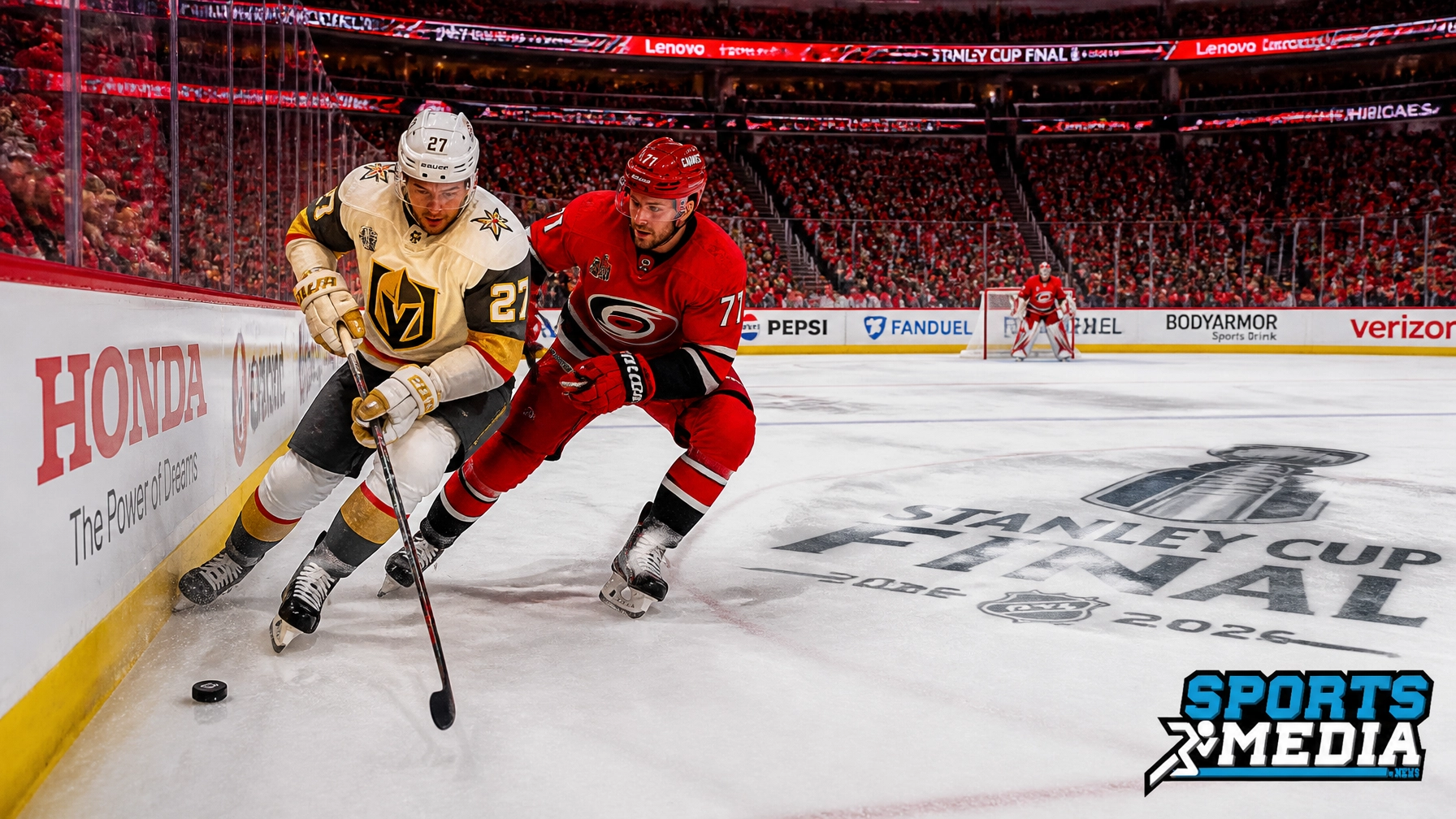
Vegas Rallies in Thriller to Take Game 1 and Secure Historic Comeback
By Mark Ricci
June 4th, 2026
Game 1 of the 2026 Stanley Cup Final delivered a championship opener that will be discussed for decades, blending a high-octane start with a historic rally that shifted the series momentum before the first horn even sounded for Game 2. In a performance defined by resilience and tactical execution, the Vegas Golden Knights overcame an early two-goal deficit to defeat the Carolina Hurricanes 5–4 at Lenovo Center.
Beyond the box score, the victory represents a watershed moment in NHL playoff history. According to data cited by ESPN Insights, road teams entered this game with an all-time record of 0–55 when trailing at any point in Game 1 of the Stanley Cup Final. By erasing a multi-goal lead on the road to secure the win, Vegas didn’t just take a 1–0 series lead; they dismantled a statistical barrier that had stood for the duration of the league’s modern era.
Early surge: Hurricanes jump ahead
The atmosphere inside Lenovo Center was electric, fueled by a Carolina crowd that had waited years for a return to the Final. The Hurricanes responded to that energy immediately, staging what appeared to be an offensive clinic in the opening minutes.
Nikolaj Ehlers, who has been a centerpiece of Carolina’s aggressive forecheck all season, scored on the Hurricanes’ very first shot of the game. Just 25 seconds after the opening faceoff, Ehlers snapped a precision wrist shot past Vegas goaltender Carter Hart, sending the home crowd into a frenzy. The early goal underscored a primary strategic concern for Vegas: the need to weather Carolina’s initial "storm" of pressure.
Ehlers wasn't finished. Minutes later, he exploited a defensive gap to find himself on a breakaway, beating Hart five-hole to double the lead. At 2–0, Vegas appeared overwhelmed by the Hurricanes’ speed and the sheer noise of the arena.
Vegas found a lifeline late in the first period. Shea Theodore, driving the offense from the blue line, fired a wrist shot through heavy traffic that found its way past Frederik Andersen. The goal cut the deficit to 2–1, a critical psychological marker that allowed the Golden Knights to head into the intermission with a sense of stability.
Vegas fights back: Swing in the middle frame
The second period showcased the tactical adjustments that have defined the Golden Knights’ 2026 run. Just 30 seconds into the period, mirroring the Hurricanes' quick start in the first, Ivan Barbashev found space in the left circle and buried a high wrist shot to tie the game at 2–2.

The momentum shift was palpable. Vegas began to dictate the pace of the "arms race" through the neutral zone, utilizing their size to disrupt Carolina’s transition game. Off an offensive-zone faceoff later in the frame, Jack Eichel executed a perfect set play, finding William Karlsson for the go-ahead goal. For the first time, Vegas led 3–2.
However, the Hurricanes proved why they are the Eastern Conference champions. Captain Jordan Staal, a veteran of high-stakes playoff hockey, responded with a gritty effort, firing a shot past Hart to level the score at 3–3. The seesaw battle set the stage for a third period defined by chaos and individual brilliance.
Third-period chaos and Hertl’s winner
The final frame was a study in high-stakes pressure. Vegas reclaimed the lead when Brett Howden tipped in a point shot for his 11th goal of the postseason. Howden’s performance has been one of the league's most significant value-adds this year, providing elite production from a secondary scoring role.
A controversial icing call late in the period gave the Hurricanes an offensive-zone faceoff they arguably hadn't earned. They made the most of it. In the ensuing scramble, Shayne Gostisbehere pounced on a loose puck to tie the game 4–4 with less than five minutes remaining.
The decisive moment arrived with 3:24 on the clock. Tomáš Hertl, acquired in a blockbuster trade that many analysts initially questioned for its cap implications, proved his worth. After a crisp give-and-go with Colton Sissons, Hertl found the slot and beat Andersen for the 5–4 lead.
The drama didn't end there. In the closing seconds, the Hurricanes mounted a furious six-on-five attack. Seth Jarvis had a clear look at an open net, but Carter Hart produced a highlight-reel glove save that preserved the win. It was Vegas’ seventh straight playoff victory, a streak that suggests a team operating at the peak of its collective powers.

Standout performances and strategic assets
The box score reveals a team effort that leveraged both high-end talent and roster depth:
- Tomáš Hertl (VGK): Scored the game-winning goal at 16:36 of the third, cementing his status as a "big-game" asset.
- Shea Theodore (VGK): Recorded a goal and multiple points, consistently breaking the Hurricanes' press.
- Brett Howden (VGK): Managed a three-point night, including a crucial goal, continuing his emergence as a playoff X-factor.
- Carter Hart (VGK): Finished with 23 saves, including the game-saving stop on Jarvis.
- Nikolaj Ehlers (CAR): His two-goal first period provided the blueprint for how Carolina can beat Vegas if they can maintain that intensity for 60 minutes.
From a business perspective, the performance of players like Howden and Theodore highlights the Golden Knights' successful long-term roster planning. While other teams have struggled with the fluctuating economics of player sponsorships and cap management, Vegas has consistently identified and retained talent that excels under post-season pressure.
Seeking legitimacy: What Game 1 tells us about the series
The fallout from Game 1 suggests several key trends that will dictate the remainder of the Final. First, the psychological advantage has swung heavily toward Vegas. Overcoming a multi-goal deficit in an opponent’s building is a feat that can demoralize even the most disciplined squads.

"The issue for Carolina is no longer just tactical; it’s mental," noted Miele. "They did everything right in the first period and still lost. That creates a seed of doubt that Vegas will look to exploit in Game 2."
At the same time, Carolina’s ability to strike quickly remains their most dangerous weapon. If the Hurricanes can tighten their defensive rotations and protect leads more effectively, they have the offensive firepower to turn this into a long series. The "arms race" for goaltending supremacy between Hart and Andersen will likely be the deciding factor.
This victory may serve as a blueprint for how the Golden Knights intend to dismantle the Hurricanes: weathering the initial storm, utilizing depth scoring, and relying on elite goaltending to close the door. As the series continues, the historic nature of this Game 1 comeback will loom large over both locker rooms.
Mark Ricci is a senior sports business analyst for Sportsmedia News. Covering league dynamics, event analytics, and industry trends, Mark provides in-depth insights into the intersection of athlete performance and sports commerce.