


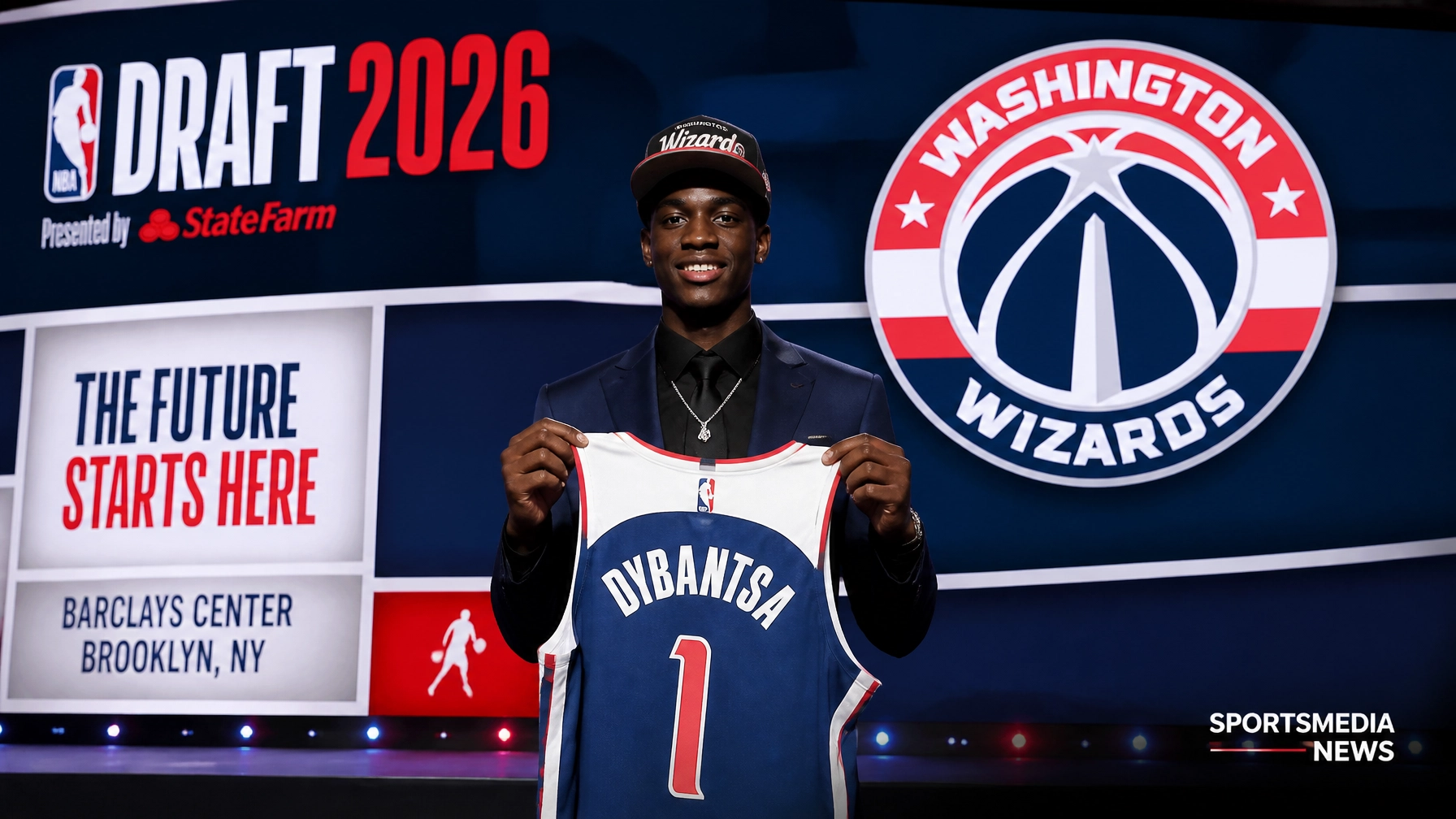
The landscape of the NBA shifted significantly over the course of two days in Brooklyn. As the 2026 NBA Draft concluded on June 24, 2026, the league welcomed a new generation of talent led by a consensus top pick and a surprising surge from the Big Ten. With front offices increasingly utilizing advanced data analytics and high-precision training modules, the margin for error has never been thinner.
From the Washington Wizards securing a potential franchise cornerstone to the Memphis Grizzlies executing a masterclass in asset management, the 2026 draft will be remembered for its tactical maneuvers and a historic showing by the University of Michigan.
The New Face of the Capital
The Washington Wizards entered the night with a clear objective and left with AJ Dybantsa, the 6-foot-9 forward out of BYU. Dybantsa, widely regarded as the most polished scoring prospect in years, represents a pivot point for a Washington franchise that has spent the last three seasons hovering in the draft lottery.
"We believe AJ is a generational scoring talent," one Eastern Conference scout noted shortly after the pick. "His ability to create separation at his size is something we haven't seen since the early days of Kevin Durant. The Wizards didn't just get a player; they got an identity."
Dybantsa’s arrival in D.C. comes with high expectations and a significant financial commitment. As the No. 1 overall pick, he is slated to sign a four-year rookie scale contract worth approximately $52.4 million, according to current league projections. The Wizards are betting that his mid-range efficiency: which hovered near 48% during his collegiate tenure: will translate immediately to the professional level.
High Stakes in the Top Five
While Dybantsa was the night's headliner, the subsequent selections underscored a draft rich in high-floor prospects. The Utah Jazz followed at No. 2 by selecting Darryn Peterson, the dynamic 6-foot-5 guard from Kansas. Peterson’s freshman year was marked by flashes of brilliance interspersed with efficiency struggles, but Utah’s front office clearly prioritized his 6-foot-11 wingspan and three-level scoring potential.

At No. 3, the Memphis Grizzlies opted for Cameron Boozer out of Duke. Boozer, the son of former NBA All-Star Carlos Boozer, brings a level of physical maturity and interior craft that many scouts believe makes him the "safest" pick in the class. The Grizzlies initially held the No. 2 pick but traded down one spot, adding significant draft capital in the process: a move that allowed them to still land their primary target while bolstering their future flexibility.
The Chicago Bulls rounded out the top tier by selecting North Carolina’s Caleb Wilson at No. 4. Wilson’s mobility and "connector" style of play offer the Bulls a modern frontcourt solution capable of operating as a secondary playmaker or a stretch threat.
The Ann Arbor Pipeline
The most significant storyline of the lottery, however, was the unprecedented dominance of the Michigan Wolverines. In a feat rarely seen in the modern era, three players from the same program were selected within the top 12 picks.
Morez Johnson Jr. led the way, going No. 9 to the Dallas Mavericks, followed by Yaxel Lendeborg at No. 11 to the Golden State Warriors, and the 7-foot-3 Spanish sensation Aday Mara at No. 12 to the Oklahoma City Thunder.

"This is a testament to the development system in Ann Arbor," said an anonymous NBA assistant general manager. "To have a high-energy big like Johnson, a versatile wing like Lendeborg, and a unique rim-protector like Mara all come from the same locker room speaks to the modern, NBA-ready style they are playing."
The Michigan trio represents a combined $115 million in projected career earnings over their first four seasons, a staggering figure that highlights the program's evolution into a professional factory.
The Art of the Deal
As is often the case with the 2026 class, the draft was defined as much by the trades as the selections. The New York Knicks were particularly active, engaging in a complex series of pick swaps with both the Los Angeles Lakers and the Dallas Mavericks. While the specifics of these deals often involve protected future assets, the immediate impact saw the Knicks consolidate their position to target specific bench depth.
Other notable moves included:
- Denver Nuggets: Traded the No. 26 pick to the San Antonio Spurs in exchange for future second-round considerations and a veteran rotation player.
- Sacramento Kings: Aggressively moved up to No. 29, signaling a desire to add immediate shooting to a roster that struggled from the perimeter in the 2025-26 season.
- Memphis Grizzlies: Beyond their move at the top, the Grizzlies added two future first-round picks through a series of late-night maneuvers.

"In this environment, you have to be willing to move," noted marketing expert and sports business analyst Sarah Jenkins. "The trade market is no longer just about talent; it’s about managing the salary cap and finding value in the margins." For more in-depth reporting on the business of basketball, readers can explore our Articles section.
The Science of Selection
A fascinating trend during the 2026 cycle has been the integration of motorsport simulation technology into basketball scouting. While the connection between a race track and a hardwood court may not be immediately obvious, the technology used for drag racing reaction time training has found a second home in the NBA.
Front offices are now using advanced drag racing simulators to measure a prospect's "twitch" and neurological response speed. Just as a driver on a sim racing drag strip must react to the "Christmas Tree" lights with millisecond precision, NBA guards are being tested on their ability to read a defensive rotation and execute a first step.

"We are essentially looking at drag racing simulation protocols to evaluate the acceleration of these athletes," explained Dr. Marcus Thorne, a sports performance consultant. "The same drag racing training technology that helps a driver launch off the line is being adapted to help players like Darryn Peterson optimize their burst. It’s an arms race of data."
This crossover between industries highlights a broader shift toward high-fidelity evaluation. Teams are no longer content with simple shooting drills; they want the granular data that only high-end simulators can provide.
Lasting Impacts
The 2026 NBA Draft has set the stage for a dramatic 2026-27 season. With blue-chip prospects like Dybantsa and Boozer entering the league with high usage rates expected on day one, the hierarchy of the Eastern and Western Conferences could look very different by Christmas.
The success of the Michigan lottery trio also suggests that the college game's power balance is shifting, as programs that prioritize NBA-style spacing and advanced tech-driven training continue to attract the nation's best. As the league continues to evolve, the integration of cross-disciplinary technologies will likely become the standard rather than the exception.
For ongoing coverage of player movements and league-wide updates, stay tuned to Sportsmedia News and our latest press releases.
By Jacob Potter