


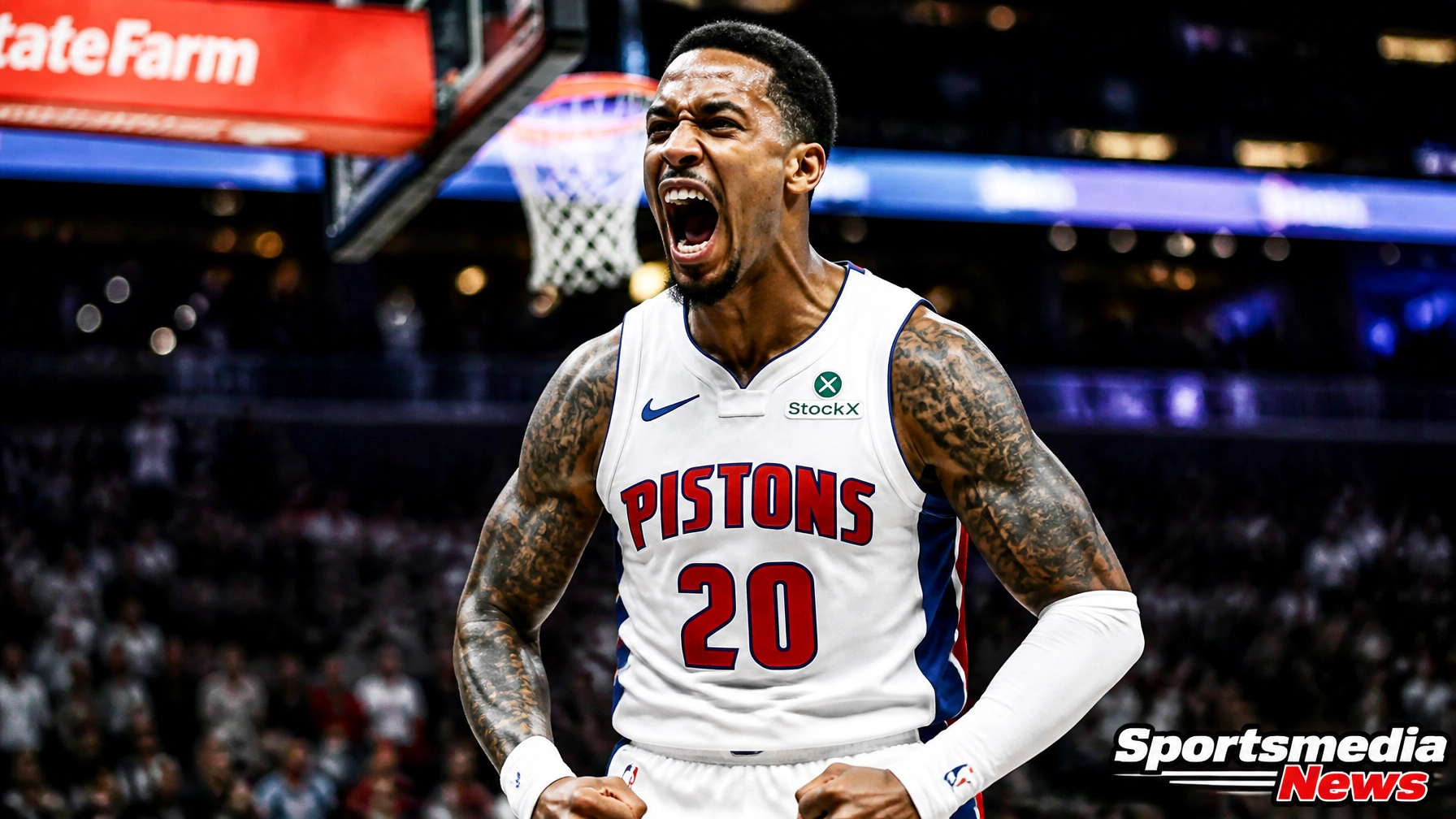
The Detroit Pistons' offseason kicked into gear this week, and the headline move looks like it's going to reshape the frontcourt for years to come. The Pistons agreed to a three-year, $51 million deal with John Collins, addressing one of the team's biggest needs while also closing the book on one of the most beloved figures of Detroit's recent turnaround.
THE COLLINS FIT
Last season, Collins averaged 13.6 points and 5.3 rebounds a game while shooting 55.2% overall and 40.6% on 3-pointers. Those numbers might not jump off the page, but the efficiency does. Collins is expected to be a frontcourt addition and a new lob threat for Cade Cunningham in Detroit, giving the Pistons another above-the-rim finisher to pair with their franchise point guard.
Collins can also space the floor both vertically and with his 3-point shot, which has returned to form over the last few seasons. That two-way scoring versatility is exactly what Detroit was missing in its frontcourt, someone who can finish lobs in transition but also space the floor in the half-court when the Pistons need to keep the paint clean for Cunningham and Duren to operate.
The pairing is expected to complement coach J.B. Bickerstaff's system of utilizing two bigs, a strategy he successfully implemented during his time with the Cleveland Cavaliers. If Detroit is able to lock up Jalen Duren this summer, a Duren-Collins frontcourt gives Bickerstaff the flexibility to play big without sacrificing spacing — something that plagued Detroit in years past. It also gives the Pistons the option to move away from Duren in parts and run a small ball lineup with Cunningham, Dannis Jenkins, newly acquired Isaiah Joe, Ausar Thompson, and Collins.
The flip side of the Collins signing is the exit of Tobias Harris, who was instrumental in Detroit's rise from the league's basement to a 60-win, No. 1 seed team in the span of two years. Harris wanted to return to Detroit, and there was mutual interest, but his departure was largely for financial reasons. A source confirmed that Harris agreed to a two-year, $31 million deal to join the San Antonio Spurs.
Losing Harris stings for reasons that go beyond the box score. Collins isn't going to be the wise veteran leader within the locker room, and you can't feed him the ball when the offense isn't functioning and ask him to back down his man for a mid-range look. Harris was often described as Detroit's "security blanket" in those moments, the guy who could get his own shot when nothing else was working. Collins brings a different skill set: more athletic, more vertical, more of a play-finisher than a shot-creator.
Harris returned to the Pistons in 2024 and played a critical role in helping the franchise regain its culture under coach Bickerstaff, with the Pistons coming off their worst season in franchise history when Harris arrived before earning the No. 1 seed two years later. That leadership won't be easy to replace, even if Collins upgrades the athletic profile of the position.
WHAT'S NEXT
The Collins deal doesn't mean Detroit is done shopping. The Pistons still need to resolve the Jalen Duren situation, potentially find a new starting center if Duren is sent out, and continue searching for a shot-creating wing. Duren has already taken meetings with other teams, including the Los Angeles Lakers, though the Lakers' recent sign-and-trade for center Walker Kessler may have taken them out of the running.
Ultimately, the Pistons' roster is changing with the exits and additions of this offseason, and with the Eastern Conference only adding talent, it will be exciting to see how this season shapes up.
By AJ Hammerle