


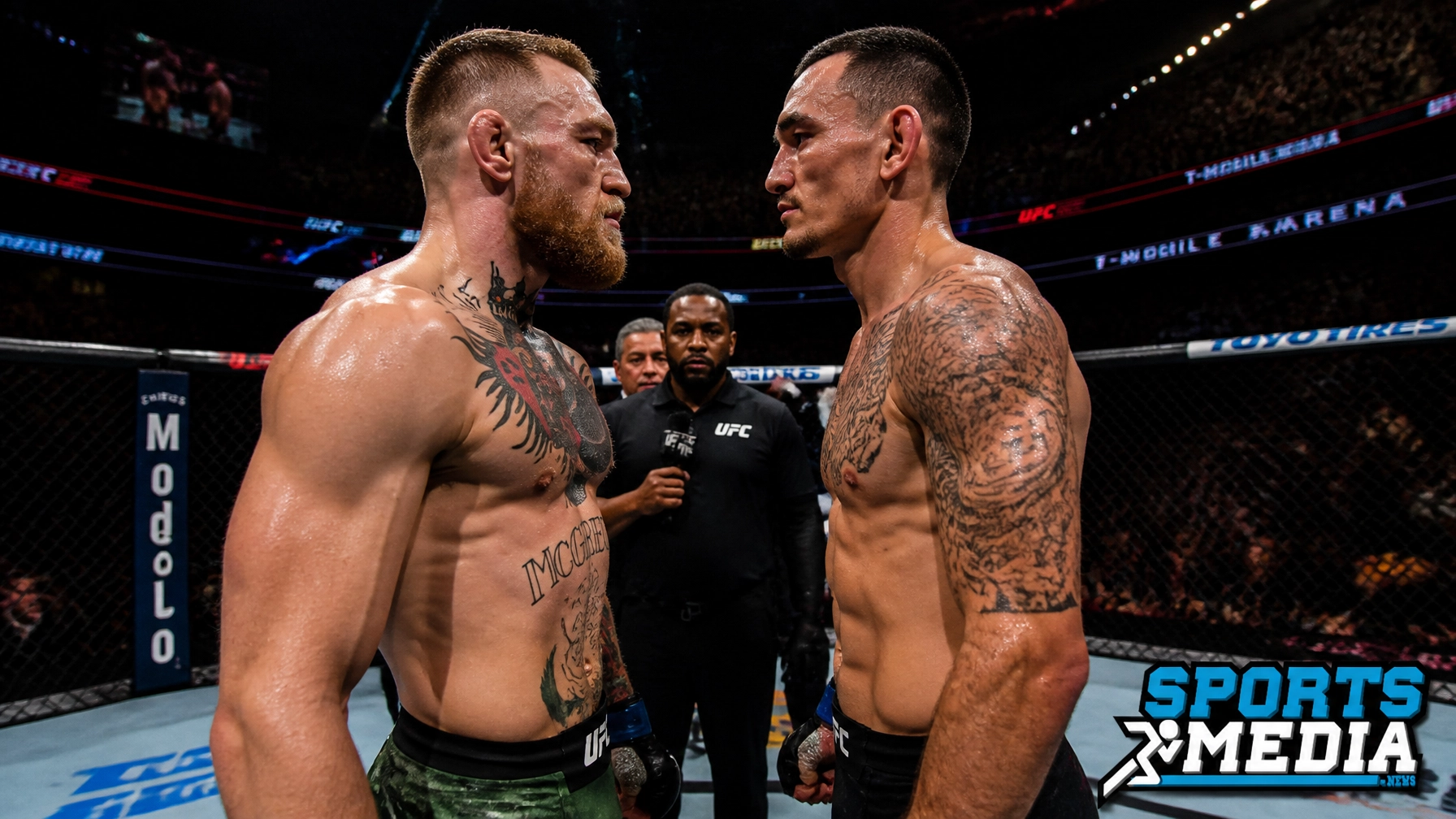
For nearly five years, the UFC world waited for the return of Conor McGregor. UFC 329 was supposed to mark the beginning of a new chapter for the biggest star the sport has ever seen. Instead, it lasted less time than it takes to read this paragraph — and it may have brought the story closer to its ending.
By Nicolas Dorigatti | July 13th, 2026
For nearly five years, the UFC world waited for the return of Conor McGregor. UFC 329 was supposed to mark the beginning of a new chapter for the biggest star the sport has ever seen. Instead, it lasted less time than it takes to read this paragraph — and it may have brought the story closer to its ending.
McGregor's long-awaited comeback against Max Holloway, in a rematch of their 2013 featherweight meeting, took place July 11, 2026, at T-Mobile Arena in Las Vegas. It lasted just 69 seconds before disaster struck. Attempting a jumping kick to open the welterweight bout, McGregor's right leg buckled beneath him. He tried to fight on, but the referee had seen enough. The bout was waved off, handing Holloway a TKO victory in one of the most anticlimactic endings in recent UFC history — and denying a sold-out, booing arena the fight it had waited half a decade to see.
The result carries major implications not only for McGregor's fighting future, but also for the UFC's plans moving forward.
The Biggest Concern: Can McGregor's Body Hold Up?

The injury at UFC 329 marks the second catastrophic lower-body injury of McGregor's career. In 2021, he suffered the gruesome leg break against Dustin Poirier at UFC 264. After spending nearly five years away from competition recovering and preparing for a comeback, another significant injury raises unavoidable questions about whether his body can withstand the demands of elite mixed martial arts competition anymore.
McGregor turns 38 this month and has fought only twice since January 2020. Ring rust, age, and years away from active competition create challenges for any fighter, even one as talented as "The Notorious." ESPN has reported McGregor is expected to undergo surgery on the injured knee, with a stated intention to fight again afterward — but for a fighter who has now suffered serious leg damage in two of his last three appearances, staying healthy enough to make it to fight night has become one of the biggest obstacles of his career.
The Michael Chandler Fight Becomes Even More Unlikely

For years, fans anticipated a showdown between McGregor and Michael Chandler. The matchup survived coaching stints on The Ultimate Fighter, multiple postponements, and endless social media exchanges.
After UFC 329, however, the possibility of that fight happening appears smaller than ever.
A lengthy rehabilitation process could sideline McGregor well into 2027, depending on the severity of the knee damage and how surgery goes. By that point Chandler will be 40 years old, making the timing increasingly difficult for a fight that already feels years overdue. UFC executives may decide the window for one of their most anticipated matchups has simply closed.
Boxing Could Become the Preferred Option

Several figures in the MMA community have already suggested that boxing may be McGregor's best path forward. The reduced emphasis on kicks, wrestling, and explosive grappling exchanges places less stress on aging joints and damaged legs.
Financially, boxing would also make sense. McGregor remains one of the few combat sports athletes capable of generating enormous pay-per-view numbers regardless of opponent. Potential exhibitions or crossover bouts could provide massive paydays without requiring the physical punishment of another UFC training camp.
There's also a wrinkle specific to this loss: in his post-fight comments, Holloway himself floated a third McGregor fight, telling the crowd he intended to "get this money" with a trilogy bout down the line. Whether that happens in MMA or elsewhere in combat sports is now an open question.
The UFC Has Already Begun Moving On

Perhaps the most significant implication from UFC 329 has nothing to do with McGregor himself.
While the main event ended abruptly, the rest of the card showcased several fighters positioned to become the promotion's next generation of stars. Paddy Pimblett needed just 52 seconds to submit Benoît Saint-Denis with a D'Arce choke. Brandon Royval survived a second-round knockdown to submit Lone'er Kavanagh in the third round in a Fight of the Night effort. Bobby "King" Green rallied from a bloodied face to stop Terrance McKinney with one second left in the first round. And Robert Whittaker made a successful move up to light heavyweight, stopping Nikita Krylov in the third round.
For years, the UFC's biggest events revolved around McGregor. UFC 329 may have been the first major sign that the company is prepared for a future where that is no longer the case.
Is This the End?

It would be foolish to count out Conor McGregor entirely. Throughout his career he has repeatedly returned from setbacks that many believed would end his time at the top of the sport, and by his own team's account, surgery and another comeback are already the plan.
But UFC 329 feels different.
This wasn't a loss caused by a better game plan or a difficult stylistic matchup. It was another reminder of the physical toll that years of fighting can take on even the sport's biggest stars — and a second reminder, in the same body part, of just how thin the margin has become.
Whether McGregor's next chapter is another rehabilitation and comeback, a move to boxing, or eventually retirement, UFC 329 will likely be remembered as one of the most important nights of his career — not because of what happened inside the cage, but because of the questions it left unanswered.
For the first time in a long time, the conversation surrounding Conor McGregor is no longer about who he fights next.
It's about whether he fights again at all.
Nicolas Dorigatti is a senior contributor for Sportsmedia News, covering combat sports, the business of mixed martial arts, and athlete career strategy.