


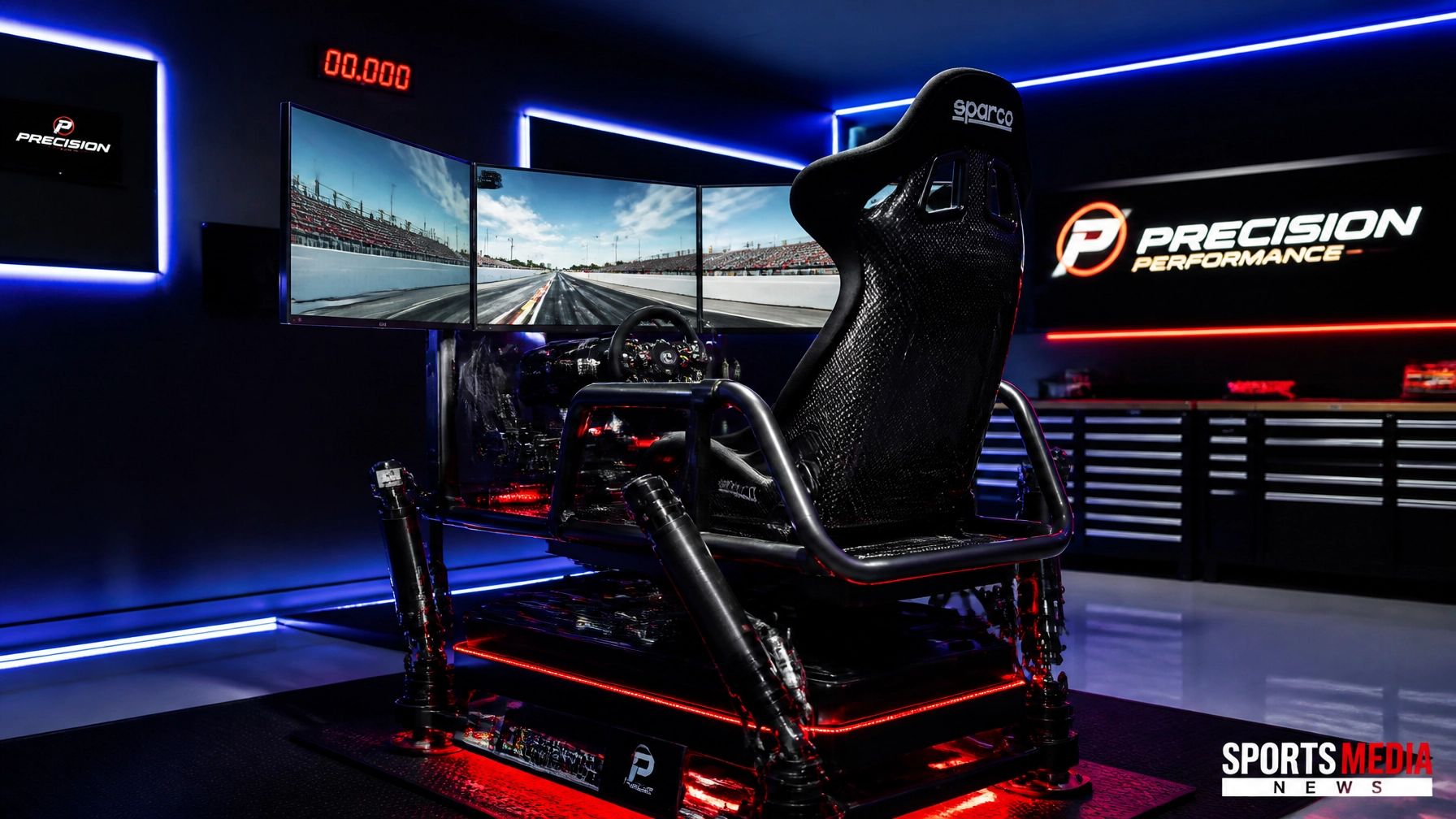
In drag racing, victory is measured in thousandths of a second. A hesitation at the start, a botched shift, or a misread track can end a race before it truly begins. That brutal margin for error is exactly why drivers — from weekend bracket racers to professional nitro teams — are turning to simulation not as a novelty, but as a genuine competitive tool.
By Nicolas Dorigatti
June 23, 2026
From Video Games to Virtual Training Platforms
Early racing games were entertainment. What exists today is something else entirely. Modern simulators combine advanced physics engines, force-feedback hardware, motion platforms, and real-world vehicle data to recreate the demands of the drag strip in remarkable detail.
Professional setups include racing seats, sequential shifters, load-cell pedal assemblies, and full-motion rigs that simulate acceleration forces — all in a controlled environment where you can run the same track a hundred times without burning a drop of fuel. The result is a training tool with no equivalent in the sport's history.
The Launch: Where Races Are Won and Lost
Ask any drag racer where their event is decided, and most will tell you the same thing: the first few feet. Reaction time — the gap between the last light on the Christmas Tree and the moment the car leaves the line — is where tenths of seconds live or die.

Simulators let drivers rehearse that moment obsessively. Staging technique, throttle application, clutch release points, transbrake timing, launch RPM — all of it can be dialed in through repetition before the car ever fires up. The deeper benefit is what that repetition builds: muscle memory. When a driver has rehearsed a launch sequence hundreds of times, the movements stop being conscious decisions. On race day, under pressure, the body already knows what to do.
Testing Setups Without Burning Parts
Every pass down the track costs money. Fuel, tire wear, stress on the engine and drivetrain — testing a new configuration on the actual car adds up fast. Simulation offers a cheaper, faster alternative.
Before making a single physical change, teams can model the effects of different gear ratios, shift points, tire pressures, weight distribution, and suspension settings in software. Not every variable translates perfectly from virtual to real — no simulation accounts for every quirk of a specific engine or chassis — but the baseline it provides dramatically reduces the trial-and-error burden at the track.
For professional teams with serious operating budgets, this can mean substantial savings over a season.
Preparing for Tracks You've Never Seen
No two strips race the same. Altitude, humidity, temperature, and track prep all change how a car performs — and how a driver needs to respond. Simulators let racers practice under a wide range of conditions: hot, slick surfaces; cool nighttime air; poorly prepped starting lines; high-elevation venues.
Some teams pull historical weather data from specific events and use it to model likely race-day scenarios in advance. The goal isn't to predict exactly what will happen — it's to make sure that when conditions are unusual, the driver isn't encountering them for the first time.
The Mental Side of the Sport

Drag racing is a psychological discipline as much as a physical one. Elimination rounds, in particular, are ruthless: one mistake and your weekend is over. Simulation builds the mental resilience to handle that pressure. Repeated exposure to high-stakes scenarios reduces anxiety, sharpens focus, and helps drivers develop consistent pre-run routines. Many competitors spend time in the sim during the days leading up to an event specifically to mentally rehearse — from pulling into the burnout box to crossing the finish line. Sports psychologists have long advocated for visualization and repetition as performance tools. Simulation delivers both, immersively.
Data as a Coaching Tool
Every simulated run generates a performance record. Reaction times, 60-foot splits, shift timing, throttle position, vehicle stability — it's all captured and available for review. That data turns training into a feedback loop. A driver can see exactly where they're losing time, identify patterns in their mistakes, and track improvement over weeks and months. In a sport defined by incremental gains, that kind of structured self-analysis is invaluable.
What Simulation Still Can't Replicate
None of this means the simulator replaces the car. The visceral reality of a hard launch — the G-forces, the tire shake, the noise, the heat — can't be fully reproduced on any rig. Mechanical surprises don't happen in simulation. And the psychological weight of a real race, with real consequences, is different from even the most immersive virtual environment.

The best competitors treat simulation as a complement to seat time, not a substitute for it. The hours in the simulator make the hours at the track more productive.
Where It's Headed
The technology keeps improving. Virtual reality, AI-driven vehicle modeling, and more sophisticated motion systems are closing the gap between virtual and real with each passing year. Professional motorsports have relied on simulation for driver development for decades — drag racing is catching up fast.
In a sport where the difference between first and second can be smaller than a blink, the ability to practice endlessly without consequence is an extraordinary advantage. For an increasing number of racers, time in the simulator is no longer optional: it's part of the job.
About the Author:
Nicolas Dorigatti is a senior technical analyst at Sportsmedia News, specializing in the intersection of high-performance motorsports and emerging simulation technologies. With over a decade of experience covering the NHRA and international drag racing circuits, Dorigatti provides deep insights into the mechanical and psychological facets of competitive racing.