


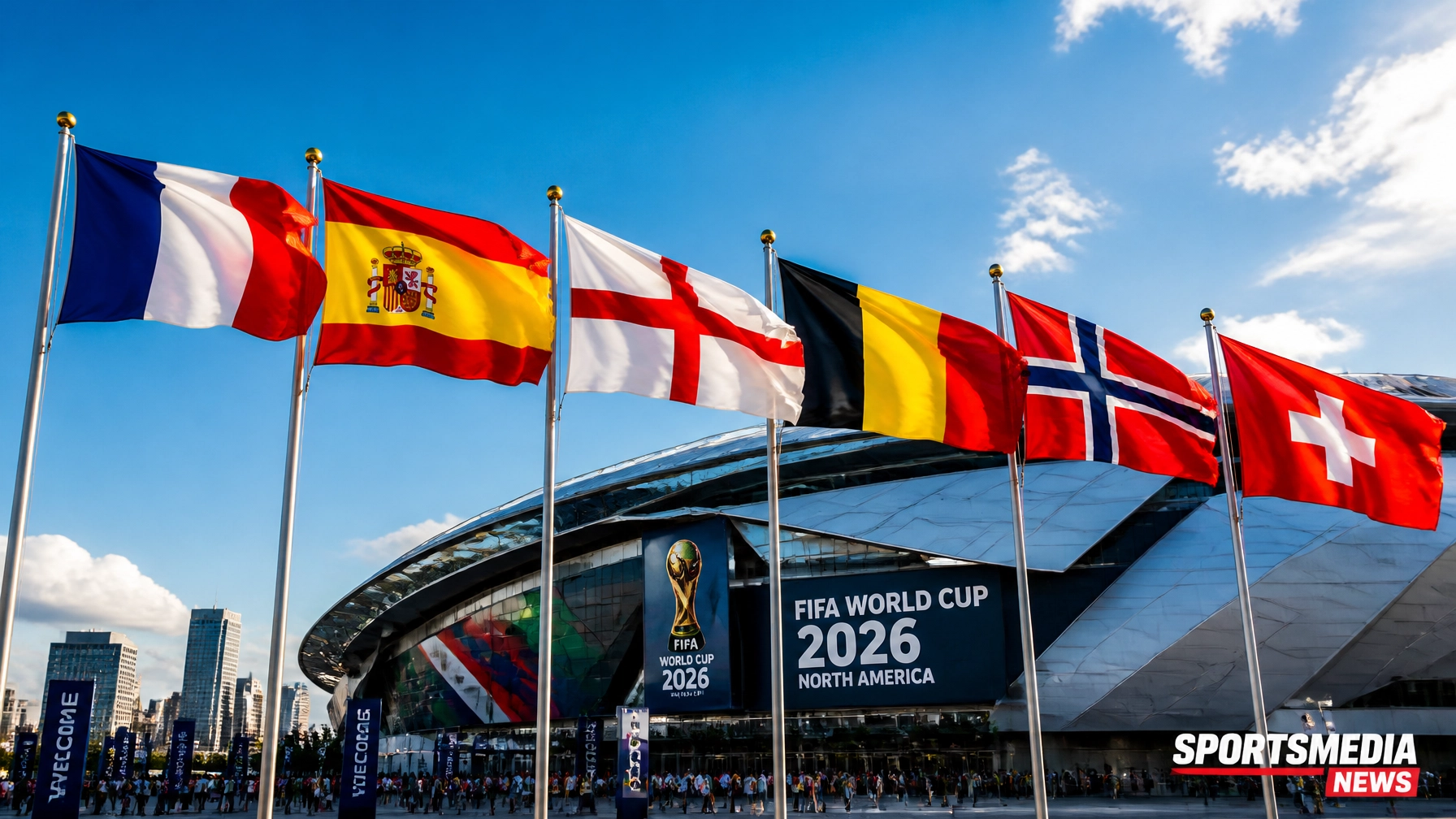
Six of the eight quarterfinalists are from UEFA — a familiar story in an unfamiliar setting, as Europe's depth, preparation, and academy pipeline have overwhelmed the field.
By Nicolas Dorigatti | July 8th, 2026
When FIFA awarded the 2026 World Cup to the United States, Mexico, and Canada, the conventional wisdom was that the tournament's format and setting would work against Europe. A 48-team field, a punishing North American summer, and thousands of miles of travel all seemed to favor nations built for heat and hardship over the continent that has long dominated the sport from home turf.
Instead, the opposite has happened. As the tournament reaches the quarterfinals, six of the remaining eight teams come from UEFA: France, Spain, England, Belgium, Norway, and Switzerland. Only defending champions Argentina and Morocco — the lone African representative — stand between Europe and a near-total sweep of the competition's final stages.
A Familiar Story in an Unfamiliar Setting
European nations dominating the World Cup's latter stages is nothing new. Europe has won 12 of the previous 22 World Cup tournaments, and UEFA has long fielded the deepest collection of elite squads in the international game. What makes 2026 different is where it's happening. Historically, European teams have struggled to replicate that success outside their own continent, worn down by long-haul travel, unfamiliar climates, and playing conditions that favor South American and CONCACAF sides. In 22 editions of the men's World Cup, only two European nations have ever won it on foreign soil: Spain in South Africa in 2010, and Germany in Brazil in 2014.

Heat was supposed to be the great equalizer this summer. Independent climate analyses found that roughly a quarter of this tournament's matches would be played above the threshold at which player performance measurably declines, with cities like Miami, Kansas City, and Monterrey among the most punishing venues on the schedule. Northern European squads, unaccustomed to that kind of heat and humidity, were widely expected to be the ones who wilted.
That narrative hasn't held up. If anything, Europe's federations turned preparation into a competitive edge: England's players trained in heated tents in Spain more than a year out from the tournament and used ingestible sensors to track core body temperature, while several squads brought in outside heat-performance specialists to build individualized acclimatization plans. It's a reminder that in modern international football, the margins are won well before kickoff.
Why Europe Is Winning
Depth. France, Spain, and England can absorb injuries and suspensions that would cripple smaller federations and barely miss a step. Squads that run 20-plus deep with players from Europe's biggest clubs mean there's always a capable replacement waiting.
Spain's collective identity. Rather than leaning on one talismanic figure, Spain has ground down opponents with tactical flexibility and contributions from across the squad — a return to the possession-based principles that won them a Euros title. Their 1-0 Round of 16 win over Portugal was built on control rather than individual fireworks, and they'll face Belgium, fresh off a statement 4-1 win over co-host USA, in the quarterfinals.

France's championship habits. Kylian Mbappé has carried much of France's attacking weight, but the team's real strength has been its ability to win ugly. Their narrow 1-0 win over Paraguay in the Round of 16 was the latest example of a side that finds a way even when it isn't at its fluent best — the same trait that carried them to the last two World Cup finals.

England's growing maturity. England beat co-host Mexico 3-2 in the Round of 16 despite playing most of the second half a man down, a result that suggested a team more capable of handling adversity than the generations before it. A blend of experienced leaders and emerging talent has the Three Lions looking like genuine title contenders rather than perennial nearly-men.
Norway's breakthrough. The tournament's biggest surprise has been Norway, whose 2-1 upset of five-time champions Brazil — powered by a two-goal night from Erling Haaland — delivered the nation's best World Cup showing in decades. Haaland now sits atop the race for the Golden Boot and gives Norway a puncher's chance against England in the quarterfinals.

The academy pipeline. Beyond any single tournament, Europe's advantage is structural. Club academies across England, Spain, France, Germany, Portugal, and Belgium continue to churn out technically polished players ready for the international stage at a young age — a pipeline that few other confederations can match at the same scale.
The Rest of the World Hasn't Disappeared
Europe's dominance doesn't mean the rest of the world has gone quiet. Morocco's win over co-host Canada extended their run from a historic 2022 semifinal appearance and made them the first African side to reach back-to-back World Cup quarterfinals — they now face France in a rematch of that 2022 semifinal, which Les Bleus won 2-0. Argentina, meanwhile, produced the most dramatic moment of the knockout rounds so far, storming back from 2-0 down against Egypt to win 3-2, with Lionel Messi among the scorers and back atop the Golden Boot conversation. Messi, notably, may also be one of the players best equipped for the North American heat, having spent several seasons adapting to South Florida's climate with Inter Miami.
Still, the numbers are hard to ignore. Six of the last eight teams wear European colors, and depending on how the quarterfinals fall, an all-European semifinal is a real possibility.
The Takeaway
The 2026 World Cup was supposed to be the tournament that finally leveled the playing field — more teams, more room for underdogs, a hostile climate that would neutralize Europe's usual advantages. Instead, it has reinforced an old truth about international football: when the stakes rise and the margin for error disappears, Europe's blend of squad depth, tactical sophistication, and player development still gives it the edge, wherever in the world the tournament happens to be played.
Nicolas Dorigatti is a senior contributor for Sportsmedia News, covering international soccer, tactical analysis, and the global business of the game.