


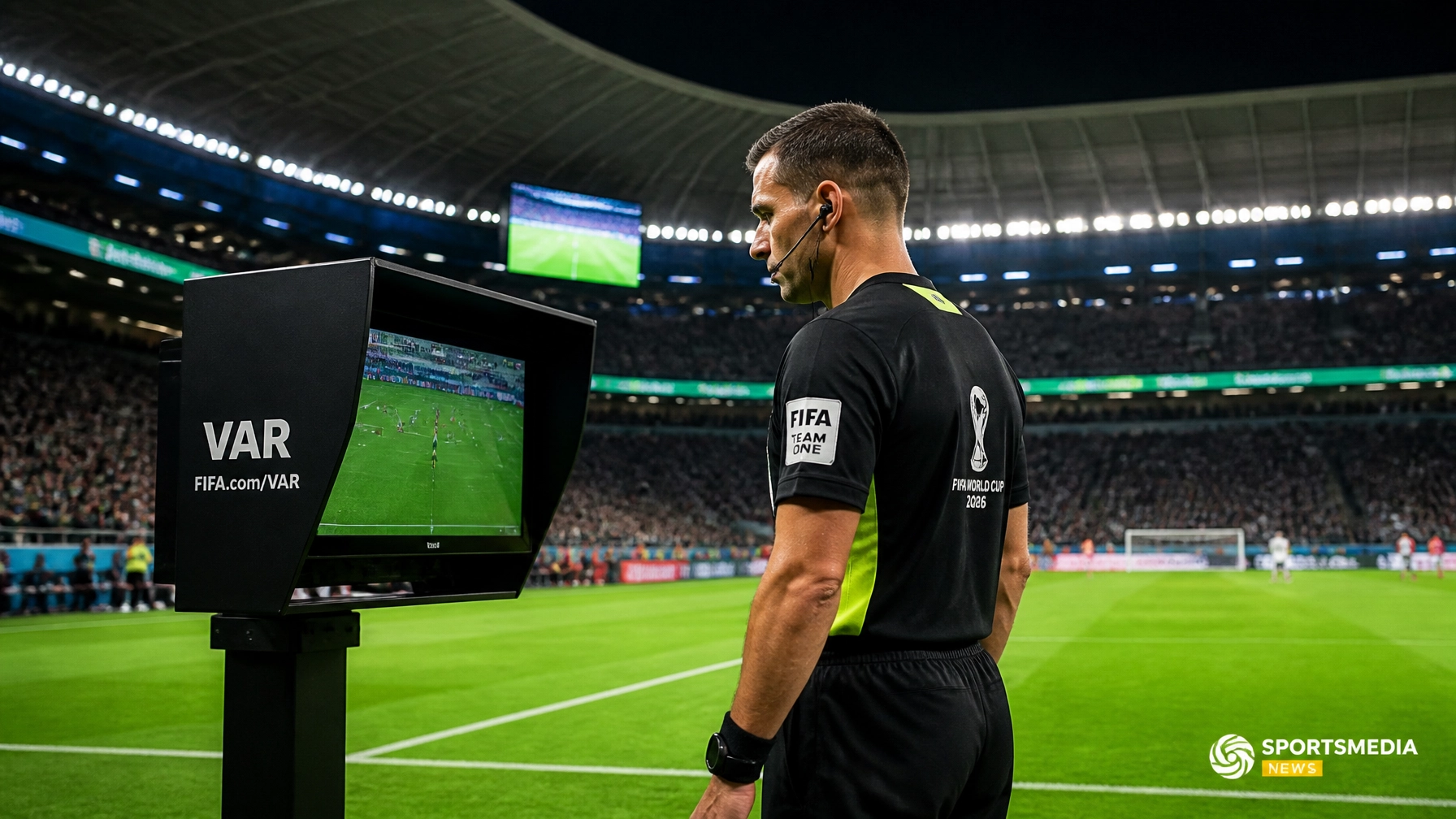
From strong match management and timely VAR interventions to controversial calls and accusations of bias, officiating has shaped how this tournament will be remembered.
By Mark Ricci | July 8th, 2026
Referees have been at the center of some of the best and worst moments of the 2026 FIFA World Cup, shaping how matches are remembered and how fans feel about the tournament. Their performance has combined strong overall control and innovative new rules with a handful of high‑profile controversies that have sparked intense debate.
Referees and new rules in 2026
For 2026, FIFA introduced a broad set of law changes aimed at speeding up matches and reducing game‑changing mistakes. The refereeing team, led by Pierluigi Collina, has implemented measures such as stricter limits on time‑wasting, tighter substitution rules, and expanded use of video review for offsides, corners, second yellow cards, and mistaken identity.
These changes give referees more tools to manage matches and rely on technology, but they also increase the number of judgment calls they must make under pressure. As a result, some of the tournament’s best refereeing moments stem from the smart use of these tools, while many of the worst moments stem from controversial applications of VAR and new laws.
Best moments: control, flow, and fair use of VAR
Strong match management and game flow
Several referees have been praised for allowing physical yet fair contests while keeping control:
Analysts have highlighted how officials in the early rounds balanced discipline with flow, issuing red cards when necessary for serious fouls or confrontations but otherwise letting robust play continue.
The new anti‑time‑wasting rules- like turning excessively delayed goal‑kicks into corners, forcing quick substitutions, and briefly excluding players who fake injuries- have been applied effectively in many matches, producing faster, more continuous football.
These moments stand out as “best” because they show referees using new powers in ways that improve the spectacle without constantly stopping play.

High‑rated performances
Independent referee rating lists after the round of 16 have given top officials very high scores, praising:
- Clear communication with players and benches.
- Consistent use of advantage and disciplinary measures.
- Confident integration of VAR to confirm key decisions without over‑reliance.
In these games, there were few major complaints about officiating, and referees were largely seen as quietly contributing to fair outcomes rather than overshadowing the football.
Correct, if painful, offside, and foul calls
Some of the “best” moments are technically correct decisions that were emotionally hard for fans:
Tight offside calls, sometimes by a toe or a millimeter, have been used to disallow goals in stoppage time or key group matches, including late efforts by Iran and Colombia that would have changed qualification scenarios. In replays, these were shown to be offside under current law, even if by the smallest margin.
VAR has also correctly intervened on fouls during attacking build‑ups, overturning goals when attackers commit small but genuine infringements, such as contact with defenders before winning the ball.
From a rules perspective, these moments reflect referees and VAR teams doing their jobs precisely; supporters of technology see them as proof that the system can deliver accurate decisions even in chaotic late‑game situations.

Worst moments: controversial VAR interventions and missed calls
Despite many solid performances, some referee moments have been widely criticized and are likely to define the tournament’s “worst” officiating memories for many fans.
Disallowed goals that changed team fortunes
Several high‑profile goals have been ruled out after VAR checks, leading to anger and accusations of unfairness:
Iran’s stoppage‑time goal against Egypt was disallowed for offside after a long VAR review, denying Iran a historic place in the knockouts. Replays showed the attacker offside by a tiny margin, but many felt the emotional cost and the delay made the decision hard to accept.
Colombia and other teams have seen late goals ruled out by extremely tight offside calls or marginal fouls in the build‑up, leaving players and fans feeling “robbed” even though the decisions aligned with current interpretations.
These moments are often cited as among the worst because they combine high stakes, huge swings in outcomes, and a sense that technology is punishing teams for infractions that feel invisible in real time.
Missed penalties and non‑interventions
Equally controversial are incidents where VAR did not intervene:
Ghana’s match against England featured a challenge in which Ezri Konsa appeared to bring down Prince Kwabena Adu in the box without touching the ball. The referee did not award a penalty, and VAR stayed out of it, prompting Ghana’s coach to joke that “VAR went for a coffee.”
Other group‑stage matches have seen what many fans regarded as obvious fouls or handballs go unpunished, despite slow‑motion replays showing clear contact.
To critics, these non‑interventions are among the worst moments because they undermine trust in VAR’s promise to correct “clear and obvious” errors. The perception of inconsistency: stepping in for some tight calls but not others: fuels claims that refereeing standards are poor or biased.

Soft or debated foul calls in big matches
Some disallowed goals and free‑kick decisions have hinged on fouls many see as “soft”:
In at least one Brazil match, Vinícius Júnior had a goal overturned after VAR ruled he fouled a defender while winning the ball, even though the contact appeared minimal and ordinary in the context of a physical game.
Leroy Sané’s early goal for Germany against Ecuador stood despite complaints about a high boot in the build‑up, leaving Ecuador’s players and fans feeling that an important foul had been ignored.
These incidents are remembered as poor refereeing moments because they showcase the subjective side of officiating: what counts as a foul or fair challenge, and how those subjective calls can carry enormous consequences.
Broader controversy and accusations of bias
The cumulative effect of these contentious calls has produced wider criticism:
Egyptian officials and media, reacting to decisions in their knockout defeat to Argentina, have filed complaints and accused referees and VAR of favoring Argentina, fueling narratives that the tournament is “directed” toward certain powers.
Fans online have compiled lists of “worst refereeing” matches, citing dives not punished, physical fouls missed, and uneven application of law changes such as new red‑card powers for confrontations and protests.
These reactions show how individual mistakes or contested decisions can merge into a broader story that refereeing at this World Cup is flawed or biased, even when most matches are handled competently.
Why these moments matter so much
Referee decisions at the World Cup carry unusual weight because:
Many matches are decided by a single goal, so a single offside call or a penalty call can determine who advances.
New laws and expanded VAR authority make officiating more visible than ever; delays, reviews, and explanations put decisions under a microscope.
Fans and national federations invest enormous emotion and pride in the tournament, making them less forgiving of perceived errors or injustices.
The best refereeing moments in 2026 are those in which officials quietly apply complex rules, manage heated games, and use technology to ensure fairness without overshadowing the play. The worst are those where tight calls, missed interventions, or unclear standards appear to change the course of matches, leaving players and supporters convinced that human judgment or technology has failed them.
Mark Ricci is a senior contributor for Sportsmedia News, specializing in international soccer, tournament officiating, and the global game.