


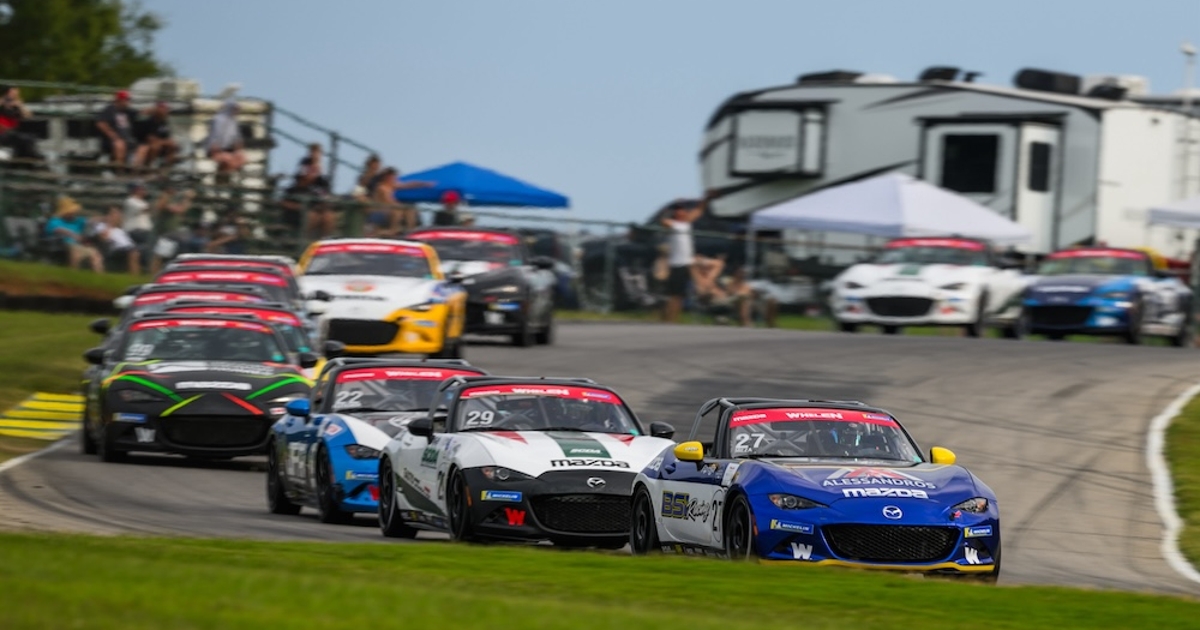
Helio Meza kind of fell into the Mazda Motorsports ladder and Whelen Mazda MX-5 Cup Presented by Michelin. But as it turns out, the series has boosted his skills like no other form of car racing he’s tried.
“I would say it’s probably the series that I’ve learned the most in cars. I mean, the field is super tight,” he says, adding that, because it’s a spec class, it allows a driver’s talent to shine and develop.
“You’re always going to be racing against someone in the pack. When I first started at the beginning of the year, I was kind of a mid-pack guy, but still racing against really great drivers. And then as you move forward and progress, you go up against guys who’ve been racing for a long time, like Jared Thomas, Tyler Gonzalez, Gresham Wagner… All these guys have a ton of experience, not only in this series, but they’ve raced a bunch of stuff over the years as well. I feel like you learn so much just being around them on the track.”
Meza wasn’t familiar with Mazda’s ladder or scholarship system until he was invited to the end-of-season Mazda Shootout after some success in karting. He won a Spec MX-5 Scholarship for the 2024 season and then returned for a second Mazda Shootout at that year’s end, netting the MX-5 Cup runner-up prize to race in the 2025 series.
“My family never really came from a lot of money, at least for the racing life, and so we were always picking up the scraps in karting – using old equipment, using tires out of the trash can to save money, to just make it as far as we could,” he recounts. “And when I got nominated for Spec MX-5, we were debating whether we should keep racing or not, or what the next step would be.”
Lack of money was one obstacle Meza had to overcome. Another was a hearing issue – Meza was born with bilateral microtia atresia, a condition in which the inner ear is absent or not fully developed – there’s no connection from his outer ear to his eardrum.
“When I was three or four months old, with the help of doctors, I was able to get a bone conduction hearing aid, and kind of wore that on a headband. It wasn’t until I was seven years old where I got surgery and got a bone anchored hearing aid implant, and that’s how I’m able to hear today,” he explains.
There was just one problem – the external part of the hearing aid wouldn’t fit when he was wearing a helmet. In karting, it was less of an issue – he could feel the vibrations. But moving into cars, there was no way for him to listen to a radio and have communication from the pits or a spotter.
“We reached out to many companies, and we were never really able to get help from anyone,” Meza says. “And so, my dad – I’m super grateful to have him – he came up with a bone-conduction system that we put inside of my racing helmet that has allowed me to hear my team and spotter whenever I’m in the car. It’s been a winding road to get where I am today, to allow me to do what I love. But thanks to the doctors and my dad, I’ve been able to chase my dreams so far.