


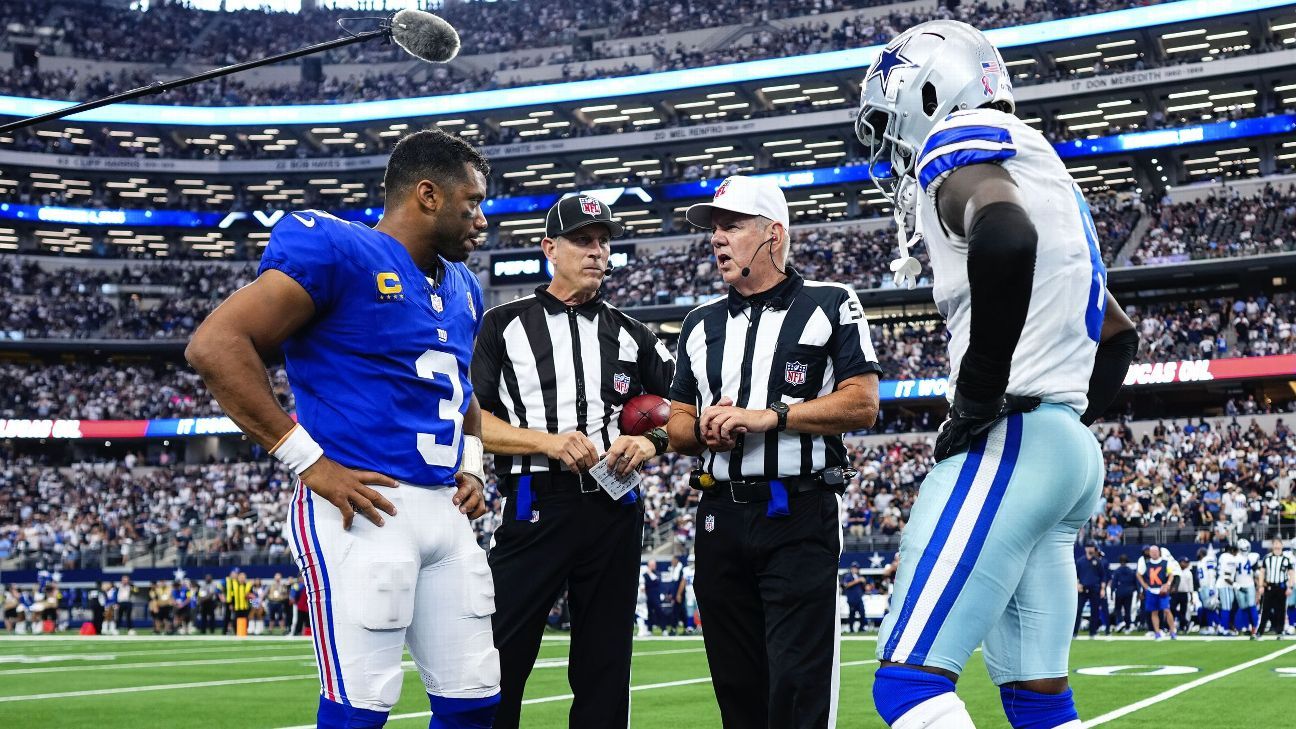
We got our first overtime frame of the 2025 NFL season in Week 2, when the New York Giants and Dallas Cowboys ended regulation tied at 37 after three scoring plays in the final minute. The Giants won the coin toss in overtime and chose to have the second possession. Neither team scored on their first drive — Dallas ultimately won on a 46-yard field goal with just 4 seconds left in overtime — but it brought up a question: Should NFL coaches take the ball first or second in OT? We say they should take it first — but it’s a close call and there are arguments for both sides.
From 1974 to 2011, overtime was sudden death, good and proper. First team to score wins. Winning the coin toss and taking the first possession was accordingly always optimal. Even after 2012, when the NFL adjusted the regular-season rules to give the second-possession team a drive after a first-possession field goal, it was still optimal to take the ball first, because a touchdown ended the game. Since 2012, there have been 201 overtime coin tosses — only two winners elected to kick off, and only three winners deferred the choice to pick a side of the field to defend. There was rarely any thought to the decision.
Until now. In 2025, the NFL is adopting the postseason overtime rules they’ve used for the past few seasons during the regular season. A first-possession touchdown no longer ends the overtime period. Short of a defensive score (or a possession that lasts the entire 10-minute extra period), both offenses will now possess the ball. If, at the end of each first possession, the score remains tied, then the next score wins. Should the 10-minute overtime period expire with the score still deadlocked, the game ends in a tie.
We saw something close to this overtime format play out in Super Bowl LVIII between the Kansas City Chiefs and San Francisco 49ers. It wasn’t exactly analogous, as playoff games can’t end in a tie — but the difficulty of the decision remains. There are advantages to taking the ball first and advantages to taking the ball second, and they aren’t concrete. They change relative to both opponent team strength and opponent behavior. In the case of the Chiefs and 49ers, San Francisco’s decision was heavily scrutinized after the team’s overtime loss. But more significant than the specifics of the choice was the fact that few on the outside — and even few among the 49ers — totally understood all of the dynamics at play.
As such, ESPN surveyed analytics staffers from nine NFL teams with a series of questions about the new regular-season overtime rules for the 2025 season. This year marks the first regular season in which the overtime coin flip decision is a meaningful moment — one in which sharp teams might find an edge. But as our survey shows, those edges still aren’t totally clear.
Jump to:
Right coin-toss choice | Actual coin-toss choice
SBLVIII effect | First or second possession?
Other factors | Go for two? | Direction over ball?
When teams win the coin toss, what should they choose?
Responses:
Lean first possession, but matchup factors could make second possession feasible (3 votes)
Lean second possession, but matchup factors could make first possession feasible (3 votes)
Almost always first possession (1 vote)
Almost always second possession (1 vote)
True 50-50 (1 vote)
Teams are split on this decision. The survey response above indicates that NFL analytics teams are coming to different conclusions about the best strategy. It’s understandable, because there are countervailing forces at play, and each option offers a potential advantage.
The second possession team has the advantage of knowing what the first possession team did on its drive. If the first possession team scored a touchdown, the second possession team knows it must go for any and all fourth downs — which can provide a playcalling advantage on third down, too, when the offense knows it doesn’t have to reach the line to gain because it will have another shot. If the first possession team failed to score, the second possession team knows it can kick a short field goal, even on a fourth-and-1.
But the first possession team also has an edge: It receives the ball in any potential third possession and it can shorten the second possession with a long opening drive. If neither team scores in the first two drives, or the teams trade field goals, then the first-possession team gets the ball back in a true sudden-death scenario.
This is the kind of question where quantitative analysis helps. But as the results above show, different analysts can come up with different responses to the same question. So what does ESPN Analytics’ model show?
The short answer is it favors taking the first possession, but there’s more to it. In fact, a lot of the decision hinges on touchbacks. In another critical rule update, touchbacks are now coming out to the 35-yard line (up from the 30-yard line last season), and the expected rate of the touchback changes this analysis.
If touchbacks continue near the 64% rate they occurred last season, then our simulation model would estimate the first-possession team’s net chances to win at 53.6%. But touchbacks will likely be less frequent given the yard-line change. If touchbacks drop to, say, a 40% rate, then we would estimate a 52.6% net win probability for the first-possession team. If it falls to 10%, then the first-possession team would have a 50.9% net win probability.
This is because having the ball at the 35 helps the first-possession team. If they are forced to punt or commit a turnover, it will be farther downfield — thus lessening the probability of a second-possession score and improving field position for a third possession.
But what is truly relevant isn’t the leaguewide average touchback rate; it’s the touchback rates for a team and its opponent. And the team kicking off has significant control over whether there is a touchback. In other words, if a team chooses to kick, it can do so knowing it is trying to avoid a touchback (though this could cost it a couple of yards if the kick is short). Sharp teams that win the coin toss against touchback-heavy opponent kickers might elect to take the first possession, hoping to start way up at the 35.
Ultimately, if we were filling out the survey, we would respond with: