


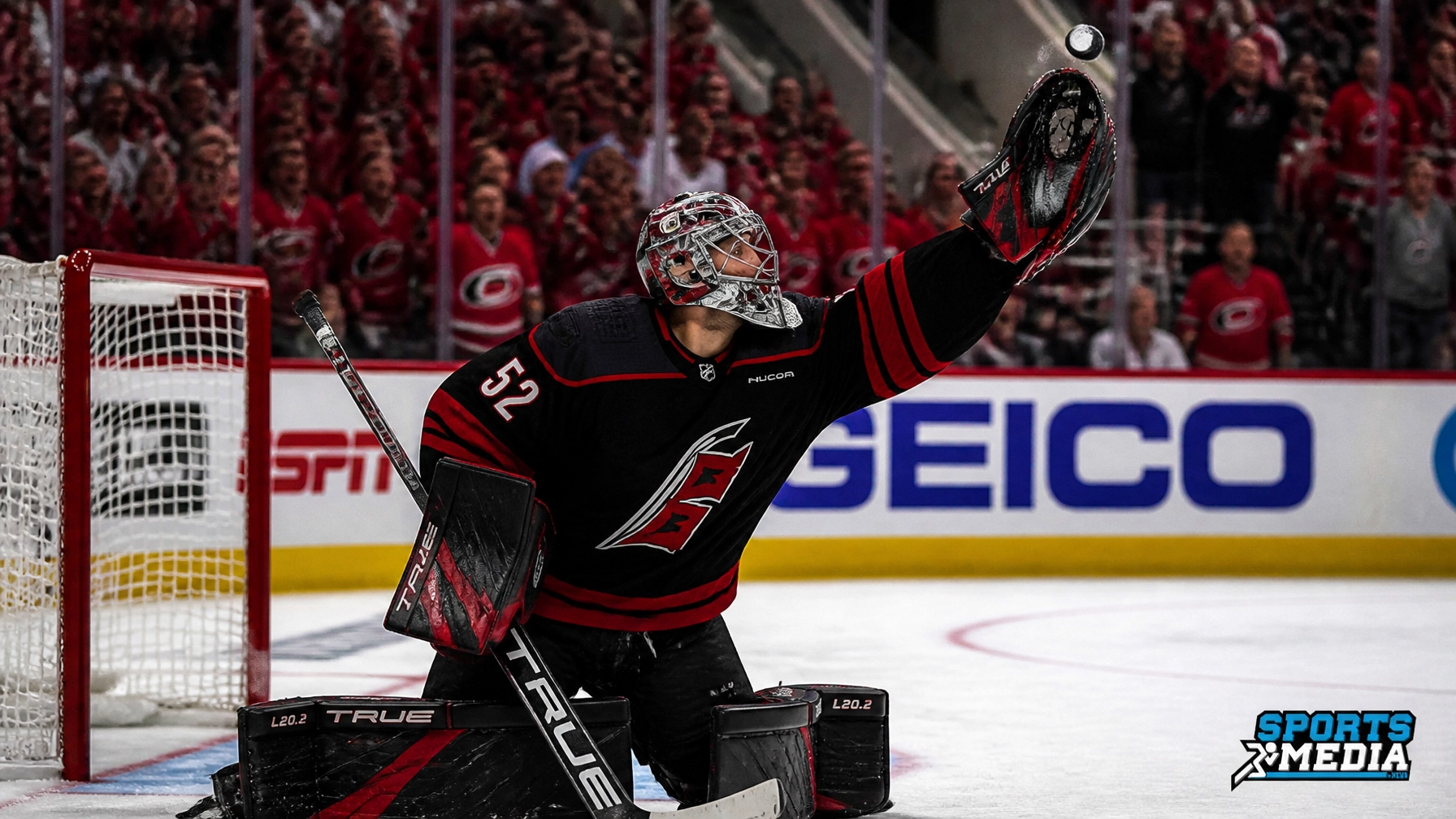
A high-stakes goaltending gamble pays off as Carolina stifles Vegas’ offense to even the series at two games apiece.
RALEIGH, NC : The Carolina Hurricanes entered Game 4 of the Stanley Cup Finals on June 9, 2026, facing a deficit that felt as much psychological as it was statistical. Down 2-1 in the series against a relentless Las Vegas Golden Knights squad, Hurricanes management faced a choice that would either define their season or accelerate their exit: stick with veteran Frederik Andersen or trust a rookie in the most hostile environment in professional sports.
The decision to start Brandon Bussi: a waiver-wire pickup from early 2025 who had only recently emerged as a reliable NHL asset: proved to be the catalyst for a 5-3 victory that has leveled the series at 2-2. The win not only shifts the competitive momentum back to Raleigh but also carries significant financial implications for a franchise eyeing the massive revenue surges associated with a deep playoff run and potential championship merchandising.
The Strategic Pivot
The goaltending narrative dominated the pre-game discourse. Andersen, a cornerstone of the Hurricanes’ defensive identity, had struggled mightily in Game 3, allowing four goals on just 16 shots before being pulled. Reports also indicated Andersen had sustained undisclosed minor hits that may have hindered his lateral movement.
"In a high-stakes series like the Stanley Cup Finals, the 'sunk cost fallacy' can be a team's undoing," says Dr. Aris Velasquez, a sports management consultant specializing in playoff strategy. "By starting Bussi, the Hurricanes coaching staff prioritized current performance over historical reputation. It was a $5.7 million bet on a young player who has shown he can handle the pressure of the big stage."
Bussi, making his first career playoff start, entered the crease with the weight of the franchise on his shoulders. The move was a calculated risk, but one that signaled the organization’s willingness to pivot in the face of dwindling odds.
Establishing Early Dominance
Carolina’s offensive unit responded to the goaltending change with immediate intensity. In the first period, the Hurricanes’ forecheck overwhelmed the Knights’ defensive pairings, leading to an early lead that quieted the vocal Vegas supporters in attendance.

Logan Stankoven opened the scoring for the Hurricanes, assisted by Jalen Chatfield and Jackson Blake. The goal was a product of high-speed transition play, a hallmark of the Hurricanes' strategy this season. The lead doubled shortly after when Jackson Blake found the back of the net himself, with assists from veteran Taylor Hall and Nikolaj Ehlers.
The Knights managed to stay within striking distance through a goal by Mark Stone, assisted by Shea Theodore and Brayden McNabb. However, Carolina captain Jordan Staal restored the two-goal cushion during a critical power play, capitalizing on assists from Shayne Gostisbehere and Sebastian Aho. By the end of the first period, the Hurricanes held a commanding 3-1 lead, successfully executing their plan to force Vegas into a defensive posture.
The Knights' Counter-Attack
The second period showcased the resilience of the defending champions. Vegas utilized their veteran depth to chip away at the Hurricanes’ lead, turning what looked like a blowout into a defensive "arms race."

William Karlsson narrowed the gap to 3-2, assisted by Rasmus Andersson and Mitch Marner. The momentum shift was palpable, and the Knights’ physical play began to test the rookie Bussi. Brett Howden eventually tied the game 3-3, with assists from Colton Sissons and Karlsson. The second period ended in a stalemate, setting the stage for a final twenty minutes that would determine the trajectory of the entire series.
"This is where the business of hockey meets the psychology of the game," noted Sarah Jenkins, a senior marketing executive at a leading sports firm. "For the Hurricanes, a loss here wouldn't just mean a 3-1 series hole; it would mean a significant hit to the 'hope index' that drives secondary market ticket sales and local sponsorship engagement. They needed a hero."
Leadership in the Clutch
The third period belonged to the Hurricanes' leadership core. Jordan Staal, who has been the emotional heartbeat of the team throughout the 2026 post-season, scored his second goal of the night on an assist from Nikolaj Ehlers. The goal broke the 3-3 tie and sent the Carolina bench into a frenzy.
As the clock wound down, the Knights pulled their goaltender in a desperate attempt to force overtime. The gamble failed when Nikolaj Ehlers secured an unassisted empty-net goal, sealing the 5-3 victory and the "flawless" finish the Hurricanes needed to regain control of the narrative.

Economic and Series Implications
With the series now tied 2-2, the focus shifts back to Raleigh for Game 5. The return to home ice is expected to generate record-breaking gate receipts for the Hurricanes. Historically, a tied series entering Game 5 increases the projected TV viewership by 25-30% as the "must-win" stakes become a primary draw for casual fans.
The issue of the starting goaltender remains the most pressing question for the remainder of the series. While Bussi’s performance was stellar, the decision to continue with a rookie over a healthy Andersen involves weighing short-term momentum against long-term experience.
"The Hurricanes have effectively reset the clock," says Velasquez. "By leveling the series, they’ve ensured at least two more games of high-revenue playoff hockey. From a business perspective, the Bussi start was a masterclass in risk management."
The Hurricanes have two more games to secure the championship. Whether they continue to ride the "hot hand" of Brandon Bussi or return to the veteran Andersen will likely be the deciding factor in who lifts the Stanley Cup in 2026.
By: Lillian Castor