


By Jacob Potter
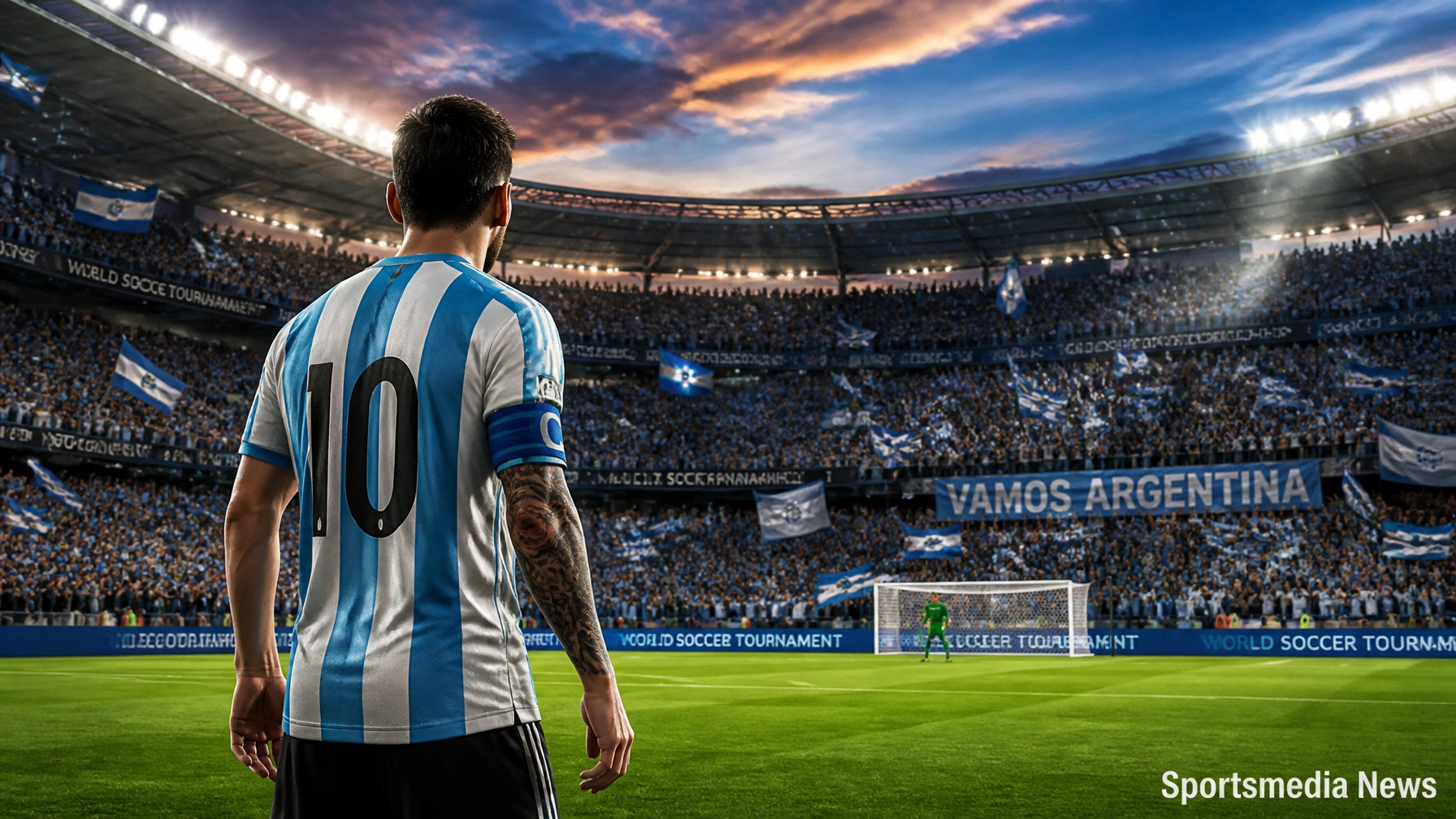
As the 2026 FIFA World Cup reaches its penultimate stage, the focus of the sporting world has narrowed to Atlanta Stadium. Argentina is set to face England in a high-stakes semi-final that could see Lionel Messi further cement a legacy that many already consider unmatched. At 39 years old, the Argentinian captain has defied the traditional trajectory of a professional athlete, leading his nation through the tournament with a blend of tactical intelligence and the same playmaking genius that has defined his career for over two decades.
Messi entered this tournament having already achieved the ultimate prize in Qatar four years ago, yet his hunger appears undiminished. He recently became the all-time World Cup top scorer, surpassing records that stood for generations. His performance in the quarter-final against Switzerland, a 3-1 extra-time victory where he recorded a record-breaking tenth career World Cup assist, served as a reminder of his enduring impact. This journey, however, did not begin under the bright lights of American stadiums, but on the dusty streets of Rosario.
The Rosario Roots
Born on June 24, 1987, in Rosario, Argentina, Lionel Andrés Messi was immersed in a footballing culture from birth. His earliest steps in the game were taken at Grandoli, a local neighborhood club where he was coached by his grandmother, Celia. It was Celia who famously pushed the local coaches to give the undersized boy a chance against older children.
"He was so small, but once he had the ball, you couldn't get it off him," recalls one of his early coaches in Rosario. This early encouragement from his grandmother left a lasting mark; to this day, Messi celebrates his goals by pointing to the sky in tribute to her. At age seven, he joined Newell's Old Boys, one of Rosario’s two major clubs. During his six years at Newell's, he was part of "The Machine of '87," a legendary youth team that lost only a handful of games.

However, the path to professional stardom was nearly derailed when Messi was diagnosed with a growth hormone deficiency at age 11. The cost of the necessary treatment: roughly $900 a month: was a significant burden for his family, and local Argentinian clubs were either unable or unwilling to commit to the long-term financial support required. This medical necessity eventually became the catalyst for his move to Europe.
The Napkin that Changed History
The story of Messi's arrival at FC Barcelona is now a staple of sporting folklore. In September 2000, a 13-year-old Messi traveled to Spain for a trial. While his talent was immediately evident to the technical staff, the club's board was hesitant to sign such a young foreign player, particularly given the medical costs involved.
The impasse was broken in December 2000 at a tennis club cafe. Carles Rexach, Barcelona's sporting director at the time, was so desperate to secure the boy's signature that he drafted an agreement on a paper napkin. The makeshift contract stated that Barcelona would pay for Messi's hormone treatments and facilitate his family's move to Spain.

"In Barcelona, on the 14th of December of 2000… Minguella and Horacio, Carles Rexach, technical secretary of FCB, is committed under his responsibility… to sign the player Lionel Messi," the document read. This napkin, now one of the most valuable pieces of memorabilia in sports history, allowed Messi to enter La Masia, Barcelona’s famed youth academy. He rose through the ranks with unprecedented speed, making his first-team debut in 2004 at the age of 17.
An Era of Dominance in Catalonia
What followed was 17 seasons of statistical dominance that restructured the record books of European football. During his tenure at Barcelona, Messi secured 10 La Liga titles, four Champions League trophies, and seven Copa del Rey titles. He departed the club in 2021 as their all-time top scorer with 672 goals, a figure that many analysts believe will never be surpassed in the modern era.
His individual accolades are equally staggering. Messi has won eight Ballon d'Or awards and six European Golden Shoes. Experts often point to his 2012 calendar year, in which he scored 91 goals, as the pinnacle of individual achievement in the sport.
"Messi is the only player that is better than he is in the PlayStation," Arsène Wenger, the former Arsenal manager, once famously noted. This sentiment reflects the "unmatched dribbling and vision" that the prompt highlights. His style is characterized by a low center of gravity, allowing for rapid changes in direction, and a "left-footed genius" that can thread passes through defensive lines that other players do not even perceive.
International Redemption and the World Stage
For much of his career, a perceived lack of international success was the only criticism leveled against him. He faced the heartbreak of being a World Cup runner-up in 2014, where he won the Golden Ball but lost the final to Germany. The pressure from the Argentinian public was immense, leading to a brief international retirement in 2016.
The narrative shifted dramatically in 2021 when Messi led Argentina to a Copa América title, ending the country's 28-year trophy drought. This victory set the stage for the 2022 World Cup in Qatar. As captain, Messi provided seven goals and three assists, scoring in every knockout round, including twice in the final against France. Lifting the trophy in Lusail Stadium was the crowning moment of his career, finally aligning his international achievements with his club success.

His success continued into 2024, where he captained Argentina to a second consecutive Copa América title. This period of international dominance has transformed him from a sporting icon into a national hero whose influence transcends the pitch.
The American Chapter and the 2026 World Cup
Following a two-year stint at Paris Saint-Germain (2021–2023), Messi made the high-profile move to Major League Soccer (MLS), joining Inter Miami. His arrival in the United States has been credited with a massive surge in soccer's popularity across the country, ahead of the 2026 World Cup co-hosted by the U.S., Canada, and Mexico.
At Inter Miami, Messi's presence was immediate, leading the club to its first-ever trophy in the Leagues Cup shortly after his arrival. While his physical speed has naturally adjusted with age, his playmaking ability has remained elite.

"He now starts deeper, combining short, low-risk touches to draw pressure with sudden vertical passes into runners," noted tactical analysts during the current 2026 campaign. This evolution has allowed him to remain the focal point of the Argentinian national team even at 39. In the current 2026 World Cup, Messi has recorded 20 passes leading to shots on goal, the highest in the tournament. He is the first player since 1966 to reach at least 20 such passes in three different World Cups (2014, 2022, and 2026).
As Argentina prepares for the semi-final against England, the world watches a player who has successfully navigated the transition from a teenage prodigy to an elder statesman of the game. Despite his status as a "mega-star," his personality remains that of a "humble, family man" who is "fiercely competitive" on the field.
The match in Atlanta represents another chapter in a story that began in Rosario. Whether he reaches another final or not, the journey of Lionel Messi has already redefined the parameters of greatness in professional sports. For more in-depth coverage of the 2026 World Cup and player profiles, visit our articles section or contact us for media inquiries.