


By Mark Ricci | June 18th, 2026
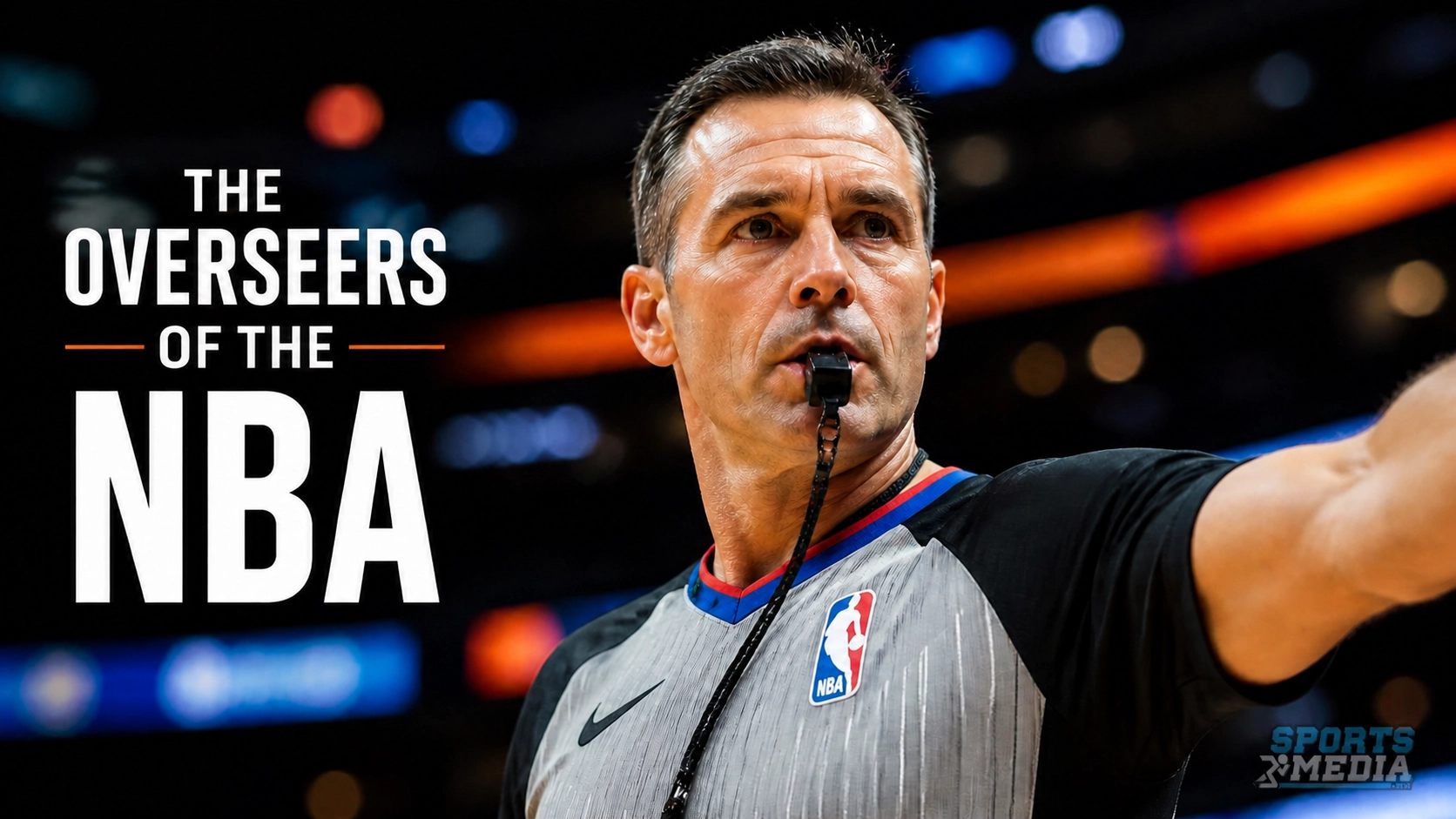
NBA referees in 2026 sit at the center of a league that is faster, more scrutinized, and more data‑driven than ever before. In an era where every movement is tracked by high-fidelity sensors and every decision is dissected by millions on social media, these officials are tasked with a nearly impossible directive: apply an evolving rule book in real-time, maintain competitive integrity, and withstand a level of public and media evaluation that has never been more intense.
As the NBA innovates its format and game-play, the "third team on the court" finds itself under a microscope that extends far beyond the hardwood.
The Role of NBA Referees in 2026
NBA officials manage a massive operational workload: 30 teams, 1,260 regular‑season games, four rounds of high-stakes playoffs, and constant motion on every single possession. Those figures reflect the standard schedule for a 30‑team NBA season, but they do not capture the mental and physical toll of maintaining "NBA speed" for 82 games and beyond. League and union materials describe these officials not merely as rule enforcers, but as the guardians of the game’s integrity: individuals who must make live decisions at accuracy levels that rival the precision of the athletes they monitor.

According to the National Basketball Referees Association (NBRA), NBA officials currently “make calls with 95% accuracy,” a figure the organization frequently highlights in its public biographies and outreach materials. While critics may point to high-profile misses, this 95% metric is the benchmark for the professional standard. This performance is monitored relentlessly by the league’s Referee Operations group through synchronized video review and internal grading on a play‑by‑play basis, ensuring that the justice prevailing in other leagues is mirrored in the officiating of the NBA.
Training, Development, and Points of Emphasis
Each year, the NBA updates its "Points of Emphasis," a set of focus areas intended to clarify how existing rules should be enforced to keep the game safe and fluid. For the 2025–26 season, the league released a dedicated Points of Emphasis video series, narrated by Senior Vice President and Head of Referee Development and Training Monty McCutchen, to explain those priorities to officials, teams, and the public.
Reporting on the 2025–26 season points of emphasis highlights several key themes designed to clean up specific areas of the game:
- Protecting the Shooter's Landing Space: Officials have been instructed to be hyper-vigilant regarding defenders invading the landing space of jump shooters. This safety-first initiative aims to reduce ankle and lower-body injuries, treating reckless closeouts as defensive fouls or even flagrant penalties.
- The "High-Five" Principle vs. Secondary Swipes: A major point of clarification involves contact on shooters. While a "high-five" (contact with the hand after the ball is released) remains incidental and legal, referees are now trained to penalize "secondary motions": extra swipes through the shooting arm or wrist that occur after the initial contest.
- Straight-Line Pathway Plays: This area deals with the "arms race" between elite drivers and defenders. The league is emphasizing how defenders can legally establish or obstruct a straight‑line driving path while keeping their bodies in legal guarding position. Conversely, officials are tasked with identifying and ignoring exaggerated offensive movements and flops.

Officials spend the preseason and the early portion of the regular season reviewing thousands of hours of video, attending clinics, and integrating these points of emphasis into their nightly work as part of the league’s ongoing education and development program.
Evaluation, Accountability, and Transparency
Contrary to a common perception among some fanbases, NBA referees are among the most extensively graded professionals in the world. The internal system is a massive data-harvesting operation where no whistle goes unexamined.
League reporting describes an internal infrastructure in which every game is reviewed on video, and officials are graded on every call and many notable "non‑calls." Referee Operations staff utilize a combination of multi-angle video and proprietary data to assess performance. These officials receive game‑specific feedback and broader performance summaries; their evaluations incorporate accuracy data and assessments of positioning and mechanics. Even coach feedback, provided through formal league channels, can be a component of the broader evaluation process.
Veteran referee Scott Foster has publicly emphasized that officials are “graded on every single play” and that accountability has increased “astronomically” since he entered the league in 1994. While the bulk of this grading data remains confidential, its impact is felt in the postseason. These evaluations directly influence assignments, including who is selected for playoff and Finals crews. High-performing officials: those with the highest accuracy in Point-of-Emphasis categories: are the ones who work deep into June.
Data, Analytics, and Referee Profiles
The rise of referee analytics means that teams, media, and fans track officials more closely than they track players in the college football playoffs. Independent stat services now publish game‑by‑game referee data for the 2025–26 season, allowing observers to examine trends such as personal‑foul rates, technical fouls, and home/road splits by official or crew.

The NBRA and NBA Official websites maintain biographies and up‑to‑date rosters, highlighting the diverse backgrounds of the staff. The 2026 roster includes veteran staff alongside a rising wave of officials drawn from high‑level college ranks, the G League, WNBA, and international circuits. This "innovation" in recruitment has created a more global and technically proficient officiating pool.
Academic research also plays a role in modern officiating. Recent large‑scale studies of NBA play‑by‑play data have found that historical "home‑team bias" has decreased significantly since the 2020 season. Furthermore, studies have shown no evidence of racial bias in technical‑foul calls in the modern era, illustrating both the scrutiny officials face and the success of the league’s anti-bias training programs.
Public Perception and Ongoing Debate
Even with 95% measured accuracy and intensive internal evaluation, NBA referees in 2026 operate under a blinding spotlight. The combination of social media, legalized sports betting, and increasingly sophisticated fan analysis has turned many borderline calls into instant national controversies.

The debate over transparency has reached the highest levels of the sport. Players and media figures, including Stephen Curry, have argued for a more "public" version of the referee grading system. Curry has stated that he would "probably want to see the refs’ grading system… more public," suggesting that seeing a referee's "report card" would help fans and players understand what constitutes a high‑performing official.
However, the NBRA has expressed significant caution. The union has warned that certain forms of public transparency: such as the Last Two Minute (L2M) Reports: can be misused to mobilize anger against specific officials, potentially putting them at risk of harassment. The balance between public accountability and official safety remains one of the most contentious issues in the league office.
A System of Perpetual Scrutiny
What is clear is that in 2026, NBA referees are not just enforcing rules; they are working inside a highly structured, data‑heavy system designed to measure, critique, and continually improve their performance. The league has moved toward a model where "innovation" is as much about the accuracy of the whistle as it is about the speed of the game.
While debates over officiating quality and fairness remain a permanent feature of the modern NBA conversation, the infrastructure behind the scenes reveals a group of professionals working at the limits of human perception. In a league defined by star power, these "overseers" remain the essential, if often criticized, foundation upon which the game’s integrity rests.
By Mark Ricci
Mark Ricci is a senior sports business contributor for Sportsmedia News, specializing in league governance, officiating trends, and the intersection of data and athletic performance. With experience covering the professional basketball landscape, Ricci provides deep-dive analysis into the institutional structures that shape the modern game.