


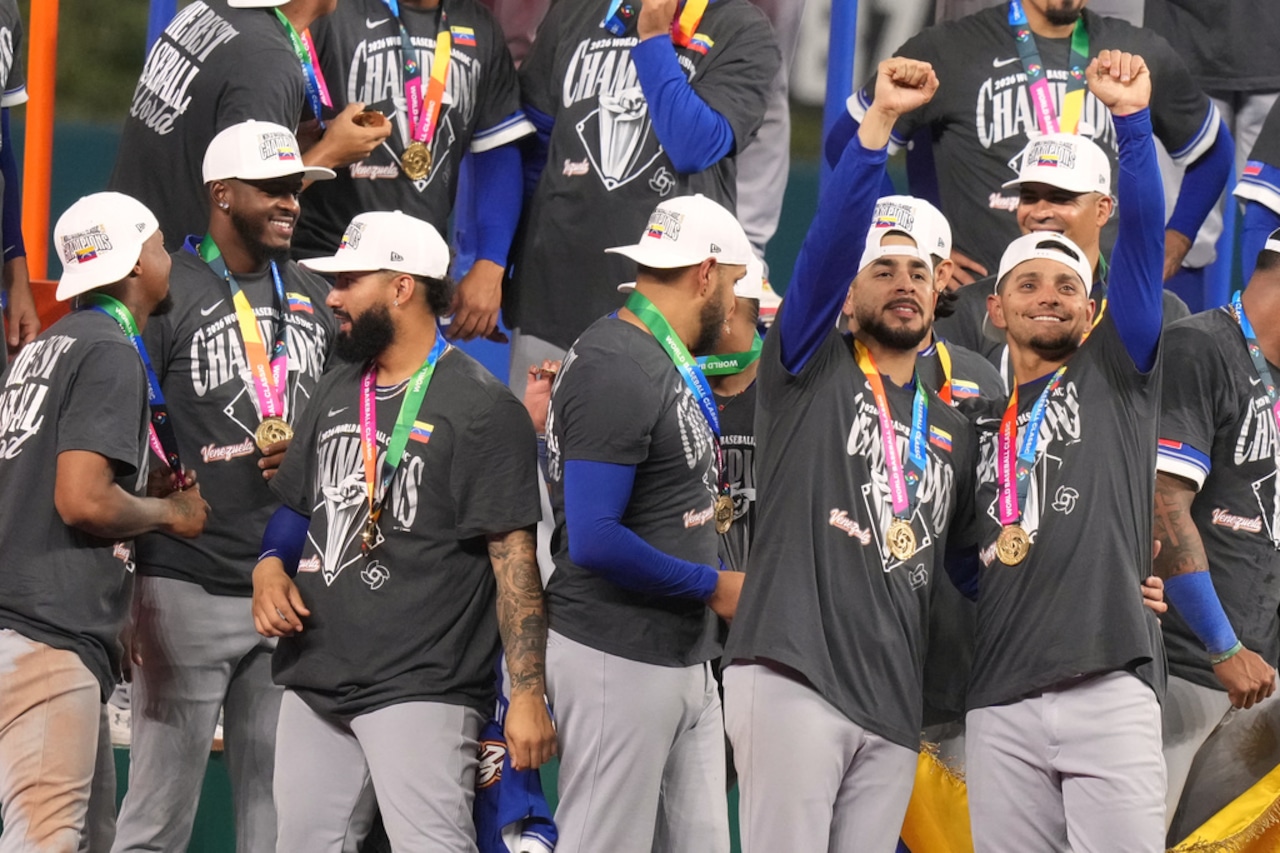
CLEVELAND, Ohio — Forget the score for a moment. Forget the lineups and the pitch counts and the spring training caveats. What happened when Venezuela knocked off a star-studded Team USA to win the World Baseball Classic championship was something that transcended box scores — and the latest episode of the Cleveland Baseball Talk Podcast made absolutely sure you understood why.
The final was 3-2. Eugenio Suarez delivered the dagger with a late RBI double. Bryce Harper gave the Americans a brief, electric lifeline with a tie-breaking home run in the eighth. And then — just like that — Venezuela finished the job in the ninth. Eduardo Rodriguez, the crafty left-hander, was brilliant on the mound. Team USA, assembled from a dream-lineup of the sport’s biggest names, never got its powerful offense untracked.
In the aftermath, beat reporters Joe Noga and Paul Hoynes on the Cleveland Baseball Talk Podcast asked the question nobody could sidestep: was this baseball’s Miracle on Ice?
Noga didn’t shy away from the comparison — or from acknowledging what it meant far beyond the diamond
“To see the passion and the joy and what it meant to those players and to that country to win that championship, it’s definitely the biggest sports moment in the history of Venezuela,” Noga said. “You’ve got to consider it that.”
The biggest sports moment in the history of Venezuela. That’s not hyperbole carelessly tossed into a conversation. That’s a statement that lands with full, devastating weight when you consider what’s happening in that country right now — the economic devastation, the political turmoil, the daily survival that millions of Venezuelans face. A group of their countrymen walked onto an international stage and beat the most powerful baseball nation on the planet. In that context, this championship carries an emotional charge that goes far beyond sport.
Noga pushed the Miracle on Ice comparison further, wrestling with whether the David vs. Goliath framework truly applied
“Were the Americans the big bad Russian hockey team there in this equation?” Noga asked. “Were the Venezuelans ragtag bunch? You know, there’s plenty of major leaguers on that Venezuelan roster that contributed, but for them to come together and knock off the United States, who had to have been the more heavily favored team, I gotta believe that the David and Goliath theme fits.” — Joe Noga, Cleveland Baseball Talk Podcast
The argument holds. Venezuela’s roster was stocked with major leaguers — this wasn’t a true amateur underdog story. But Team USA wasn’t just a collection of baseball players either. They were an assembled juggernaut, a national brand, a lineup that reads like an All-Star ballot filled out by unanimous vote. They showed up with the weight of expectation, the resources of the richest baseball infrastructure in the world — and as Hoynes pointed out, something unmistakably symbolic.
More Guardians coverage
Bubble wrap him now: The Guardians must get Chase DeLauter across the spring training finish line
Guardians score 5 in the 8th to come from behind and beat Reds, 8-6
Venezuela beats US, 3-2, on Eugenio Suárez’s 9th-inning double to win first World Baseball Classic title
“Team USA came in wearing the USA Olympic hockey jerseys, the gold medal jerseys,” Hoynes said. “It was politically charged. Just like the 1980 Miracle on Ice. Instead of Russia in the U.S. this was Venezuela in the U.S. There’s a lot of similarities in that.”
Political. Charged. Gold medal jerseys as a deliberate statement. It wasn’t subtle, and it wasn’t meant to be. The United States arrived projecting dominance, a reminder of a championship already claimed. Venezuela arrived with something else entirely — pride, unity, and the weight of an entire struggling nation on their backs. That asymmetry of motivation is precisely what makes the upset so resonant.
Hoynes also noted that Venezuela faced arguably the tougher bracket road, playing back-to-back games in the semifinals and championship — a gauntlet that tested their pitching depth to the absolute limit. None of it slowed them down.
There are legitimate nuances to the Miracle on Ice comparison. The 1980 US hockey team was built from amateur college players facing a professional Soviet machine — that purity of amateurism doesn’t exist here. And Hoynes reasonably noted that spring training timing affects even elite players, which may partially explain Team USA’s offensive struggles. Both points are fair.
But none of those caveats diminish what Venezuela accomplished. A nation navigating genuine hardship watched its players step onto that field and beat the world’s most powerful baseball country in the biggest game the sport offers outside the World Series. That means something profound. The passion of that Venezuelan dugout, the tears, the unbridled celebration — that was not spring training emotion. That was history being made in real time.
Want to hear the full debate on Venezuela’s WBC win, the Miracle on Ice comparison, and what it all means for the sport? The latest episode of the Cleveland Baseball Talk Podcast dives deep into all of it — don’t miss this one. Listen now.
Read the automated transcript of today’s podcast below. Because it’s an AI-generated transcript, it may contain errors and misspellings.
Podcast Transcript
Joe Noga: Welcome back to the Cleveland Baseball Talk Podcast. I’m Joe Noga, joined by Paul Hoynes. Hoynsie, the Guardians come out on top and a road game in their home ballpark in Goodyear, Arizona last night, defeating the Reds 8 to 6. Comeback win for the Guardians. Colby Allard on the mound as a starter. We were used to seeing him as a reliever last season and sort of a guy who pitched in a variety of different roles, but Stephen Vogt telling us a couple weeks ago that they were going to get Allard stretched out. I guess that it doesn’t bode well for his chances to, to make the opening day roster, but it does sort of get him into a, a position where he can help the, the club out. And, you know, AAA Columbus is going to need guys in their starting rotation. It looks like that’s where Allard might be starting the season.
Paul Hoynes: Yeah, Joe, I mean, he pitched very well. Three innings, five strikeouts, gave up a home run, was char when gave up. You know, his line said two runs, one unearned run because of an error. But yeah, I thought he pitched really, really well. He was sharp. He’s, you know, he’s got some inner fortitude. I mean, he’s not throwing really hard, but he challenges hitters. He works the edge, but he’s really, really aggressive. He throws a lot of strikes and, you know, that’s what we saw last year and last night. That’s exactly what we saw against if he, you know, obviously I don’t think he’s going to make the ball club coming out of the camp, but if he agrees to go down and at Columbus get stretched out some more, I mean, I think he can really help this team at some point during the regular season.
Joe Noga: Yeah, you talk about mental fortitude. I guess there’s also the mental fortitude of just being able to be adaptable and accept whatever role. If they tell you right up front, hey, there’s not a spot for you right now either in the rotation or in the bullpen, but we know that you’re going to help us at some point during the season. Just in talking to Colby Allard all throughout last year, you see that sort of step through. It’s not just he knows himself, knows what he’s capable of and like you said, aggressive attacks the hitters but, but doesn’t necessarily blow you away with his stuff. He’s a pitcher, he pitches to guys and he gets guys out by pitching to them. And that’s, you know, not something you see a lot of in, in in baseball now, especially coming out of a bullpen. But you know, you’re talking about guys that, that you know are high 90s throwers that, that have crazy breaking stuff. Kobe Allard isn’t a guy who, whose metrics jump off the page at you in that regard, but he’ invaluable when it comes to, you know, go out there and get us three outs.
Paul Hoynes: He’s a, he’s a guy that gets it. There’s a lot of guys in the big leagues that don’t get it, that they play the game one way. This is a guy that, he’s been through the kind of the mill, so to speak. He’ll, he’s adaptable, he’ll, he’ll change roles. He knows what he has to do to be a long guy, to be a short guy, to be a starter. He’s kind of learned through the attrition of the game and come out and, and has come out the other end, I think much, much better for it. Yeah.
Joe Noga: And that comes to go through it. He was a first round draft pick. He was a guy who had a lot of expectations and demands who, who didn’t have a lot of success early on and he had to, he had to, you know, sort of be humbled and learn and come back and, and now you get the best version of him, I think. And I know that Stephen Vogt recognizes that in him. I see that just in the way he talks about him. Yeah, don’t, don’t count Colby Allard out at some point. He is definitely going to help this ball club during the regular season. A guy who’s definitely going to help the, the ball regular season is Reese Hoskins. I think we saw that last night. His, the birthday boy, 33 years old and he goes yard in the, the game against the Reds. His second home run of the season for, for Cleveland.
Paul Hoynes: Yeah, really a shot too. Two outs in the fourth. He almost hit the, he may have hit the scoreboard in left field, Joe, way beyond the left field fence. It just, it looks like he’s finally getting into a groove. They’ve been giving him a lot of at bats since they signed him as a, you know, brought him into camp as a minor league free agent. And this is a guy that right handed hitters got some power. You know, he really fits well into this club and this lineup and now they’ve, you know, he’s just got to stay healthy for the rest of camp these last few, you know, several days at camp and they’ve got to make you Know, find, you know, then they have to maneuver the 40 man roster to get, get him a spot.
Joe Noga: Yeah, I misspoke their third home run in the year for, for Hoskins, third home run in training camp for him. But I think between you and me, we, we both really, there’s, there’s no doubt that they’ve got a spot and they’re going to find a way to get him on the roster and he’s going to, to, to sort of help solidify that lineup, particularly against left handed pitching. I think we’re going to see him often against lefties but also, you know, wouldn’t be surprised to see him in there against right handers occasionally too. They’re, they’re going to play him and they’re going to find ways to use him during the regular season as well as Chase DeLauter, the, the rookie is doing just about everything that you, you want and expect and hope for him. They had him in the number three spot in the order last night. With Jose Ramirez still taking his time. Coming back off the shoulder injury, Lauder had a hit, 1 for 3, had a strikeout. But he’s batting.393 this spring with 1076 OPS. His double last night was 115.3 miles an hour off the bat. The hardest hit ball by a guardians player in spring training this year. Everything looks like it’s full steam ahead. All systems go with Chase DeLauter.
Paul Hoynes: Yeah, and he made a nice catch in right field. Showed some speed out there, you know, on a drive on near the left field. I mean the right field foul line I should say.
Joe Noga: Yeah.
Paul Hoynes: In right field. And Joe, you know, the countdown is on. It’s almost like Valera didn’t make it and it, you know, it doesn’t look like he’s going to be able to open the season because of the calf muscle. Every time, you know, the Lauder comes to the plate or catches a fly ball, you, you, you, you just kind of waiting for something, you know, the other foot of the other shoe to drop. So you know, hopefully that, you know, this is a good sign he’s played really and just, just make it to opening day and then, then we’ll go from there.
Joe Noga: Put him in bubble wrap for the next week. Make sure he gets on the plane to Seattle from, from Phoenix next week on, on Tuesday night. And as long as nothing happens between now and then, we’re looking at the, the starting right fielder and, and a guy who’s pretty much going to be a linchpin for this lineup, they’ll still take their time. They’ll, they’ll still, you know, don’t be surprised, don’t be shocked. You know, if he plays on opening day, then he doesn’t play in the second game or that they load him in that first week. But you know, they, they’ve seen what he can do and they want him to be able to perform at his, his max. So they’re, they’re going to do whatever they can to, to keep him on his feet and keep him healthy. Like you said, George Valeria didn’t make it. That was the other side of that equation was, you know, was Valera going to stay healthy finally in training camp? And, and once again the injury bug jumped up and, and bit him. We’ve got Valera and Hunter Gaddis both in that sort of same position where they might be close to being able to get, and get ready to play, but there’s just, they’re just running out of time in training camp to do that. And it looks more and more like both of those guys are going to open the, the season on the injured list.
Paul Hoynes: Yeah, and there’s no reason to push them right now, Joe. I mean I heard Hunter Gaddis might be ready by the time they get off this, you know, the seven game season opening trip through Seattle and in Los Angeles, he might be ready for the home opener. But we’ll wait and see and probably the same, you know, I would think Valera will probably, you know, who knows with the, with the calf muscle, how long it’ll take. But they’re not, I don’t think they’re, they’re, they’re serious, serious injuries. You’re not looking at a lot of time down. You know, as long as Gaddis, you know, right forearm is, is, is a minor injury and they’re being careful with it.
Joe Noga: Yeah. And I think about like the, the guys who were likely to start the season on the injured list. Usually you’re talking about off season guys who had surgery or anything like that. I believe it was year David Fry was open the season on the injured list because he was still recovering from elbow surgery. You can use that 60 man injured list as well to free up a spot on the 40 man roster and maybe that’s the way they get Reese Hoskins on. If, if a guy like Andrew Walters is, is not ready or won’t be ready for an extended period of time because Walters is coming back off of surgery, maybe he’s the, the spot where they, they can manipulate and get Hoskins on the 40, man.
Paul Hoynes: That’s a good point. Definitely. You know, he’s, you know, he is making progress, but still he’s not going to be ready for opening days. You know, he. And he’s going to have to, you know, go through an entire spring training. So, yeah, he’s, he’s somewhere down the road there and he’s, you know, a good candidate for the 60 day high.
Joe Noga: L. Yeah, and that again, that takes them off the 40 man roster in terms of using up a spot there. So it’s, there’s possibilities all over the place as far as the, you know, the rest of the game. Last night we did see Travis Bazzana come up late in the game. He got a nap batter. Two actually. He got, he started the game three. Three. Three at bats. Two hits. No, I’m sorry, three at bats. And he drove in a pair of runs with a double late in the game. Batting.294.897 OPS in in spring training. Limited number of at bats. Uh, 17 so far. Uh, hitting the ball well, uh, and, and playing solid defense.
Paul Hoynes: Yeah, he just, you know, he. This was a really good at bat that Bazzana had and turned into a two run double. It came off red starter Nick Lodollo, a lefty. So it was a left on left at bat and Bazzana went the other way. He drove a double into the gap and in the left center to the fence and scored two runs. So, you know, we’re starting to see more and more of this guy’s game develop. Joe, I think he may have maybe, you know, getting the word that he, okay, you’re going to go down, you’re going to start the season at Columbus. Maybe just relaxed him a little bit. He knows where he’s going because that was a, that was just a great at bat that he had and going the other way against the lefty. So that, that was encouraging. And we saw him the night before make some nice plays at second base. So, you know, his. We’re starting to see why, you know, the Guardians made this guy the number one pick in 2024.
Joe Noga: And DeLauter and Bazzana likely to both be participating in the spring breakout game on Thursday. That game has a new start time. It’s 11am out in Arizona, 2pm here in Cleveland. They’re making all sorts of time changes because of the weather, because the heat. While we’re getting snowed out at the St. Patrick’s Day parade, they’re worried about 100 degree temperatures out in Arizona out there. Hoynsie yeah, Bazzana and DeLauter are probably on that, that roster because like we were talking here, Major League Baseball wants the top rated prospects playing in these showcase games. They’re making Connor Griffith play for the, the Pirates and that’s a guy who all the, you know, all the signs point to Griffin making the opening day roster for Pittsburgh and he’s the number one overall prospect going right. Likely that we’ll see Bazzana and probably DeLauter as well. Don’t know how much of them we’ll see in that game. But you definitely don’t want to expose either of those guys to any sort of injuries, getting extra playing time or anything like that in spring training when both are so close to contributing and being such a big part of what the major league team is ready to do this year. I just, you know, how much are we looking forward to that, that spring breakout session as it comes up tomorrow afternoon?
Paul Hoynes: Yeah, I think it’ll be fun, Joe. I mean, it was, it was enjoyable last year when they played it and you know, you’re going to see some of the Guardians top prospects. You know, I’m sure Ralphie Velasquez will be there. We had such a good spring. We might see Tolentino there, although he’s, he’s kind of still up with the big league. You know, he’s still kind of bouncing between a big league team and helping them. He played last night, but yeah, I think, you know, you really get a good look at, you know, some of the top players in Cleveland’s farm system, which, you know, is, is highly rated by a number of publications this year.
Joe Noga: Yeah, the Guardians Cactus League, you know, games have, have been like spring breakout games for most of these guys anyways. We, we’ve seen so much of the, these top prospects already playing in the Cactus League games. It’s like, why, why do we need an extra showcase? Haven’t you been paying attention? I don’t know, it’s. To me, it, it seems like the guys who, who already have one foot sort of on the major league roster, making them participate in the extra, you know, game there almost feels like when the NBA has its All Star game and it’s, it’s rookie showcase and they make the second year players go back and play in that, you know, you’ve got Victor Wembanyama playing in that game a couple of years ago and it’s like, you know, this guy’s like a frontline NBA superstar. Why are you making him play in a rookie game? It didn’t make a lot of sense to me, but that’s sort of the feeling that I get with, with this spring breakout is if these guys are already close to making the major league roster, then they shouldn’t be forced to have to play in some showcase. You know, bring up the guys from, from single A and let them play.
Paul Hoynes: Yeah, guys like, you know, I think James Violet. Yeah, yeah, sure. Jason Cheerio could play. Kahlil Watson. Those, those kind of guys, I think are, you know, would. Should make the, the. The roster or would be on the roster. You know, pitchers like Cal, Stephan, Raylan, Doty. What is it? Doty, Maybe even Espino might get an inning. So, you know, we’ll see how that goes.
Joe Noga: Yeah, and maybe let Espino start that game. That’d be kind of fun. But yeah, that’s the spring breakout. Definitely something to keep an eye on tomorrow. Pedro Avila, who was, who had signed after playing a year in Japan and had gone through a camp, was informed on Monday that he was not going to make the opening day roster, asked for and was granted his release yesterday. So Pedro Avila going, going shopping for a major league gig. What do you think the chances are he finds one with another team or maybe could he come back to Cleveland?
Paul Hoynes: Yeah, I think this is a tough time to be a free agent, to be making calls around. Everybody is trying to get their roster down to, you know, 26 or they’re not necessarily looking to add. You’re looking to subtract now. So tough, tough time of the year to be looking for work. Pedro, you know, was, you know, not coming off a great, great year with Japan in from his. With the, the Yakult Swallows last year in Japan. So, you know, I think I’d say it’s, it’s 50, 50 that he, you know, he comes back and probably signs a minor league deal with Cleveland. You know, hopefully I, you know, I’m. Hopefully he gets a big league job. Pedro’s a good guy, pitched well here in 2024 and you know, he’s, you know, you’re doing what you got to do. You got to ask for your release. You’ve got to have your agent call around trying to see if there’s another job available and if not, you got the guardians to back on.
Joe Noga: Yeah. And Stephen Vogt spoke very highly of Pedro on Monday. Sort of really gassed him up in terms of what he, you know, contributed and what he means to the club. I guess it sounds like there’s a, you know, door is always open sort of policy there. But you Know, you never know who might take a chance on him at this point in 2024. Avila was getting ready to go to, you know, start the season with the Padres and they, he cut him. The Guardians picked him up right away and early in April there that, that first week of April and he, he stayed with the club and, and really contributed all the way through the playoff run. So, you know, even, even contributed emotionally during that, that playoff run, as we recall. So no, just. We’ll, we’ll, we’ll keep an eye on where, where Avila ends up and if he does resign and, and accept a minor league assignment from the, the Guardians as well. All right, Last, the World Baseball Classic championship game against Venezuela. Bit of a struggle on offense for the US The Venezuelan team scoring, you know, what, what’s probably considered one of the biggest upsets in World Baseball Classic history. I think to win that, win their first title in that game. They, they come through Eugenio Suarez with the, the big RBI double late in the game and what, four, two was the final branch. Three, two, three, two. The United States really never got it going offensively. Bryce Harper with a late home run to, to tie the game in the eighth inning. But, you know, Suarez comes back in the ninth and, and there’s. What do you have to say about the, the United States getting to the championship game, getting to the end, being so close once again and not being able to finish the job in the, the World Baseball Classic?
Paul Hoynes: Yeah, I think, I think we got to remember this is still spring training. That’s, that’s the key to me that throw these, all these teams, you know, I think, you know, the upper echelon teams, you know, really performed well. When you take into effect the, you know, the time of year it is, especially for the players, big league players who are, you know, not, you know, I don’t think they’re in top form yet. Maybe that caught up to the U.S. you know, Team USA. It seemed like they, like you were saying, Joe, they never got on track offensively. They had the, you know, one of the best lineups, you know, a dream lineup in, in, you know, and they just, But I think they showed they were human. They showed that this is. You don’t play the season yet starts in March, but it usually starts in late March. And so these, you know, these games were, were highly charged. And I think sometimes that gets the better of even great players in a,
Joe Noga: in a best of five or even a best of three series. Do you think the United States takes two out of three in that or, or do you think they have a better chance in a longer series? I mean, obviously, baseball playoffs are a longer format. You know, the team that’s, you know, the better team that day doesn’t necessarily win the series because there’s more of an opportunity to, for your players to sort of come to the, come to the front and perform over a longer series. A single elimination tournament like this, you know, you really sort of have to build your roster for that. To, to win one game, I guess, is the way to look at it. Was it a failure, maybe, of roster construction, the, the approach? Or was it just the pressures of, you know, 30 different managers and GMs calling Mark DeRosa and telling him how to use their players?
Paul Hoynes: I think that’s, there’s a little bit of all of the above in, in the, in that answer, for sure. I think when you get a lot of those, you know, kind of a. Personalities in one room and, you know, all those, you know, those, like those great players, you know, who’s the leader, who’s not the leader, you know, that, that, that seems to, that would be a tough job for a manager to manage to just the kind of. Who plays, who doesn’t play. You tell Bobby Witt he’s, you know, I, I don’t know. That’s, that’s a little tough. And so I think, you know, there’s a lot of, there’s a lot of that. And like you said, Joe, there, there’s a lot of outside influences, you know, at work with this team, too, because, you know, you can’t use certain pitchers past a certain pitch limit or you’re going to use this guy two days in a row. All that stuff comes into play because it’s still spring training.
Joe Noga: But on the other hand, you. It’s still spring training for Venezuela, too. And to see the, the passion and the, you know, joy and what it meant to those players and to that country to win that championship. It’s, it’s probably the biggest, it’s definitely the biggest sports moment in the history of Venezuela. You’ve got to consider it that. But does it equate to the miracle on ice? Does it, you know, were the Americans, the, the big bad Russian hockey team there in this equation? Were the, were the Venezuelans, the, the ragtag bunch? You know, there’s plenty of major leaguers on that Venezuelan roster that contributed, but for them to come together and knock off the United States, who had to have been the more heavily favored team, I gotta believe that, you know, the David and Goliath sort of theme there fits. And no country has needed a shot in the arm more than Venezuela, considering the, the, you know, economic and political times that we’re living in. So you got to think of. Think of this as one of the biggest upsets in, in the. The history of the sport.
Paul Hoynes: Yeah. I think, you know, Team USA came in wearing the USA Olympic hockey jerseys, rather championship, the gold medal jerseys. Yeah. It was political and it was politically charged. Just like the 1980, the Miracle on Ice. There was instead of Russia in the U.S. this was Venezuela in the U.S. there’s a lot of similarities in that, Joe. And Venezuela, you know, played a great game. They came back late and won it. They had probably the tougher road to go. They had to have played back to back games in the semifinals and the finals. So. Yeah. And their, you know, depth was tested on the pitching end of it. Hats off to Venezuela. They won it and they deserve to win it.
Joe Noga: Yeah. And as you predicted, Eduardo Rodriguez going out there and, and really shoving on the mound, a guy that, in a big situation, you don’t want to face a crafty lefty like Rodriguez. That was an outstanding performance by him to lead Venezuela to the championship. All right, Hoynsie, that’s going to wrap up today’s edition of the Cleveland Baseball Talk Podcast. Off day for the Guardians on Wednesday. They’ll be back at home against the Royals on Thursday and we’ll talk to you tomorrow.
Paul Hoynes: Good deal.