


In Week 3, the blocked field goal had a moment.
As the early window careened toward its breathtaking conclusion, three games – including a massive upset – swung on a blocked field goal in a span of 10 real-time minutes. The Cleveland Browns blocked a kick to set up a game-winning field goal. The Philadelphia Eagles blocked one to preserve a one-point lead, then returned it for a touchdown to preserve an all-time cover of the point spread. The New York Jets blocked a kick, then their resulting return touchdown changed a deficit to a one-point lead. They blew that in the final two minutes, just as a reminder that they are still the Jets.
It was another unforgettable finish in the early window. Here’s what to know.
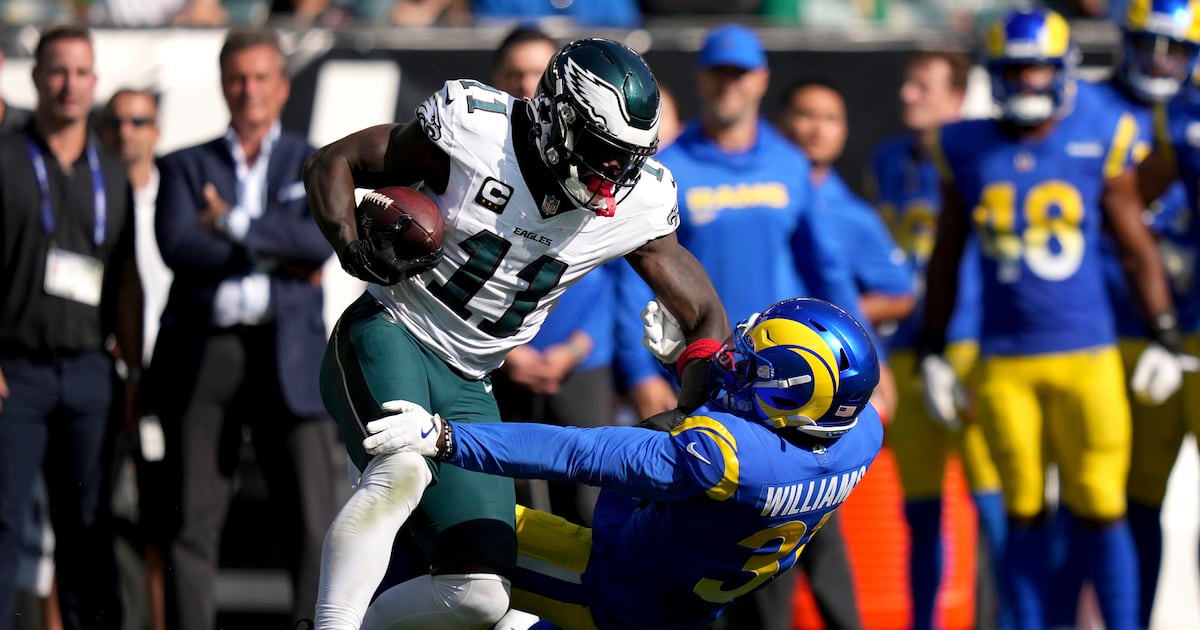
The Eagles finally remembered they have A.J. Brown
In a rematch of last year’s divisional round, the Eagles trailed the Los Angeles Rams 26-7 and faced second and 13 from their own 29-yard line early in the second half. Quarterback Jalen Hurts, maligned this year for his lack of deep passing, dropped back and heaved a ball down the sideline to a forgotten man.
In the season’s first two weeks, A.J. Brown – one of the best wideouts in the NFL and Philadelphia’s third-highest-paid player – caught six passes for 35 yards. As their offense spiraled toward a new low Sunday, the Eagles reintroduced him. Brown’s 38-yard reception was the igniting moment of a memorable 33-26 victory.
Mammoth defensive tackle Jordan Davis sealed the victory by blocking a last-second field goal and returning it for a touchdown (a moment that broke the brains of bettors with Rams +3.5). But it was Brown, who finished the day with six catches for 109 yards and a touchdown, who made the comeback possible and provided a reminder that Philadelphia functions best when its offense runs through him.
In terms of skill, Brown is far closer to Saquon Barkley than their roles in the offense suggest. On a third and 10 from the Philadelphia 9-yard line midway through the fourth quarter, he snatched a short pass from a defensive back and barreled through tacklers for a 25-yard gain.
So many times Sunday, Philadelphia seemed headed for an offensive morass with a quarterback who couldn’t throw deep. Reserve tackle Fred Johnson warrants mention – he replaced Matt Pryor, who played like a turnstile for a few series after replacing injured superstar Lane Johnson, and provided capable relief. Still, when the Eagles most needed a spark, Brown was the best player on the field.
The Browns’ defense is legitimate
While the Browns almost certainly will not be relevant to the playoff race, their fast, bruising, complex defense could make them a spoiler all season long. Cleveland claimed its first victim Sunday with a stunning, 13-10 victory over the Green Bay Packers, who entered as a burgeoning juggernaut on 10 days’ rest. The Browns did not score until the fourth quarter, but their defense kept them within reach. They won, ultimately, because Shelby Harris blocked the Packers’ go-ahead field goal try with 27 seconds left and then rookie Andre Szmyt nailed a 55-yarder as time expired.
No matter how the final sequence played out, Cleveland’s defense had proved it will be a force this year. Myles Garrett is an unblockable menace off the edge. Coordinator Jim Schwartz is still one of the best defensive play callers in the NFL. Rookie linebacker Carson Schwesinger, a second-round pick, is a sideline-to-sideline missile and a demon on the blitz.
The Browns have high-end individual talent, and the pieces fit together. They shut down Joe Burrow in Week 1 and mostly stifled Lamar Jackson in Week 2 despite the Baltimore Ravens’ 41 points. On Sunday, they limited the Packers to 3.8 yards per play and held Jordan Love to 183 passing yards. Cleveland may be a flaming dumpster of an organization, but its defense is – no kidding – a Super Bowl-caliber unit.
Isaiah Rodgers had a dream game
It’s not often a cornerback in the middle of a depth chart becomes one of the stars of an entire week. It happened Sunday in Minneapolis: The Carson Wentz-Jake Browning backup quarterback showdown turned into the Isaiah Rodgers Game.
In the Minnesota Vikings’ 48-10 demolition of the Cincinnati Bengals, Rodgers scored two touchdowns and forced a fumble that ultimately led to another Vikings touchdown. In the first quarter, Rodgers intercepted Browning and returned it 87 yards for a score, which provided an early theme – there were a remarkable seven non-offensive touchdowns in Sunday’s early window of games.
Rodgers’s second touchdown came shortly before halftime. After tight end Noah Fant caught a short pass and turned upfield, Rodgers drilled him right on the ball, swiped it away and sprinted 66 yards for another touchdown. For good measure, Rodgers forced another fumble on the Bengals’ next drive. On the sideline, teammates mimicked fanning Rodgers to cool him off.
The Falcons’ quarterback situation isn’t getting simpler
In a startling 30-0 loss to the previously inept Carolina Panthers, Atlanta Falcons Coach Raheem Morris benched Michael Penix Jr. for the fourth quarter. He made the decision, he said, only because “the game was out of hand” and he wanted to keep Penix “out of harm’s way.” It’s easier to do that when the backup is not Kirk Cousins, a veteran making $40 million.
No matter what happens moving forward, Penix took a significant step back Sunday. Against one of the worst defenses in the NFL since the start of 2024, Penix completed 18 of 36 passes for 172 yards with two brutal interceptions, one of which Chau Smith-Wade returned 11 yards for a touchdown. Typically decisive, Penix was skittish and inaccurate.
The Falcons had a chance to assert themselves as contenders in the NFC South, and instead they fell into a tie with the Panthers at 1-2. In his first full season as a starter, one year after Atlanta drafted him eighth overall despite signing Cousins weeks earlier, Penix had a chance to cement himself. Instead, the Falcons’ quarterback situation again became an open question.
C.J. Stroud’s regression hasn’t stopped
Over the offseason, the Houston Texans overhauled their offense around C.J. Stroud. They revamped an offensive line that yielded 54 sacks. They drafted wideouts in the second and third rounds. They fired offensive coordinator Bobby Slowik and replaced him with Sean McVay acolyte Nick Caley.
Through three games, the outcome has been the same: Stroud is unable to recapture the efficiency and excellence of his rookie season. Despite having one of the best defenses in the NFL, the Texans fell to 0-3 – already three games behind the Indianapolis Colts – with a 17-10 loss to the division rival Jacksonville Jaguars. Another loss fell at the feet of Stroud, who threw two interceptions and passed for 204 yards on 38 attempts, a paltry 5.4 average.
As a rookie, Stroud passed for 273.9 yards per game. In 20 games since, his average is just 216.3. The pressure he faced last year has affected him – and he has started to exacerbate his line’s shortcomings. Stroud tends to drift backward even out of clean pockets, sometimes hanging his tackles out to dry. His eyes, once locked downfield, have tended to drop to look at the pass rush. He is a cerebral quarterback playing panicked football. He needs to improve before a downward trend invites long-term questions.
The tush push discourse isn’t going away
The Eagles used two tush pushes to score on a short touchdown drive. On both conversions, after a week in which the NFL instructed officials to call false starts on the play “tight,” replays showed right guard Tyler Steen moving before the snap.
It is tempting to fault officiating incompetence, but that would an unfair scapegoat. On slow-motion replay, Steen’s early movement is obvious. In real time, among a tightly packed heap of massive bodies, it’s unrealistic – if not impossible – for an official to spot it.
Offensive linemen false start by imperceptible margins on almost every play by anticipating the snap count. It’s one reason using a silent count on the road is such a detriment. The difference is that an imperceptible head start on a short-yardage sneak, especially by a lineman at the center of the attack, can create the difference between a fourth-down defensive stand and a touchdown.
If there is an argument against the tush push, it lies somewhere in those inherent factors. The play brings an outsize benefit derived from the exploitation of the limits of human eyesight. If the NFL wants to officiate the play, it would require replay reviews of potentially missed false start and offside calls. Nobody should want to open that Pandora’s box.
The Steelers’ defense is a sneaky problem
The final score of the Pittsburgh Steelers’ 21-14 victory over the New England Patriots concealed what has been a major issue early in the season: Their defense has not played like it needs to play.
The Steelers forced five turnovers, two of which came inside their own 5-yard line. Coach Mike Tomlin takes pride in his team forcing turnovers and insists they do not come by accident. But it’s not sustainable for Pittsburgh to let teams move the ball up and down the field. The Patriots gained 369 yards and recorded 26 first downs. The Steelers entered Sunday yielding 6.3 yards per play, fourth worst in the NFL.
The acquisitions of Aaron Rodgers and DK Metcalf placed the focus on Pittsburgh’s offense. For them to succeed, though, the Steelers need a big season from a defense to which they have devoted $117 million in cap space, second in the NFL. T.J. Watt – who recorded his first two sacks of the season – and Patrick Queen are among the five highest-paid players at their positions. Jalen Ramsey is still a star cornerback. Cameron Heyward is a top-10 defensive tackle in terms of cap hit. Pittsburgh’s defense is built to be elite, and it has barely been mediocre.
Brian Callahan gave a lesson in game mismanagement
Tennessee Titans Coach Brian Callahan, the author of multiple puzzling game management decisions, provided a lesson in how not to handle the end of a first half under the new kickoff rules in his team’s 41-20 loss to the smoking-hot Indianapolis Colts.
Trailing 17-6, the Titans faced fourth and one at the Indianapolis 39-yard line after a run fell short of a first down. Indianapolis called a timeout with 42 seconds left. Tennessee lined up to go for it, then called a timeout after it couldn’t draw the Colts offside. The Titans sent out big-legged Joey Slye for a 57-yard field goal, but Callahan’s disorganization led to a delay-of-game penalty, moving the spot back to 62 yards.
At this point, Callahan’s game management went from bad to worse. Slye can make a 62-yarder, but it’s less than 50-50. If he missed, Indianapolis would already be in field goal range. In the unlikely event Slye converted from 62 yards, Tennessee would have been hoping for merely a push. With 35-ish seconds left, taking possession from about the 30-yard line – a fair expectation with new kickoff rules – the Colts would have needed only a couple of first downs for a field goal attempt.
Going for it – a higher percentage by far than a 62-yard field goal – would have given the Titans a chance to run the clock out and try for a field goal without the chance of an Indianapolis answer. A punt probably would have allowed Tennessee to head into the locker room with the score unchanged. A long-shot field goal try provided most of the downside and little of the upside.
Callahan opted for the field goal. Slye’s attempt was blocked, giving the Colts possession across midfield. They made a field goal to go up two touchdowns at halftime. It was a bad result for the Titans. Even if Slye made the kick, it would have been a bad decision.