


By Nicolas Dorigatti | July 14th, 2026
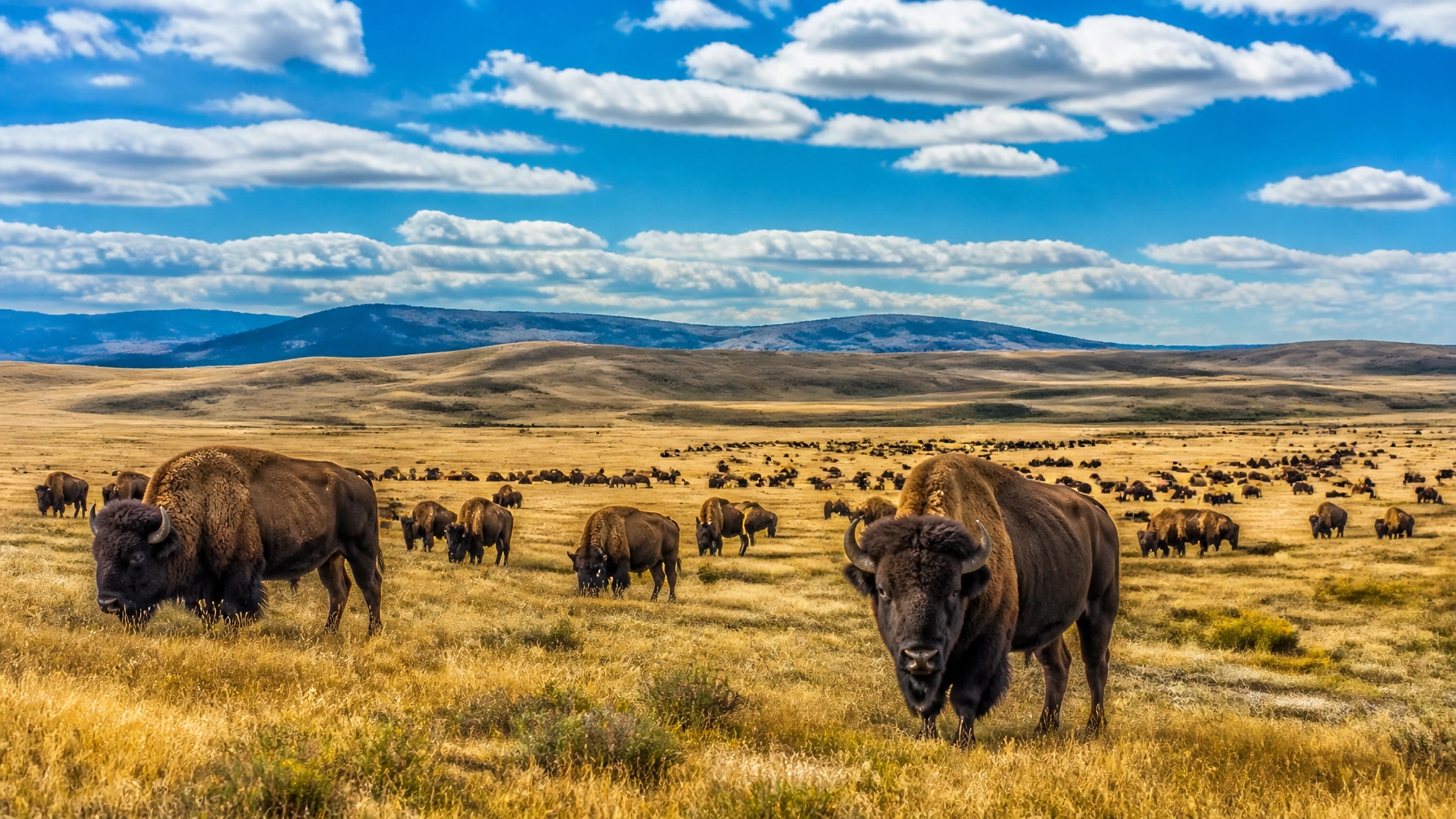
For thousands of years, the American bison roamed the grasslands of North America in staggering numbers. Historians estimate that between 30 and 60 million bison once ranged across the continent, in a corridor of rich grassland known as the "great bison belt" stretching from Alaska south to the Gulf of Mexico and east toward the Atlantic seaboard. Yet by the late 1880s, the wild population had collapsed to a few hundred animals. The near-total disappearance of a species that once numbered in the tens of millions, compressed into little more than a single human lifetime, stands as one of the most dramatic examples of human-caused wildlife loss in recorded history.
A Species Built for the Plains
Bison first arrived in North America over 100,000 years ago, descending from steppe bison that crossed the Beringia land bridge from Siberia. Over time they became the dominant large grazer of the continent, shaping the very grasslands they depended on: their grazing kept woody shrubs from overtaking the prairie, their hooves broke up compacted soil to let water soak in, and their winter trails through snow created paths that smaller animals relied on to survive. For Plains nations — including the Lakota, Cheyenne, and Comanche, among many others — bison were not just a food source but the foundation of an entire way of life, supplying meat, hides for clothing and shelter, and bone and horn for tools.

By the mid-1800s, that ecosystem was on a collision course with westward expansion.
Massive Commercial Hunting
The single largest driver of the bison's collapse was industrial-scale hunting during the 19th century. As settlers pushed westward, professional hunters began killing bison not for subsistence but for profit, supplying a booming market for hides, tongues, and bones. A single hunter could kill dozens or even hundreds of animals in one outing, often stripping only the hide or tongue and leaving the rest of the carcass to rot on the plains. Bison leather was in high demand for machine belting, industrial equipment, and clothing, and the sheer scale of the market meant hunting only intensified as the herds thinned.
The devastation was staggering in its speed. Populations that had numbered in the tens of millions in the early 1800s were reduced to only a few hundred animals by 1889.
The Railroad's Role

Railroads turned hunting from a regional trade into a continental industry. Rail lines cut directly through the bison's traditional migration corridors, splitting herds into smaller, more vulnerable groups and giving hunters direct access to animals that had once been out of reach. The trains themselves also made hunting easier to transport: hides and bones could now be shipped east in bulk, feeding tanneries and fertilizer plants far from the plains.
Railroads didn't just enable hunting — they encouraged it.
Large herds crossing the tracks could delay trains for hours, so companies had little incentive to discourage shooting. Passengers sometimes fired at bison from open windows purely for sport, with no intention of using any part of the animal.
Government Policy and the Targeting of Native Nations
The destruction of the bison herds was not only a byproduct of commercial hunting — for some U.S. officials, it became a deliberate strategy.
Recognizing how completely Plains nations depended on bison for survival, military and government leaders saw the herds' destruction as a way to force Native peoples onto reservations and break their resistance to relocation. Secretary of the Interior Columbus Delano captured this thinking bluntly in the early 1870s, arguing that the disappearance of game from tribal hunting grounds would help compel Native nations to abandon their traditional, nomadic way of life.

As the herds vanished, so did the material basis of Plains life. Communities that had relied on bison for food, shelter, clothing, and tools lost that resource almost overnight, which made it far harder to resist the pressure to relocate. Historians widely regard this campaign as inseparable from the broader effort to subjugate Native nations during westward expansion — the destruction of the bison and the displacement of Indigenous peoples were two sides of the same policy.
Habitat Loss
Even as hunting decimated the herds directly, the bison's habitat was disappearing underneath them. Settlers converted millions of acres of native grassland into farms, ranches, and towns across the Great Plains. Fences, roads, and cultivated fields fragmented the open range the bison needed to migrate and graze, leaving even the animals that survived hunting with less and less space to recover their numbers.
Disease and Competition with Cattle
The arrival of large domestic cattle herds added further strain. Cattle competed directly with bison for grazing land and water, and they sometimes introduced diseases, such as bovine tuberculosis and brucellosis, into wild herds that had no prior exposure. Disease was never the primary cause of the bison's decline — hunting and habitat loss did the overwhelming majority of the damage — but it compounded the pressure on a population already in freefall, and it left a genetic legacy that persists today: cattle genes have been found in the majority of both public and private bison herds in North America.
Hitting Bottom
By 1889, the wild bison population had fallen from tens of millions to only a few hundred animals — estimates from that era range from roughly 500 to just over 1,000 depending on the source and how "wild" versus "captive" herds were counted.
Whatever the exact figure, the species stood on the edge of extinction. What had been one of the most abundant large mammals on Earth was, within the span of a few decades, reduced to a handful of scattered, isolated herds.
Conservation Efforts and Recovery
The bison's near-disappearance eventually alarmed conservationists, ranchers, and government officials alike. In 1905, a group of naturalists founded the American Bison Society at the Bronx Zoo in New York, with former president Theodore Roosevelt serving as honorary president. The Society worked to establish protected herds on public and private land, while the U.S. government set aside preserves — most famously in Yellowstone National Park, the only place in the continental United States where wild bison have lived continuously since prehistoric times.
These efforts, combined with careful breeding programs on private ranches and tribal lands, slowly pulled the species back from the brink. What began as a handful of surviving animals in the early 1900s grew, over the following century, into a recovering population spread across parks, refuges, ranches, and Indigenous lands throughout North America.
Bison Today

The species is no longer at risk of extinction, but its recovery has been uneven. Current estimates put the total North American bison population somewhere between roughly 200,000 and 500,000 animals, the majority of them raised commercially on private ranches for meat production rather than living as wild, free-ranging herds. Only a small fraction — commonly estimated in the range of 20,000 to 30,000 — roam in conservation herds on public lands, tribal lands, and protected reserves such as Yellowstone.
Tribal nations have become increasingly central to modern bison restoration, with a growing number of Native communities managing their own herds and returning bison to ancestral lands as part of broader efforts at ecological and cultural restoration. Organizations such as the National Bison Association have set ambitious goals for continued growth, aiming to expand the total population well beyond current numbers in the coming years.
Even with this progress, today's bison population remains a small fraction of the tens of millions that once covered the continent, and the vast majority live in managed, fenced conditions rather than the open, migratory herds of the past.
A Lasting Lesson
The story of the American bison is often told as a conservation success — and in many ways it is: a species reduced to a few hundred animals now numbers in the hundreds of thousands.
But it is also a case study in how quickly human activity can unravel an ecosystem that took thousands of years to form. Commercial hunting, railroad expansion, deliberate government policy, habitat loss, and disease didn't act in isolation; they reinforced one another, turning one of the most abundant large mammals in history into an endangered species within a few generations. The partial recovery that followed shows what sustained conservation effort can accomplish — but it also underscores how much was permanently lost along the way.
Nicolas Dorigatti is a senior contributor for Sportsmedia News, covering conservation, wildlife policy, and the history of North American ecosystems.