


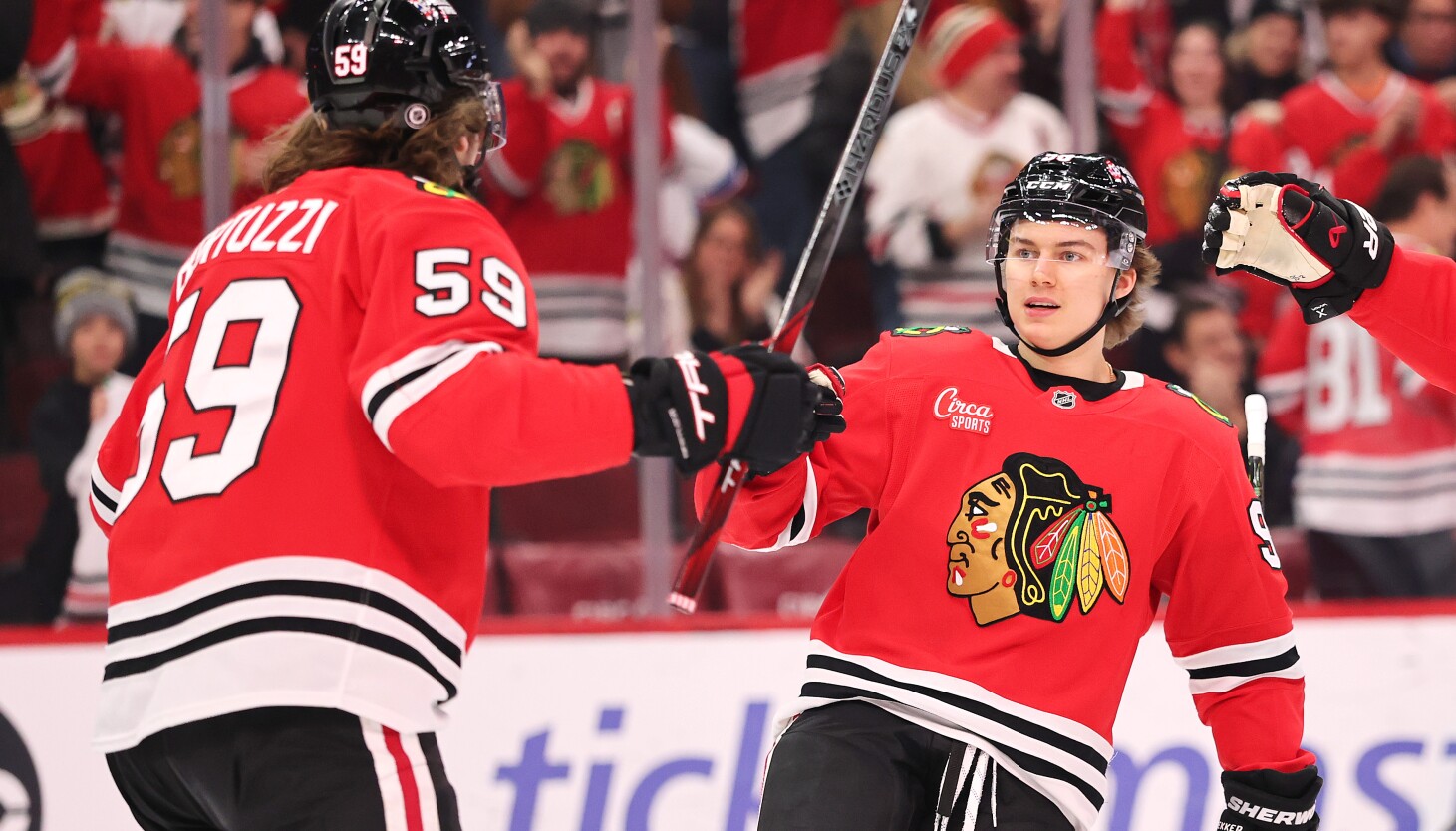
At this stage of their careers, Blackhawks veterans like Tyler Bertuzzi, Teuvo Teravainen and Connor Murphy pretty much are what they are.
It’s not impossible to substantially improve in one’s late 20s or early 30s — as Ryan Donato demonstrated last season, thanks to his skating technique overhaul — but it’s very rare.
Even accounting for some inevitable year-to-year variation in luck and playing time, the range of possible outcomes for a player like Bertuzzi is relatively small. On cue, he entered last season with three separate 21-goal seasons to his name and tallied a right-on-par 23 goals for the Hawks.
Health is often the biggest reason for fluctuation, be it negatively due to injury (as Jason Dickinson endured last season) or positively due to finding a rhythm after recovering from an injury (as Ilya Mikheyev experienced last season).
On the other hand, Hawks youngsters like Connor Bedard, Frank Nazar, Sam Rinzel, Artyom Levshunov and Spencer Knight are much less certain commodities.
They’re still developing and improving as they gain skills and experience, and their valuations are based more on future potential and less on pre-established track record. They might end up reaching that projected ceiling — or even exceeding it — or they might fall short of it. The range of possible outcomes is wide.
The 2025-26 Hawks are going to deploy a ton of players every night who reside in that category, given how wholeheartedly they’ve committed to their youth movement.
In addition to the five guys listed above, other youngsters who will compete for NHL roster spots and playing time include Oliver Moore, Ryan Greene, Nick Lardis, Landon Slaggert, Colton Dach, Samuel Savoie, Kevin Korchinski, Ethan Del Mastro, Wyatt Kaiser (once his contract situation is resolved), Nolan Allan and Drew Commesso. It’s an extremely long list.
Even preexisting NHL stalwarts like Alex Vlasic, Lukas Reichel and Arvid Soderblom are still young enough to improve significantly, as well.
The Hawks are a team full of wide-range-of-outcome players, and in turn, that makes them a wide-range-of-outcomes team. It’s difficult to predict with certainty what their lineup will look like, much less how competitive that lineup will be against 31 opponents.
In the Hawks’ current situation, this uncertainty is actually intriguing. It’s a welcome departure from the past few seasons, when the Hawks were full of small-range-of-outcome placeholder veterans, making them a small-range-of-outcomes team, and that small range was centered around the very bottom of the standings.
Expectations for the Hawks this season are just as low as they have been, of course. The first team since the late-1990s Lightning to win fewer than 30 games in five consecutive seasons is unsurprisingly projected to land at the very bottom of the standings yet again.
FanDuel projects the Hawks for 68.5 points, the lowest total in the league (two points below the Sharks). DraftKings projects the Hawks for 67.5, also the lowest total. JFresh, a popular hockey analytics account on Twitter/X, projected the Hawks for 74 points, the fourth-lowest total.
But what those projections don’t convey is the Hawks’ wider range of possibilities. They’re like a hurricane that’s just forming, with a cone of forecasted routes ranging from Florida to Bermuda.
Yes, the Hawks have a higher chance this season of falling well short of their projected point total — a terrifying thought. But the Hawks also have a higher chance this season of greatly exceeding their projected point total — an exciting thought.
Almost every season, there are a few teams who break free of preseason bottom-feeder expectations, fool everyone and hang around on the playoff bubble.
In 2024-25, the Canadiens (projected for 76.5 points, earned 91) actually did squeak into the playoffs, while the Blue Jackets (projected for 67.5, earned 89) and the Flames (projected for 81.5, earned 96) each almost did.
In 2023-24, the Predators (projected for 86.5 points, earned 99) made the playoffs and the Flyers (projected for 75.5, earned 87) held a spot for months before a late collapse.
Those examples will fuel optimism for the Sharks, Ducks, Kraken, Red Wings and Sabres this autumn just as much as they will for the Hawks, and maybe only one of those teams will actually become the 2025-26 example, so skepticism remains prudent. But anything is possible.
It’s worth calling extra attention to the 2024-25 Jackets in particular, because following the tragic August 2024 death of their best player, Johnny Gaudreau, they appeared on paper to be one of the worst teams in recent history.
However, career years from two established veterans (Zach Werenski and Sean Monahan), major growth from several youngsters (Kirill Marchenko, Adam Fantilli and Kent Johnson) and one savvy waiver claim (Dante Fabbro) changed their trajectory.
The sense of higher purpose that motivated that Jackets team won’t be replicable elsewhere, but their blueprint of development and roster composition might be.
So what confluence of events could conceivably lead to the Hawks greatly exceeding their projections this season? A stardom-cementing breakout from Bedard would almost certainly need to be the first ingredient. If he averages over a point per game and improves defensively, that would make a big difference.
Knight proving himself an above-average NHL goalie, Nazar continuing his sky-high rate of growth, Rinzel capably handling 23 minutes per game the way he did in his nine-game cameo last spring and even perhaps Andre Burakovsky enjoying a Monahan-esque renaissance could also represent part of that best-case scenario.
Good luck would be necessary, too, both in terms of key players staying healthy and the team scraping out lots of close wins and overtime points. The latter was a key part of both the Canadiens’ and Flames’ success last season; they posted a combined 37-6-25 record in games decided by one goal. The Hawks, conversely, went 7-9-11 in such games.
While fantasizing about the Hawks’ best-case scenario, it’s important not to disregard the equal chance of a worst-case scenario unfolding, though.
It’s conceivable this extremely young, extremely unproven team could be a total disaster, even more so than the veteran-laden ones. If the 2025-26 Hawks are not the 2024-25 Jackets, they could be what the 2024-25 Jackets were supposed to be: one of the worst teams in recent history.
If Bedard and Nazar either stagnate or get injured, the offense could be hopelessly punchless. The defense — with its mere one player (Murphy) older than 24 — is going to be inconsistent no matter what, and if the young defensemen don’t develop individually or gel together, things could get messy.
And if Knight’s .893 save percentage in his first 15 Hawks starts was a sign of things to come, the goaltending could be no better.
That’s the nature of things at the beginning of a youth movement. Nobody really knows what’s going to happen during this Hawks season.
At the very least, it will be interesting to find out.