


Prosper ISD tried to take the lead in the state’s stadium arms race in 2023, asking voters to approve a $2.8 billion bond package that included a record-setting $94 million for a new football stadium.
The fast-growing community in the northern Dallas suburbs made its pitch only four years after opening the $53 million Children’s Health Stadium. The case was made for a second stadium to accommodate the three high schools Prosper has opened in the last five years, with another on the way, but voters weren’t buying it.
Last year, Anna ISD made a bid for the most expensive high school football stadium in Texas. Voters rejected the $100 million proposal — for the second time.
“Bond voters are saying enough is enough,” said Brandon Rottinghaus, professor of political science at the University of Houston.
“Voters are becoming more cost-conscious on bonds than ever before,” he said. “It’s happening in Houston, too. It happened in Montgomery County, it happened in Katy ISD. There were efforts to build these mega stadiums, and the voters looked carefully at the fine print and they decided they didn’t want to foot the cost for it.”
The Dallas area had 28 new high school stadiums open from 2000 to 2019 but only four from 2020 to 2024, according to information The Dallas Morning News requested from school districts to gauge the investment North Texas communities are making in football and how that translates on the field halfway through the 2025 regular season.
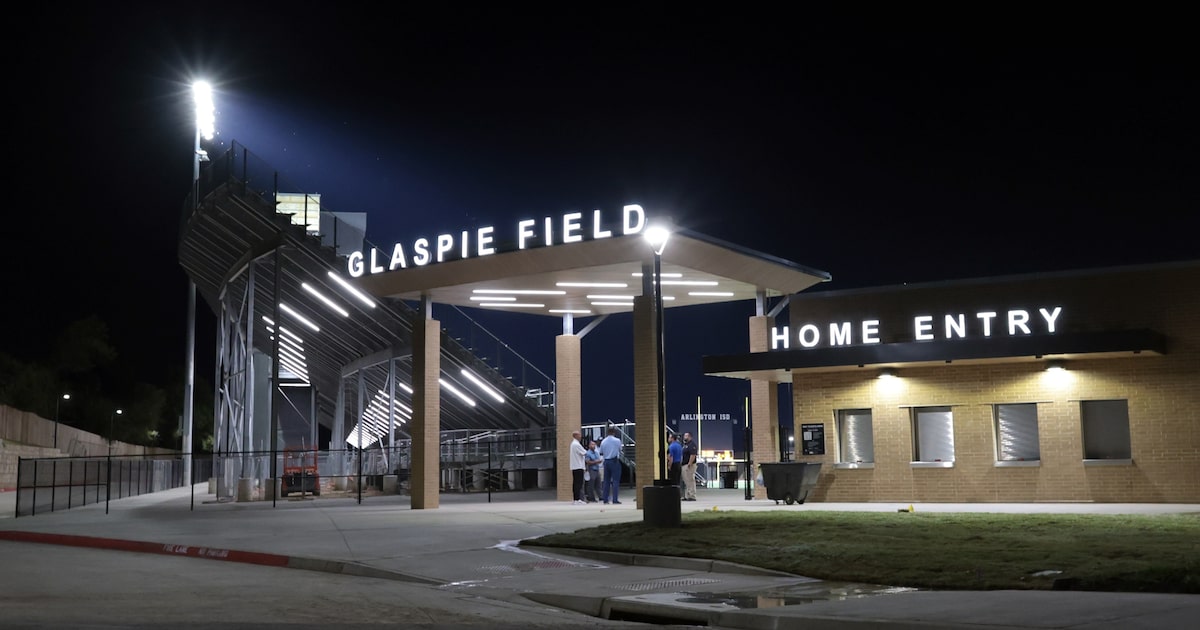
D-FW’s newest stadium, Glaspie Field in Arlington, opened last week. But recent years have marked a departure from the halcyon days of the stadium arms race, which Allen kicked off with its $59.6 million Eagle Stadium in 2012, before other schools followed in building palaces that rival college facilities. Texas voters have since grown more reluctant to approve school bond packages of any kind, not just athletics, even as districts that have built new stadiums have reaped the benefits on the field.
“There was a time when bonds were passed because they always did,” Rottinghaus said. “There was a presumption that people wanted to improve their local communities, and this was a low-cost way to do it. That is not true anymore. Voters can look around and see that many of these stadiums are perfectly usable, and having to spend money on additional ones might be duplicative.”
A ‘wretched excess’
When Allen ISD opened its stadium, Forbes opined that an 18,000-seat stadium built for the district’s only high school was a “wretched excess of the state’s mania for high school football.”
That’s how some voters see it.
Anna won the Class 4A Division I state title in 2023 to cap a two-year run in which it was 28-2. Two years after its first pitch for a new stadium failed, the district asked for a facility that could have hosted graduations and other community-wide events and would have replaced the current 4,000-seat stadium that Anna is quickly outgrowing.
“Was it disappointing for me [that it was rejected]? No, because I like our stadium. Is there going to be a need for it? Yes. There is going to be a need here in another year or two,” Anna football coach Seth Parr said.
He doesn’t think there’s an arms race when it comes to stadiums in Texas. Many of these lavish facilities are being built for more than football.
“They were probably being built for need,” Parr said. “If you are going to build something, do you build it average or do you think about the future and think about all the needs that it needs to [fill]?”
At least 14 school districts in Texas have opened stadiums the last two decades costing $34 million or more. But voters across the state might be suffering from sticker shock at the polls.
In 2013, voters initially rejected a budget that included $69.5 million for the new stadium in Katy that eventually opened in 2017 for $72 million. Last year, voters in Willis ISD turned down — for the third time — a $115.4 million bond package that included funding for a $68 million high school football stadium.
Both Anna and Prosper’s proposals would have exceeded the cost of the two most expensive stadiums in the state — Katy ISD’s Legacy Stadium and Cy-Fair ISD’s $80 million Berry Center, which includes an 11,000-seat football stadium.
“Prosper ISD remains one of the fastest-growing districts in Texas. We’ve opened three high schools in the past five years, and we anticipate opening another high school in 2029,” said the district’s director of athletics, Jeff Smith. “We have thousands participating in events that extend well beyond football. We’ve got trainers, band, cheer, drill teams, soccer teams and more. We also host graduation here.
“You’re asking the why? It’s because of all these things. We have an anticipated enrollment exceeding 40,000 students.”
Times have changed
In some communities, voters have even said no to renovations and basic upgrades to athletic facilities.
Mansfield ISD residents voted against spending more than $100 million on stadium renovations and indoor practice facilities in a 2024 bond proposal, while Lovejoy voters recently declined to spend $4.5 million on improvements to the existing stadium and track.
It’s becoming a trend. The News reported in 2021 that voters rejected more school bond proposals than they approved for the first time in over a decade, and The Texas Tribune reported last November that Texas voters rejected 20 of 35 bond propositions put forward by 19 school districts in one month.
“In the past, you could wrap all of your athletic facilities into the bond with the academic piece. Now, they make you separate it,” Crowley ISD executive director of athletics Gregory Williams said. “Sometimes voters don’t believe in athletic needs. It makes it a little more difficult.”
Bond procedures in Texas changed in 2019 when a law went into place that requires school districts to separate proposals for academic facilities from those for certain athletic and recreational projects.
One of the items that has to be a separate proposal is the construction, acquisition or equipment of a stadium with seating capacity for more than 1,000 spectators.
When Allen’s stadium was approved in 2012, it was part of a $119 million bond that included a district service center and a $23.2 million Performing Arts Center that had a television studio, a student-run restaurant and a $100,000 Steinway grand piano.
Voters might also be scared off by what happened when new football cathedrals were built in Allen and McKinney. Allen had to close its stadium for 15 months in 2014-15 to make $10 million in repairs after cracks indicated the potential for collapse of a suspended concourse. The $69.9 million McKinney ISD Stadium opened in 2018, even though cracks rippled through the concrete, with some large enough to poke a finger through.
“Voters are inundated with bond requests from every level of government, so they may just look at the latest one and be much more unwilling to support it,” Rottinghaus said. “These building projects are expensive and fraught with problems. Voters are more aware of these things than they have ever been. It definitely gives them pause before they want to embark on yet another major potential cost boondoggle.”
Boomtowns ask for more
Troy Mathieu, chief of athletics for Grand Prairie ISD, said communities can be overwhelmed by too many bond proposals in a short period of time.
“I don’t know if it’s as much the numbers that may have caused a problem with getting passage and the necessary votes as much as maybe voter fatigue,” Mathieu said. “How many asks can a community get and constantly stay positive and supportive of those measures? I think more of it is tied to the timing of the asks of the public.”
Grand Prairie ISD’s Gopher-Warrior Bowl, one of the oldest stadiums in the area, was built in 1956 at the cost of $200,000, according to the stadium information The News requested.
There have been renovations over the years, including a $4.1 million project in 2004, but the district never felt the need for a new stadium because Grand Prairie isn’t experiencing the population boom of northern D-FW suburbs such as Prosper, Anna, Melissa and Celina.
But those who are willing to spend big have earned big rewards.
Only six Dallas-area football stadiums that have opened since 2012 have cost more than $30 million, The News found. That doesn’t include The Star in Frisco, a joint venture between the Cowboys and Frisco ISD that opened in 2016 and cost $255.5 million.
Following the Allen, McKinney and Prosper venues, the $53 million Crowley ISD Multi-Purpose Stadium and Melissa ISD’s $35 million Coach Kenny Deel Stadium opened in 2022 and 2023, respectively. Denton ISD’s Carrico Athletic Complex, which opened in 2022 and includes facilities for other sports, had an estimated cost of $62.5 million, according to the Texas Department of Licensing and Regulation.
Two of the six districts have had teams win state titles in football since their stadiums opened — Allen and North Crowley.
Celina’s stadium wasn’t as expensive, but the team won the Class 4A Division I state title last year, and Celina has had four seasons with 11 or more wins since the new Bobcat Stadium opened in 2019 as part of a $24.5 million athletic complex for all sports.
North Crowley is 46-3 in the three years since Crowley ISD Multi-Purpose Stadium opened and won the Class 6A Division I state title last year while going 16-0.
Crowley ISD voters also approved a $1.1 billion bond in 2023 that included funds for new outdoor and indoor tracks that will open in the coming years. The district is banking on others building similar facilities and the UIL one day sanctioning indoor track as a sport, as well as the idea that the tracks and the new football stadium will help attract new students.
“Our enrollment is going up like crazy in Crowley ISD. We’ve got 20,000 new homes and we’re the No. 1 fastest-growing city in the southern sector of the metroplex,” North Crowley football coach Ray Gates said in July at the Texas High School Coaches Association convention. “It’s being there at the right time, plus all the new facilities. We are going to be the only [school district] in the country with an indoor and outdoor track complex. People want to be a part of that.”
Three-time state champion DeSoto, which won back-to-back 6A Division II state titles in 2022 and 2023, will be getting much-needed upgrades to its football stadium as part of a nearly $200 million bond that will also fund critical renovations, repairs, and new constructions to enhance the district’s educational facilities.
“I think the better facilities you have, the better chance of your athletes performing,” DeSoto football coach Claude Mathis said. “If you have great facilities, you will have a chance to be great. I think that is why a lot of these athletic departments right now are putting [money] into the facilities.”
Allen is 171-19 and has won four of its five state titles since Eagle Stadium opened in 2012 — including a three-peat led by quarterback Kyler Murray from 2012 to 2014.
“What you see is probably not that you build those and then the success comes,” Allen football coach Lee Wiginton said, “but rather as success starts coming and the communities start seeing tremendous value in that, then those things happen.”
So where do school districts go from here?
Smith, the Prosper ISD athletic director, said the district doesn’t have a timeline for another bond election. Anna ISD board president Tiffany Terry said in an email, “The board has not decided how to progress forward at this point.”
At some point, the rapid growth of the communities could force the issue, and voters will relent and agree to fund a new stadium. If they do, Texas will likely have the first high school football stadium to cost $100 million — or more.
More from this series
— Football may be king in Texas, but is its grip on some North Texas communities weakening?
— The highest-earning football coaches in D-FW are at schools that excel in the classroom
— Salary tracker: See how much North Texas football coaches make and their tenure
— See the newest premier high school football stadiums in North Texas
— Thursday: How much money do D-FW booster clubs spend to help teams succeed?
Find more high school sports coverage from The Dallas Morning News here.