


By Jacob Potter
June 29, 2026
Tournament storylines take shape
The 2026 FIFA World Cup has officially transitioned into its high-stakes knockout phase, leaving behind a group stage defined by record-breaking individual performances and the tactical evolution of host nations. As the Round of 32 commences across 16 cities in North America, the global football community is fixated on two converging narratives: the unprecedented form of aging icons Lionel Messi and Cristiano Ronaldo, and the statistically significant reemergence of the United States Men’s National Team (USMNT) on the world stage.
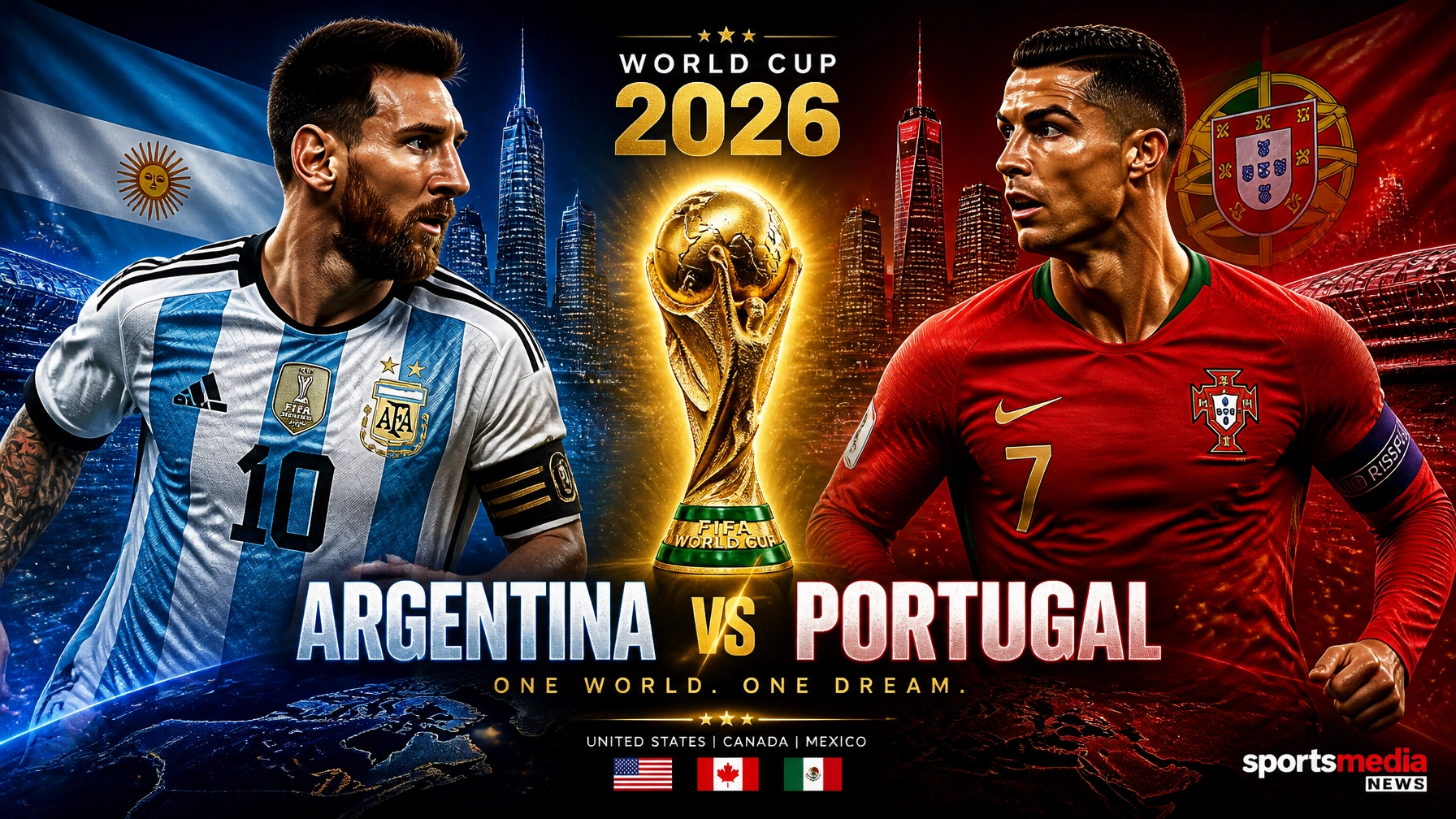
With the bracket now taking shape, the potential for a quarter-final collision between Argentina and Portugal has shifted from fan theory to a distinct statistical probability. Simultaneously, the United States has secured its position as a serious contender, winning Group D and preparing for a critical knockout tie in Santa Clara. These developments underscore a tournament that is balancing the twilight of legendary careers with the sunrise of a new American soccer era.
The Weight of Legacy: A Potential Final Duel
The primary individual headline of the tournament remains Lionel Messi’s relentless pursuit of history. Following a clinical hat-trick in Argentina’s 3–0 victory over Algeria earlier this month, Messi has officially reached 16 career World Cup goals, equalling Miroslav Klose as the all-time top scorer in the tournament's history. At 38, Messi also became the oldest player to record a World Cup hat-trick, further cementing his influence even as his physical profile shifts toward a deep-lying playmaker role.

"It is an honor to be compared with the greats who came before, but these lists don't mean anything to me if we don't achieve our team goals," Messi stated following the Algeria match. His focus remains squarely on a repeat championship, yet the shadow of his long-time rival, Cristiano Ronaldo, looms large over the bracket.
Portugal’s path has been similarly effective, though characterized by a different tactical approach. Statistical models, including those developed by economist Andreas Klement, suggest that both Argentina and Portugal are on a collision course for the quarter-finals. However, Klement’s research also offers a provocative caveat regarding Ronaldo’s role. "Our models indicate Portugal’s overall efficiency often improves when Ronaldo is utilized as a high-impact substitute rather than a 90-minute starter at this stage of his career," Klement noted in a recent briefing. This "Last Dance" narrative provides a cinematic backdrop to a tournament already bursting with commercial and competitive tension.
The American Renaissance: Securing Group D
While the legends of the game battle for history, the United States has utilized its home-field advantage to signal a definitive reemergence. The USMNT finished the group stage at the top of Group D, accumulating six points through a series of dominant, if occasionally volatile, performances.
The campaign opened with a statement 4–1 victory over Paraguay in Inglewood, highlighted by a brace from Folarin Balogun and a masterclass in midfield distribution from Giovanni Reyna. This was followed by a disciplined 2–0 win against Australia in Seattle. Although the team suffered a narrow 3–2 loss to Türkiye in their final group match, the technical staff had already secured the top seed, allowing for a strategic rotation of the squad.

"The objective was to win the group and establish a culture of winning on home soil," said a senior USMNT official during a press conference in Santa Clara. "We have achieved that, and now the tournament truly begins. The reemergence isn't just about qualifying; it’s about the expectation of deep runs."
The USMNT is now scheduled to face Bosnia and Herzegovina in the Round of 32. Bosnia and Herzegovina advanced as one of the best third-place teams, setting up a matchup that many analysts view as a "must-win" for the Americans to validate their status as a rising global power.
Seeking Legitimacy in the Knockout Phase
The challenge for the United States now moves from group-stage navigation to knockout-round survival. Unlike previous cycles where the U.S. was viewed as a scrappy underdog, the 2026 iteration of the team is built on a foundation of elite European-based talent. However, skeptics remain focused on the team's defensive lapses, specifically the three goals conceded against Türkiye.
Industry experts suggest that the "American Reemergence" will only be viewed as legitimate if the team can overcome the tactical rigidity of European and South American giants in the later rounds. "The U.S. has the athleticism and the home support, but the Round of 16 and beyond requires a level of psychological fortitude we haven't seen them tested on yet," an ESPN FC analyst remarked during a recent broadcast.

At the same time, the presence of stars like Messi and Ronaldo in the same bracket provides a measuring stick for the younger American core. If the U.S. progresses deep enough, a matchup against one of these titans could serve as a "passing of the torch" moment for global viewership.
Economic and Cultural Footprint
Beyond the pitch, the 2026 World Cup is shattering commercial records. With 104 matches across three nations, the scale of the event is unprecedented. The tournament has not been without its logistical hurdles, however. A report from Climate Central highlighted that 97 of the 104 matches are being played in conditions that require intensive heat management for both players and spectators.
Despite these environmental concerns, the business of the World Cup is thriving. Domestic viewership for USMNT matches has reached levels comparable to the Super Bowl, and the "Messi effect" continues to drive ticket prices to historic highs for any match involving Argentina. This economic surge is a critical component of the American reemergence, as the Sportsmedia News team continues to track the intersection of sport and commerce.
"We are seeing a fusion of celebrity culture and elite sport that is unique to the North American market," says a marketing executive involved in the tournament’s sponsorship activation. "Whether it's the potential Messi-Ronaldo clash or the U.S. making a run to the semi-finals, the commercial upside is nearly limitless."

Looking Ahead
As the tournament moves toward the July 19 final, the narratives of legacy and emergence will continue to dominate the airwaves. For Messi and Ronaldo, the coming days represent perhaps the final opportunity to define their international stories on their own terms. For the United States, the knockout rounds are a chance to prove that their "reemergence" is a permanent shift in the global football hierarchy rather than a temporary home-field anomaly.
The world now turns its attention to Santa Clara, Houston, and Foxborough, where the next chapter of this 104-match epic will be written.
For more updates on the tournament, visit our articles section or contact us for media inquiries.
By Jacob Potter
About the Author: Jacob Potter is a senior sports correspondent for Sportsmedia News, specializing in international football and the business of global sporting events. With over a decade of experience covering FIFA tournaments, he provides in-depth analysis of tactical trends and the economic impact of the world's most popular game.