


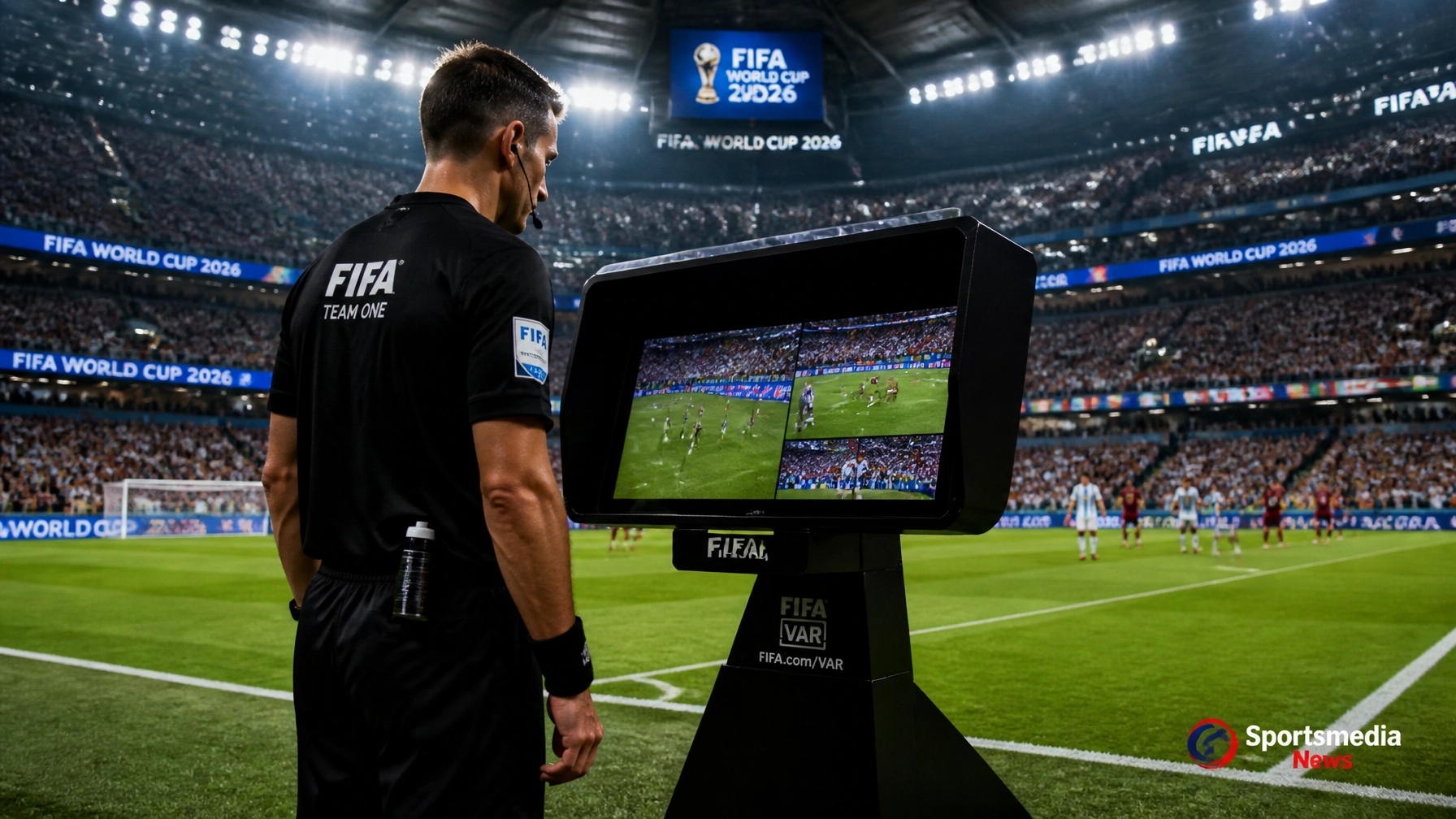
For decades, the FIFA World Cup produced unforgettable moments defined as much by controversy as by skill. Diego Maradona's "Hand of God," Frank Lampard's phantom goal against Germany in 2010, and countless disputed penalties and offside calls all became part of football folklore. Those moments remain iconic precisely because they exposed the sport's oldest problem: human error, unfolding in real time, with no way to correct it.
The introduction of the Video Assistant Referee (VAR) changed that. Since its tournament debut in 2018, VAR has steadily reshaped how the World Cup is officiated — first as a blunt but effective safety net, and by 2026, as a fully integrated system of AI tracking, biometric modeling, and real-time sensor data. Along the way, it has sparked one of football's most persistent debates: how much technology is too much for a sport built on flow and emotion?
A New Era Begins
FIFA officially introduced VAR at the 2018 World Cup in Russia, following years of testing across domestic leagues and international competitions. The system gave a team of video officials the ability to review four categories of match-changing situations:
Goals and the buildup play leading to them
Penalty decisions
Straight red cards
Cases of mistaken identity
Crucially, VAR was designed to support referees rather than replace them. The stated goal was narrow and specific: eliminate "clear and obvious" errors in the sport's highest-stakes matches, without turning every decision into a video review.
Immediate Impact in Russia
The first VAR-assisted World Cup showed just how much difference the technology could make. Officials overturned several high-profile calls throughout the tournament, and FIFA later reported that decision accuracy on key incidents rose to roughly 99.3 percent — a dramatic jump from previous tournaments.
The most visible shift came inside the penalty area. Defenders could no longer get away with grabbing shirts at corners or committing fouls that used to go unseen by the referee on the pitch. The result was a record number of penalty kicks at the 2018 tournament, many of them awarded only after a VAR review flagged an infringement the on-field official had missed.
Reaction was mixed. Some fans felt the spike in penalties rewarded diving and over-officiated marginal contact. Others argued defenders were, for the first time, being held accountable for fouls that had gone unpunished for generations.
Qatar 2022: Offside Goes Automated
By 2022, VAR had matured considerably. FIFA introduced Semi-Automated Offside Technology (SAOT), combining artificial intelligence, a network of dedicated tracking cameras, and a sensor embedded inside the official match ball.
Instead of officials manually drawing lines across a paused broadcast image — a process that could take several minutes and still invite criticism — the new system calculated a player's position relative to the last defender almost instantly. That single change reduced offside review times by more than 70 percent compared to earlier tournaments, while also improving precision to a level no human eye could match.
The result was faster restarts, fewer prolonged stoppages, and far fewer disputes over exactly where an attacker's body was at the moment the ball was played.

The 2026 World Cup: The Most Connected Tournament Yet
The 2026 World Cup, hosted jointly across the United States, Mexico, and Canada, has taken officiating technology further than any tournament before it — and expanded VAR's authority in the process.
Expanded review powers. For the first time, VAR can intervene when a red card results from what was originally an incorrect yellow card decision, correcting sequences that previously could not be fixed retroactively. Officials can also step in on mistaken-identity cases involving yellow cards, not just red ones, and can review incorrectly awarded corner kicks if the correction can still be made before play restarts.
Full-body digital avatars. Every one of the 1,248 players across the tournament's 48 teams was body-scanned in advance, creating precise 3D digital models used to render offside decisions. Unlike the generic player silhouettes used at Qatar 2022, these avatars reflect each player's actual height and build, giving broadcasters and stadium screens a far more realistic and convincing visualization of close calls.
A sharper offside threshold. The automated system now flags players who are more than 10 centimeters offside, tightened from the 50-centimeter threshold used in previous tournaments — a change made possible by more precise tracking data and reduced margin for error.
Real-time alerts for linesmen. Rather than routing offside data through the video review booth first, the upgraded system sends automated audio alerts directly into assistant referees' earpieces in real time. This addresses one of VAR's long-standing structural problems: assistants historically had to delay their offside flag on close calls to avoid wrongly cutting off a promising attack, which sometimes led to reckless, unnecessary challenges during phases of play that were already effectively dead.

A smarter match ball. The official ball, the Adidas Trionda, carries a 500Hz inertial measurement unit sensor embedded in one of its four panels, with counterweights built into the others to preserve balance and flight characteristics. The sensor records motion data 500 times per second and feeds it directly to the VAR system, giving officials a ball-side perspective that camera angles alone cannot fully replicate. Engineers designed the housing to add no perceptible weight or shift in the ball's center of gravity, since a ball that behaves differently from what players expect would undermine the very fairness the technology is meant to protect.
Referee body cameras. All 104 matches of the tournament feature cameras worn by the officials themselves, giving broadcasters — and fans — a ground-level view of incidents as the referee actually sees them.
Clearer fan-facing graphics. Stadium screens now display more realistic 3D renderings of offside decisions in place of the flat blue-and-red lines that frustrated supporters for years, and fans in the stadium can see the exact replay angle the referee is reviewing, live, on the big screen.
Taken together, these changes suggest FIFA's priority for 2026 was not simply more technology, but tighter integration between the technology and the humans using it — feeding officials better information faster, rather than asking them to wait longer for a more accurate answer.
More Correct Calls, Fewer Season-Ending Mistakes
VAR's central achievement, across every tournament it has touched, is the reduction of game-defining errors:
- Goals that should stand are no longer wrongly ruled out.
- Offside goals are caught before they count.
- Missed handballs and dangerous tackles get a second look.
- Wrongly awarded penalties can be reversed before they change a result.
In a competition where a single mistake can eliminate an entire nation, having a mechanism to catch and correct that mistake matters enormously for the players, coaches, and fans whose tournament hangs on it.
The Cost: Emotion and Momentum
Despite the accuracy gains, VAR remains one of football's most polarizing innovations. The core criticism has not changed much since 2018: it interrupts the game's natural rhythm. Football has always thrived on unfiltered emotion — the eruption after a goal, players sprinting to celebrate with supporters, momentum swinging in an instant. VAR introduced hesitation into all of it.
Players now often delay celebrating, aware that a goal could still be chalked off for a foul earlier in the buildup. Fans in the stadium frequently sit through lengthy pauses with little clarity about what, exactly, is being reviewed. The 2026 upgrades — real-time alerts, faster offside processing, on-screen review transparency — are direct attempts to shrink that gap between incident and resolution. But even a delay of ten or twenty seconds can blunt the emotional peak of a World Cup goal.
The Marginal Offside Debate
A more philosophical criticism has grown alongside the technology's precision. Modern tracking can determine that an attacker's shoulder, knee, or toe was mere centimeters offside — and with the 2026 threshold tightened to 10 centimeters, that margin has only shrunk further. Critics argue this level of precision, while technically correct under the Laws of the Game, drifts from the original intent of the offside rule: preventing blatant goal-hanging, not penalizing attackers for fractions of a limb. The debate has pushed FIFA and other governing bodies to keep testing alternative approaches, including a more forgiving offside law proposed by Arsène Wenger, even as the traditional rule remains in force for now.

Players and Referees Have Adapted
VAR has changed behavior on the pitch as much as it has changed the rulebook.
Defenders are more disciplined inside the penalty area, aware that grabbing or shoving is far more likely to be caught. Attackers increasingly play through apparent fouls rather than stopping to appeal, trusting that a genuine infringement will be picked up on review. Simulation has become a riskier strategy, since exaggerated dives rarely survive close video scrutiny. And referees, rather than feeling undermined by the system, have generally grown more confident — they retain final authority on the pitch while carrying a safety net for the highest-stakes calls.
Looking Beyond 2026
If the arc from 2018 to 2026 is any indication, officiating technology will keep compounding rather than plateauing. Faster communication systems, deeper AI integration, and more granular player-tracking data are all likely to push review times down further while expanding what can be caught in real time.
The challenge for FIFA has not changed, even as the tools have: balancing technological precision against the fast, emotional, unscripted nature that makes football the world's most popular sport. Perfect accuracy and perfect spontaneity may simply be in tension with each other, and every future tournament will keep testing where that balance should sit.
Final Thoughts
VAR has transformed the World Cup across four tournaments, from a rough first draft in Russia to the deeply integrated, sensor-driven system on display in 2026. It has not eliminated controversy — arguably, the razor-thin precision it enables has created new categories of dispute that didn't exist before. But it has measurably reduced the number of game-changing officiating errors and made the competition fairer for the players and nations whose fate depends on a single call.
The debate over VAR isn't going away. Some see it as the guardian of the sport's integrity; others see it as a quiet erosion of football's spontaneity and joy. Both views hold real weight. What's clear is that VAR is now inseparable from the modern World Cup — and as the technology keeps evolving, so will the conversation about how to protect the game's emotion while making sure its biggest moments are decided by the players, not by mistakes.
By Nicolas Dorigatti
July 2nd 2026
About the Author:
Nicolas Dorigatti is a veteran sports journalist and business analyst specializing in the intersection of technology and professional athletics. With over a decade of experience covering FIFA World Cups and international football governance, Dorigatti provides deep insights into how data, AI, and officiating innovations are reshaping the world’s most popular sport. His work has been featured in leading sports-business publications, focusing on the tactical and commercial implications of digital transformation in stadium operations and on-pitch officiating.